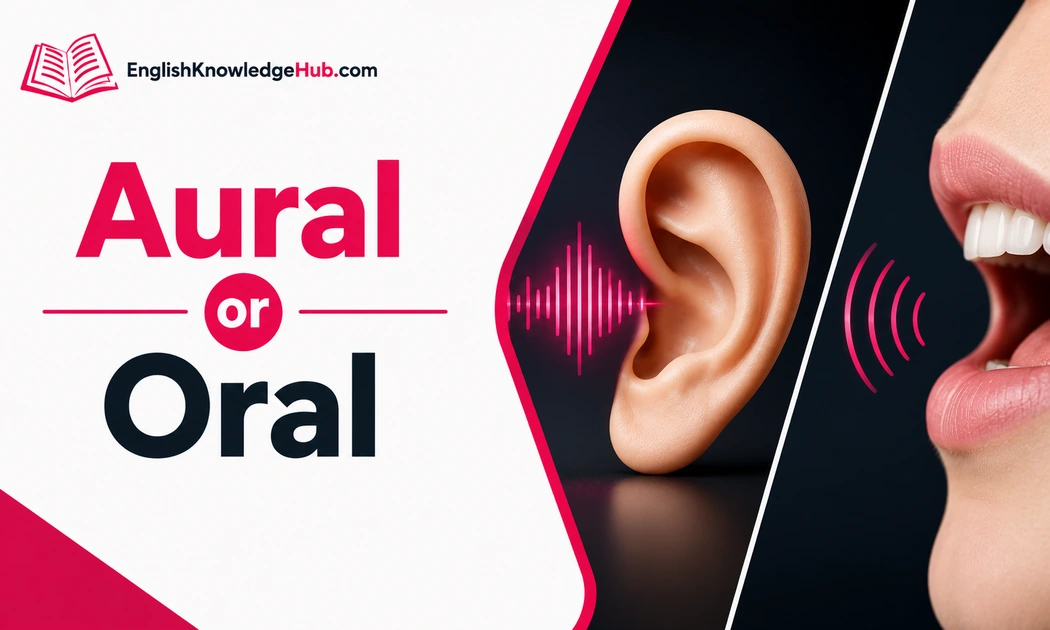
Aural vs oral, what is the difference? Aural relates to hearing, listening, or the ear, while oral relates to speaking or the mouth. For example, an aural test checks listening skills, while an oral test checks speaking skills.
Oral also describes things connected with or taken through the mouth, such as oral hygiene and oral medication. Cambridge confirms these distinct uses of the two words.
The words can sound very similar, which makes them easy to mix up. This guide explains their correct spelling, meanings, pronunciation, origins, usage, and common mistakes.
Aural vs Oral at a Glance
Here is the easiest way to tell them apart:
| Word | Meaning | Think Of | Example |
|---|---|---|---|
| Aural | Related to hearing or listening | 👂 Ear | aural skills |
| Oral | Spoken rather than written | 🗣️ Speech | oral presentation |
| Oral | Related to or taken through the mouth | 👄 Mouth | oral medication |
Quick rule: If you hear it, think aural. If you say it or it involves the mouth, think oral.
What Does Aural Mean?
Aural is an adjective that means related to hearing or the ear. Cambridge gives its meaning as relating to hearing.
You will often find it in phrases such as:
- aural skills
- aural training
- aural comprehension
- aural test
- aural experience
For example:
The music teacher gave the students an aural test.
The students need to listen and identify sounds, so aural is correct.
Another example is:
She has excellent aural comprehension in English.
Here, the focus is on understanding something through hearing.
What Does Oral Mean?
Oral has two main meanings, and knowing both will help you avoid mistakes.
Oral Can Mean Spoken
Use oral for something that someone speaks rather than writes.
Common phrases include:
- oral exam
- oral presentation
- oral agreement
- oral instructions
- oral history
- oral communication
Cambridge lists oral agreement and oral exam as examples of this spoken meaning.
For example:
Each student must give an oral presentation.
The student has to speak, so oral is the right word.
Oral Can Also Relate to the Mouth
Oral can describe something connected with, done to, or taken through the mouth.
You may see this meaning in:
- oral health
- oral hygiene
- oral surgery
- oral medication
For example:
Good oral hygiene helps keep your teeth and gums healthy.
Here, oral refers to the mouth rather than spoken language.
What Is the Main Difference Between Aural and Oral?
The main difference is hearing versus speaking or the mouth.
Aural relates to hearing. Oral relates to speech or the mouth.
| Situation | Correct Word | Reason |
|---|---|---|
| Listening test | Aural | You listen |
| Recognizing sounds | Aural | You use hearing |
| Spoken exam | Oral | You speak |
| Spoken instructions | Oral | Words are said aloud |
| Dental care | Oral | It involves the mouth |
| Medicine taken by mouth | Oral | It enters through the mouth |
So, the two words are not opposites. They simply describe different things.
Aural Test vs Oral Test
This is one of the most useful differences to understand, especially for students and language learners.
An aural test checks your ability to listen, hear, or recognize sounds.
An oral test checks your ability to speak or give answers aloud.
Imagine an English exam with two sections:
In the aural test, you listen to a recording and answer questions.
In the oral test, you answer the examiner’s questions aloud.
Cambridge also uses oral as a noun for an exam where a person gives spoken rather than written answers.
A simple question can help:
Are you listening or speaking?
Listening = aural
Speaking = oral
How Do You Pronounce Aural and Oral?
This is where the pair becomes tricky.
Cambridge gives the common US pronunciation of aural as /ˈɔːr.əl/, although it records additional pronunciations. Its common US pronunciation for oral is also /ˈɔːr.əl/.
That means the words can sound identical for many speakers. Pronunciation can also vary with accent.
Because sound alone may not tell you which word someone means, context matters.
Want to hear the words spoken aloud? This short video can help you compare their pronunciation:
After listening, remember that pronunciation is only part of the answer. The meaning of the sentence tells you which spelling you need.
Are Aural and Oral Homophones?
They can be homophones, depending on the speaker’s pronunciation and accent.
A homophone is a word that sounds the same as another word but has a different spelling or meaning.
Consider these sentences:
The musician developed strong aural skills.
The student developed strong oral communication skills.
The first sentence concerns hearing. The second concerns speaking.
Even if the words sound identical when spoken, their meanings remain different.
Where Does Aural Come From?
The history of aural gives you another useful way to remember its meaning.
The word entered English in the 1800s. It comes from Latin auris, meaning ear. Its early meaning was connected directly with the ear, and the sense of something received or understood by hearing followed later.
So the connection is straightforward:
Aural → ear → hearing
The same root appears in binaural, which refers to both ears.
Where Does Oral Come From?
Oral has a different history.
It comes through Late Latin oralis, from Latin os, with oris as its genitive form, meaning mouth. English records the word in the 1600s for things spoken by mouth and later for things related to the mouth itself.
That history explains why modern English uses oral in both:
- oral communication, words spoken by mouth
- oral health, health of the mouth
So, even its two modern meanings share the same basic connection.
Aural vs Oral in Education
You will often see these words in schools, language courses, and music lessons.
Aural Skills
Aural skills involve listening and recognizing what you hear.
In music, this might include recognizing:
- pitch
- rhythm
- melody
- intervals
- chords
In language learning, aural work can involve listening to spoken English and understanding what was said.
Oral Skills
Oral skills involve speaking.
A language teacher may assess a student’s:
- pronunciation
- fluency
- spoken answers
- conversation
- presentation skills
The distinction is simple:
Aural skills are listening skills. Oral skills are speaking skills.
Can Something Be Both Aural and Oral?
Yes. An activity can involve both.
Think about a conversation. You listen to another person and then speak in response.
The listening part uses aural skills, while the speaking part uses oral skills.
This distinction is useful in language learning because listening and speaking often work together, but they are not the same skill.
Aural vs Auditory: Are They the Same?
Aural and auditory both relate to hearing, but they do not always feel equally natural in every sentence.
Cambridge defines auditory as relating to hearing and labels it as a specialized biology term in its learner entry.
You may therefore see auditory more often in scientific or medical contexts, such as:
- auditory system
- auditory nerve
- auditory processing
Aural works naturally when talking about listening, sound, music, and hearing experiences.
For everyday writing, choose the word that best fits the phrase rather than replacing one automatically with the other.
Oral vs Verbal: Is There a Difference?
Oral clearly tells the reader that something is spoken rather than written.
For example:
We received oral instructions.
This means someone spoke the instructions.
Verbal relates more broadly to words and language, so it can sometimes create uncertainty if you specifically want to contrast speaking with writing.
When you clearly mean spoken, oral is often the more precise choice.
Common Aural vs Oral Mistakes
Most mistakes happen because the words sound similar. Check what the sentence actually describes before choosing the spelling.
1. Using Oral for Hearing
❌ The students completed an oral listening test.
If the test checks listening ability:
✅ The students completed an aural test.
2. Using Aural for Speaking
❌ She gave an aural presentation.
A presentation delivered by speaking is:
✅ She gave an oral presentation.
3. Using Aural for the Mouth
❌ Good aural hygiene protects your teeth.
The correct phrase is:
✅ Good oral hygiene protects your teeth.
The easiest check is still the same: ear or mouth?
How to Remember Aural vs Oral
Still worried you will mix them up? Try these two memory tricks.
Aural = Audio 👂
Aural and audio both start with au.
Think:
AUral → AUdio → hearing
Oral = Open Mouth 👄
Connect the O in oral with an open mouth.
You can also remember familiar phrases such as oral hygiene and oral health.
Your final memory rule is:
Aural is for the ears. Oral is for speaking and the mouth.
Real-World Examples of Aural and Oral
Seeing the words in natural situations can make the distinction clearer.
Aural:
Musicians often improve their aural skills through careful listening.
The language lesson included an aural comprehension exercise.
Oral:
Maya has an oral exam on Friday.
The dentist explained how to improve oral hygiene.
Notice that you do not need to memorize dozens of examples. Just identify whether the sentence concerns hearing, speaking, or the mouth.
Frequently Asked Questions
Is aural related to hearing or speaking?
Aural relates to hearing, not speaking. It describes something connected with listening, hearing, or the ear.
Does oral mean spoken or written?
Oral means spoken rather than written when it refers to communication. An oral exam, for example, requires spoken answers.
Does oral always mean speaking?
No. Oral can also mean related to or taken through the mouth. That is why we say oral hygiene, oral surgery, and oral medication.
Which is correct, aural skills or oral skills?
Both are correct, but they describe different skills. Aural skills involve listening and hearing. Oral skills involve speaking.
What is the difference between an aural exam and an oral exam?
An aural exam tests listening or hearing ability. An oral exam requires you to answer by speaking.
What is the easiest way to remember aural and oral?
Connect aural with audio and oral with an open mouth. If you hear it, think aural. If you speak it or it involves the mouth, think oral.
Final Thoughts
The aural vs oral difference is easy to remember once you connect each word with its main idea. Aural relates to hearing, listening, and the ear. Oral relates to speaking and the mouth.
If you are unsure which word to write, ask yourself one simple question: Am I talking about hearing or speaking? Hearing points to aural. Speaking or the mouth points to oral.
Want to make confusing English words easier? Visit EnglishKnowledgeHub.com for clear, practical guides that help you choose the right words and use them with confidence.
