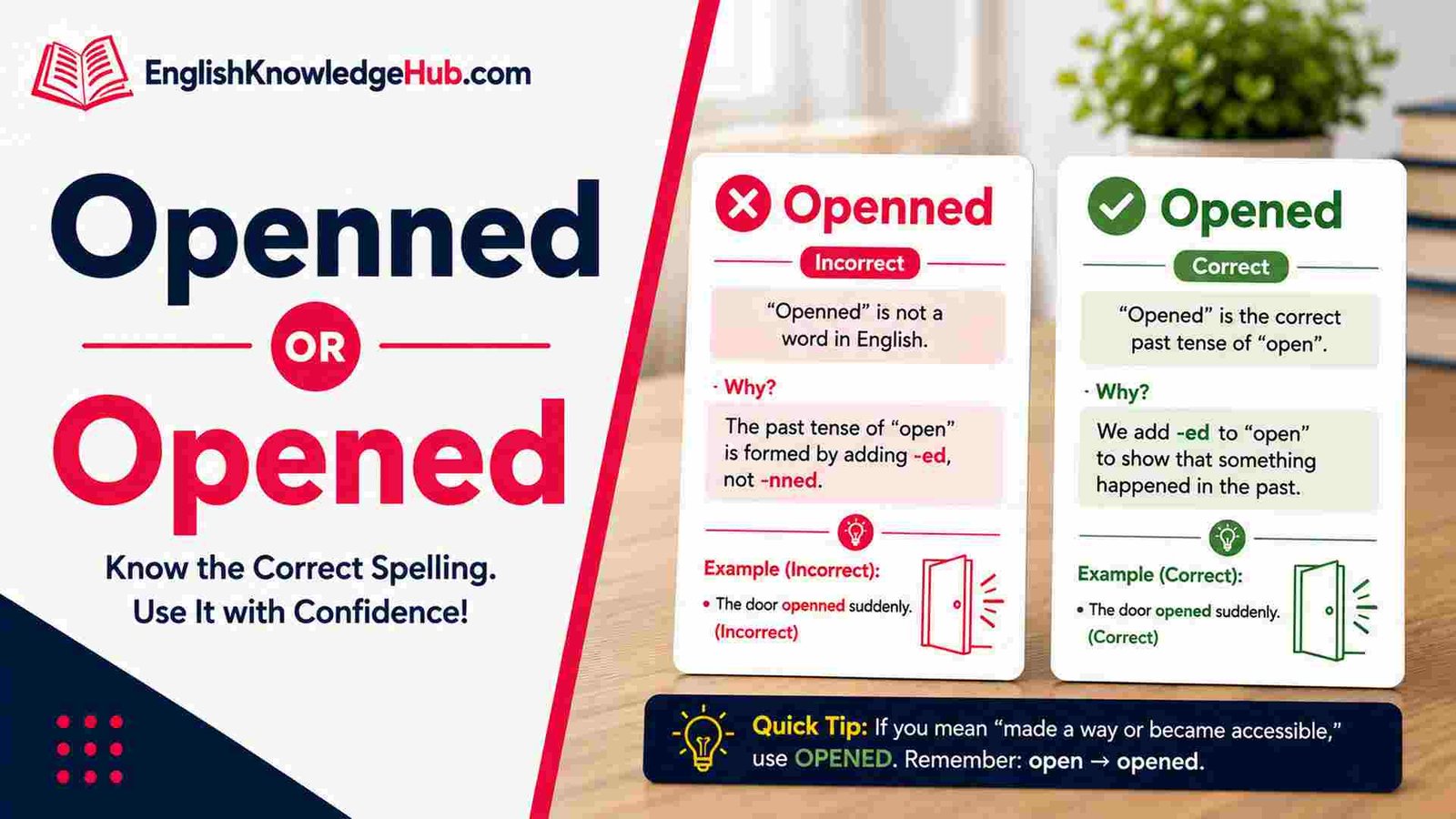
Opened is the correct spelling; openned is not standard English. Opened is both the simple past and past participle of open. The final n does not double because open is a two-syllable word stressed on its first syllable. So write opened and opening, never openned or openning.
In this article, you’ll learn why opened keeps one n, when to use open, opened, and opening, and how to avoid the spelling and grammar mistakes that usually cause this confusion.
Why Opened Has Only One N
The spelling makes more sense when you listen to the word. We pronounce open with the stronger beat at the beginning: O-pen. With many two-syllable verbs, English doubles a final consonant before -ed or -ing when the last syllable carries the stress. That is not what happens in open.
Compare prefer → preferred, where the ending syllable is stressed, with open → opened, where it is not. This is why adding another n to open creates the misspellings openned and openning.
| Form | Correct spelling | Example |
|---|---|---|
| Base verb | open | Please open the envelope. |
| Third-person singular | opens | The library opens at nine. |
| Past | opened | Maya opened the envelope carefully. |
| Past participle | opened | We have opened the registration page. |
| -ing form | opening | He is opening the window. |
Merriam-Webster’s entry for open records opened and opening as the standard forms.
What Opened Actually Tells the Reader
Opened usually tells us that an action happened. Someone may have moved a door, accessed a file, started a meeting, made an account available, or began operating a business. The surrounding words tell us which meaning is intended.
At home, you might say, “Nadia opened the kitchen window after dinner.” At work, “The chair opened the meeting with a short announcement” sounds natural. Online, you can say, “I opened the attachment, but the image would not load.” The spelling stays the same in every meaning.
Open or Opened? The Difference Is Not Just Tense
One useful distinction is easy to miss: open can describe a state, while opened often describes the action that produced that state.
“The door is open” tells you its condition. “Leo opened the door” tells you what Leo did. In the same way, “The café is open today” normally sounds more natural than “The café is opened today” when you simply mean it is operating.
This state-versus-action distinction is especially useful for English learners because choosing the correctly spelled word is only half the job. You also need the form that fits the sentence.
Opened as a Past Tense and Past Participle
For a finished past action, opened can stand on its own: “The technician opened the case yesterday.” When you build a perfect tense, the same form follows has, have, or had: “She has opened the file,” or “They had opened the hall before the guests arrived.”
If verb forms are the part that trips you up, our guide to hoping vs hopeing explains another common spelling change that happens before -ing.
Why “Openned” Looks Tempting
Learners often remember words such as planned, stopped, and beginning and assume every short-looking ending needs a doubled consonant. English is more selective. Stress and word structure matter, so copying the pattern from plan or stop gives the wrong result for open.
A simple memory line works better than trying to judge the spelling every time: open, opened, opening. Keep the single n through the whole family.
Common Errors in Real Sentences
Incorrect: The receptionist openned the office early.
Correct: The receptionist opened the office early.
Why: The past form of open keeps one n.
Incorrect: I am openning the spreadsheet now.
Correct: I am opening the spreadsheet now.
Why: The same no-doubling pattern applies before -ing.
Incorrect: I open the parcel yesterday.
Correct: I opened the parcel yesterday.
Why: Yesterday places the action in the past.
Less natural: The museum is opened on Sundays.
Natural for its operating status: The museum is open on Sundays.
Why: Here you are describing the museum’s state or schedule, not focusing on the action of opening it.
Does British English Spell It Differently?
No. Opened is standard in both British and American English. Some verbs do show regional differences in consonant doubling, but this word does not require you to choose between national spelling systems.
Quick Questions About Openned or Opened
Is openned a word?
Not as the standard past form of open. If you mean the past tense or past participle, write opened.
How do you spell opened?
Spell it O-P-E-N-E-D, with one n.
Is it opening or openning?
Opening is correct. Openning incorrectly doubles the n.
Can I say “has opened”?
Yes. Opened is the past participle, so forms such as has opened, have opened, and had opened are correct.
Should I say “the store is open” or “the store is opened”?
Use the store is open when describing its current status. Use opened when focusing on an action, such as “The manager opened the store at 8 a.m.”
What is the opposite of opened?
It depends on context. Closed is the usual opposite, while shut, locked, or sealed may fit particular situations.
The Spelling to Keep
When the choice is openned or opened, choose opened. The most useful thing to remember is the whole word family: open, opens, opened, opening. None of these forms adds a second n.
Keep building these small spelling patterns and they soon become automatic. You can find more practical, learner-friendly word and grammar explanations at EnglishKnowledgeHub.com.
