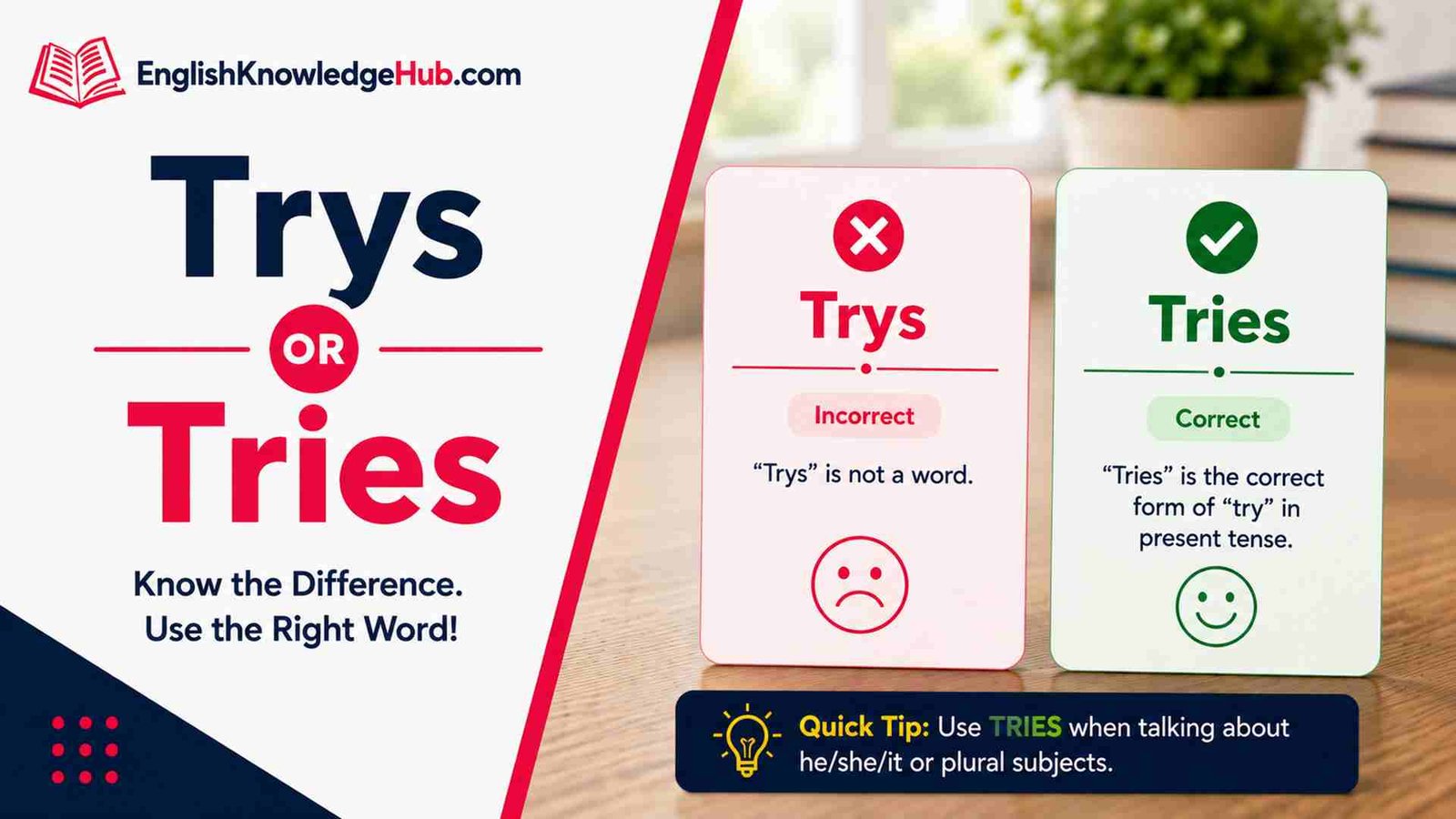
Tries is the correct spelling, while trys is not the standard form of try. Use tries with he, she, or it, as in “She tries again.” You also use tries as the plural of try, as in “It took three tries.”
In this article, you will learn why tries is correct, when to use try or tries, how the spelling rule works, and how to avoid common mistakes such as trys, tryed, and triing.
Trys or Tries: Quick Answer
If you are choosing between trys or tries, write tries.
| Form | Correct? | Example |
|---|---|---|
| trys | No | She trys to help. |
| tries | Yes | She tries to help. |
Tries has two common uses:
- It is a verb with he, she, or it.
- It is the plural noun form of try.
Examples:
- He tries to arrive early.
- She tries her best.
- It took three tries to open the door.
For the standard forms of try, the correct spelling is tries, not trys.
Try vs Tries vs Tried vs Trying
The word try changes form depending on how you use it.
| Form | Use | Example |
|---|---|---|
| try | I, you, we, they | They try again. |
| tries | he, she, it | She tries again. |
| tried | past | She tried yesterday. |
| trying | ongoing action | She is trying now. |
This table gives you the main forms at a glance.
Why Does Try Become Tries?
When a word ends in a consonant + y, the y commonly changes to i before es is added.
So:
try → tries
The letter before the y in try is r, which is a consonant.
You can see the same pattern in other words:
| Base Word | New Form |
|---|---|
| try | tries |
| cry | cries |
| fly | flies |
| study | studies |
| carry | carries |
| worry | worries |
This rule explains why tries is correct and trys is not the standard spelling.
What If a Word Ends in Vowel + Y?
When a word ends in a vowel followed by y, you normally keep the y and add s.
Examples:
- play → plays
- stay → stays
- enjoy → enjoys
- buy → buys
- say → says
Compare:
- try → tries
- play → plays
The letter before the y changes the spelling pattern.
When Do You Use Tries as a Verb?
Use tries in the simple present tense with:
- he
- she
- it
- one person
- one animal
- one thing
Examples:
- He tries to wake up early.
- She tries to save money.
- James tries to help his friends.
- The dog tries to catch the ball.
- The computer tries to connect again.
Use try with I, you, we, and they.
Try vs Tries
Here is the simple pattern:
| Subject | Correct Form | Example |
|---|---|---|
| I | try | I try every day. |
| You | try | You try again. |
| We | try | We try our best. |
| They | try | They try to help. |
| He | tries | He tries again. |
| She | tries | She tries to learn. |
| It | tries | It tries to start. |
A quick way to remember it is:
I, you, we, they = try
He, she, it = tries
Common Subject Mistakes
These common forms are easy to mix up.
Correct:
- He tries
- She tries
- It tries
- They try
- I try
- We try
- You try
Incorrect:
- He trys
- She trys
- They tries
- I tries
The subject tells you which form to use.
When Is Tries a Noun?
Tries can also mean more than one try.
As a noun, try often means an attempt to do something.
Examples:
- It took three tries to open the lock.
- I needed two tries to guess the answer.
- She passed after several tries.
- Give the puzzle a few more tries.
- His first two tries did not work.
In these examples, tries means attempts.
For example:
It took three tries.
means:
It took three attempts.
Is It 3 Trys or 3 Tries?
Write 3 tries.
Do not write 3 trys.
The correct pattern is:
- one try
- two tries
- three tries
- five tries
- several tries
Example:
It took me three tries to enter the correct password.
Why Is Trys Wrong?
Trys does not follow the normal spelling used for the standard forms of try.
Because try ends in a consonant followed by y, the spelling changes:
try → tries
So write:
- She tries.
- He tries.
- It took two tries.
Do not write:
- She trys.
- He trys.
- Two trys.
Want to Try or Want to Tries?
Use want to try.
After to, use the base form try.
Correct:
- I want to try again.
- She wants to try again.
- He wants to try the new food.
- They want to try another way.
Incorrect:
- She wants to tries again.
Even though we say “she tries,” we say “she wants to try.”
Can Try or Can Tries?
Use can try.
After words such as can, could, should, will, may, and might, use the base form try.
Examples:
- She can try again.
- He should try harder.
- They might try later.
- We could try another way.
- It may try to restart.
Do not write can tries.
Try, Tried, and Trying
The other main forms are also easy to learn.
Try
Use try with I, you, we, and they.
- I try to read every day.
- We try to help.
- They try new ideas.
Tried
Use tried for the past.
- I tried to call you.
- She tried again yesterday.
- They tried a new plan.
Trying
Use trying for an action that is happening or continuing.
- I am trying to sleep.
- She is trying to learn.
- They are trying again.
Tryed or Tried?
Tried is correct.
Write:
try → tried
Do not write:
try → tryed
Examples:
- She tried to help.
- I tried my best.
- We tried again.
Trying or Triing?
Trying is correct.
The word keeps the y before ing.
Correct:
try → trying
Incorrect:
try → triing
Examples:
- She is trying to help.
- I am trying to learn.
- They are trying again.
Trys or Tries in Rugby?
The correct plural in rugby is also tries.
A try is a way of scoring points in rugby.
Examples:
- The player scored one try.
- The team scored three tries.
- He scored two tries in the match.
So the pattern stays the same:
one try, two tries
How Do You Pronounce Tries?
Tries is pronounced /traɪz/, with a final z sound.
It sounds close to “trize.”
British and American English
Both British English and American English use tries.
Examples:
- She tries to help.
- He tries again.
- It took three tries.
The normal spelling does not change between these two forms of English.
Common Mistakes to Avoid
Here are the mistakes that learners often make.
1. She Trys
Incorrect:
She trys to help.
Correct:
She tries to help.
2. Three Trys
Incorrect:
It took three trys.
Correct:
It took three tries.
3. They Tries
Incorrect:
They tries to help.
Correct:
They try to help.
4. She Wants to Tries
Incorrect:
She wants to tries again.
Correct:
She wants to try again.
5. He Can Tries
Incorrect:
He can tries again.
Correct:
He can try again.
6. Tryed
Incorrect:
I tryed my best.
Correct:
I tried my best.
Easy Trick to Remember Tries
Use this simple memory trick:
If cry becomes cries, try becomes tries.
Both words end in a consonant followed by y.
You can also remember:
Consonant + y commonly changes to i before es.
Examples:
- cry → cries
- fly → flies
- try → tries
More Examples of Tries in Sentences
Tries as a Verb
- Maria tries to walk every morning.
- My brother tries to save money.
- The teacher tries to make lessons easy.
- The child tries to tie his shoes.
- She tries to answer every question.
- He tries not to laugh.
Tries as a Noun
- I got the answer after two tries.
- She needed several tries to learn the move.
- His first three tries failed.
- Give it a few more tries.
- The game took four tries to complete.
Frequently Asked Questions
Is “trys” a word?
Trys is not the standard spelling of try. Use tries when you need the third person verb form or the plural noun.
What is the plural of try?
The plural of try is tries.
Example:
It took three tries.
Why does try become tries?
Try ends in a consonant followed by y. The y commonly changes to i before es is added, giving tries.
Is tries a verb?
Yes.
Tries is the simple present form used with he, she, and it.
Example:
She tries to help.
Is tries a noun?
Yes.
Tries is also the plural of the noun try.
Example:
He needed two tries.
Is “he tries” correct?
Yes.
He tries is correct.
Example:
He tries to arrive early.
Do You Write Try’s Instead of Tries?
No, not when you mean the verb or plural noun.
Write:
She tries.
and:
three tries
Do not use try’s to make the normal plural.
What Does Tries Mean?
As a verb, tries means that someone makes an effort or attempts to do something.
As a noun, tries means more than one attempt.
Final Answer
When choosing between trys or tries, use tries in standard English.
Use tries with he, she, or it, as in “She tries her best.” Also use tries for more than one attempt, as in “It took three tries.”
Remember the simple pattern: try becomes tries, just as cry becomes cries.
For more easy spelling, grammar, and word guides, visit EnglishKnowledgeHub.com and keep improving your English one clear rule at a time.
