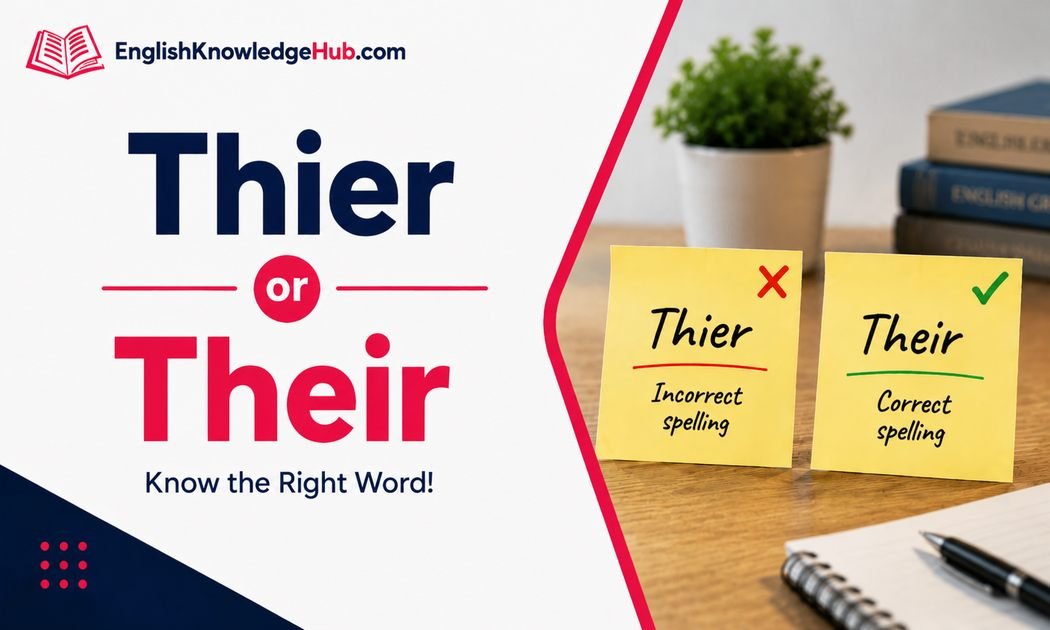
Thier or their, which spelling is correct? Their is the standard English spelling. It is a possessive determiner used before a noun to show that something belongs to, relates to, or is associated with people, animals, or things. Thier is a common misspelling caused by reversing the middle letters.
Use their in phrases such as “their home,” “their plans,” and “their teacher.” It can refer to more than one person, and modern English also uses singular their when a person’s gender is unknown, unspecified, or when that person uses they/them pronouns. The easiest spelling reminder is simple: their = th + ei + r.
Thier or Their: Quick Answer
| Form | Status | Use |
|---|---|---|
| Their | Correct | Shows possession or connection |
| Thier | Misspelling | Replace it with their |
For example, write “The students opened their books,” not “The students opened thier books.” Merriam-Webster defines their as the possessive form connected with “them,” and Cambridge likewise describes it as meaning “of or belonging to them.”
What Does Their Mean?
Their normally comes before a noun and tells us who that noun is connected to. In modern grammar, it is commonly called a possessive determiner.
The usual pattern is their + noun:
- The musicians packed their instruments.
- The puppies followed their mother.
- My neighbors sold their old car.
Notice that their does not always mean literal ownership. It can also show a relationship or connection. In “The students thanked their teacher,” the students do not own the teacher. The word simply connects the teacher with those students.
Why Is Thier Wrong?
The spelling thier switches the letters e and i. That makes it a spelling error when you mean the possessive word their.
Correct spelling: T H E I R
Common error: T H I E R
This mistake is easy to make because English spelling does not always match simple memory rules. Instead of relying on “i before e,” remember the word as a whole: their.
Their Can Refer to More Than One Person
A very common use of their is with a plural subject.
- The nurses checked their schedules.
- Ali and Sara brought their lunches.
- The birds returned to their nests.
In each sentence, their connects something with two or more people or animals.
Can Their Refer to One Person?
Yes. Singular they and their are established parts of modern English. They are especially useful when you do not know a person’s gender, when gender does not matter, or when a person uses they/them pronouns.
For example:
- Someone left their water bottle here.
- Every applicant should check their email.
- If a customer has a question, ask for their order number.
Both Merriam-Webster and Cambridge document this singular use. Merriam-Webster notes that forms related to singular they have been used for centuries and are now widely accepted.
Their vs There vs They’re
The spelling problem becomes trickier because their, there, and they’re sound alike in standard pronunciation. Their jobs are different.
| Word | Simple Meaning | Example |
|---|---|---|
| Their | Belonging or connected to them | Their bus arrives at eight. |
| There | A place, or used in structures such as “there is” | Your bag is over there. |
| They’re | Short for “they are” | They’re waiting outside. |
A quick test helps. If you can replace the word with they are, choose they’re. If you are talking about a place or using “there is/there are,” choose there. If a noun belongs or relates to them, choose their.
Their vs Theirs
Their and theirs both show possession, but they work differently. Their normally needs a noun after it. Theirs stands alone.
Compare these sentences:
- That is their bicycle.
- That bicycle is theirs.
Do not write “theirs bicycle.” If a noun follows directly, use their.
Common Mistakes and Corrections
| Incorrect | Correct | Reason |
|---|---|---|
| Thier garden looks beautiful. | Their garden looks beautiful. | The correct spelling is their. |
| They’re shoes are wet. | Their shoes are wet. | The shoes belong to them. |
| Their are two seats left. | There are two seats left. | Use there in “there are.” |
| Their going home now. | They’re going home now. | They’re means they are. |
Natural Examples of Their
Seeing the word in different situations makes its role easier to remember:
- The chefs cleaned their workstations after dinner.
- Our guests placed their coats near the door.
- The company changed their opening hours for the holiday.
- Each learner can improve at their own pace.
- The trees lost their leaves during the dry season.
Want another common spelling pair? See our guide to Receive or Recieve.
How to Remember Their
Try this short spelling cue: THE + IR = THEIR. You can also remember that their begins with the same three letters as them: the. Both words point back to people or things already being discussed.
For meaning, use an even simpler test. Ask, “Does this noun belong or relate to them?” If yes, their is probably the word you need.
Frequently Asked Questions
Is it thier or their?
Their is the correct standard spelling. Thier is a common misspelling.
What does their mean?
Their shows possession, association, or connection. It normally comes before a noun, as in “their apartment” or “their idea.”
Is their singular or plural?
It can be both. Their traditionally refers to a plural group, but singular their is also widely accepted when referring to one person.
What is the difference between their and they’re?
Their shows possession or connection. They’re is the contraction of they are.
What is the difference between their and there?
Their is possessive. There often refers to a place and also appears in expressions such as “there is” and “there are.”
Final Thoughts
When choosing between thier or their, use their. The spelling thier reverses the middle letters and should be corrected in standard English. Remember that their usually appears before a noun and shows possession or connection.
Also keep their, there, and they’re separate. Their shows possession, there often points to a place or introduces something, and they’re means “they are.” That small distinction will prevent several common writing mistakes at once.
Sources: Merriam-Webster, “Their”; Cambridge Dictionary, “Their”.
