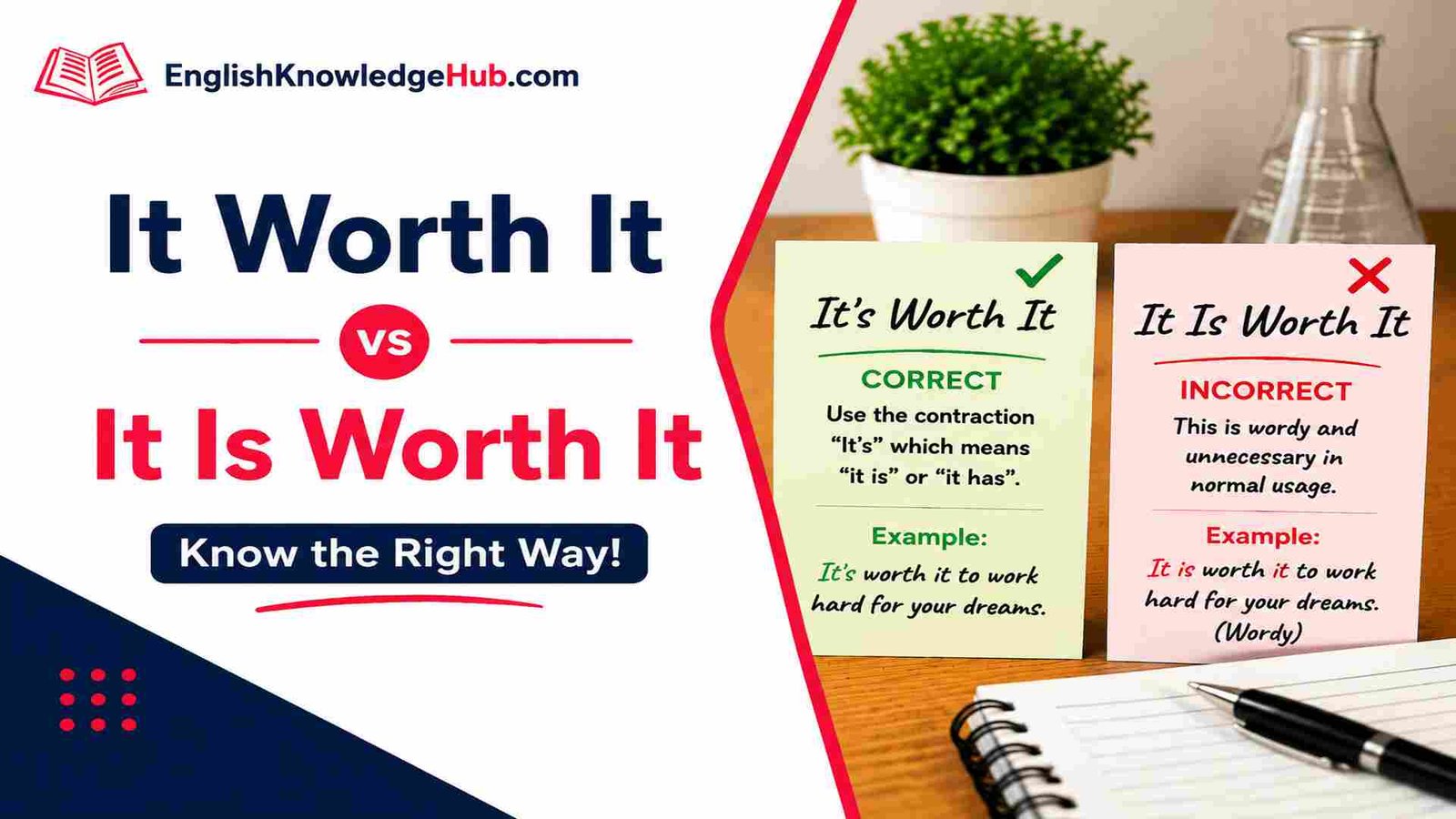
“It is worth it” is the standard complete sentence, while “it worth it” is normally ungrammatical because it is missing the verb is. You can also say “It’s worth it.” The phrase means that something is valuable, useful, enjoyable, or beneficial enough to justify the money, time, effort, or difficulty involved.
In this article, you’ll learn It Worth It or It Is Worth It through sentence structure, contractions, questions such as Is it worth it?, patterns like worth doing, and natural everyday examples. Cambridge defines worth as having enough value or importance to justify the cost, effort, or time spent.
The Correct Expression Is “It Is Worth It”
The standard phrase is:
✅ It is worth it.
The shorter conversational form is:
✅ It’s worth it.
The incorrect version is:
❌ It worth it.
The reason is that worth is not used like regular action verbs.
For example:
- She works hard.
- It helps me.
- The idea matters.
These verbs can stand alone.
However:
- It is worth it.
- The book is worth reading.
- The experience was worth the effort.
The word worth needs a form of the verb be before it.
What Does “It Is Worth It” Actually Mean?
The expression “it is worth it” means that the result is valuable enough to make the cost, difficulty, or effort acceptable.
The “cost” can be different things:
- money
- time
- energy
- patience
- inconvenience
- hard work
For example:
The online course was expensive, but it was worth it.
Meaning:
The learner paid a lot, but the knowledge gained was valuable enough.
Another example:
The early morning practice was exhausting, but it was worth it.
Meaning:
The effort was difficult, but the final result made the effort worthwhile.
Why “It Worth It” Is Wrong
The mistake happens because many learners think worth behaves like a verb.
They may think:
- It works.
- It helps.
- It costs.
- It worths.
But worth is different.
You cannot create a sentence by placing worth directly after the subject.
Incorrect:
This movie worth it.
Correct:
This movie is worth it.
The missing word is acts as a bridge between the subject and the description.
A useful way to remember:
Something + is/was/will be + worth it
Examples:
- The repair is worth it.
- The decision was worth it.
- The investment will be worth it.
How to Use “Worth It” Correctly in Different Situations
Everyday Conversations
People often use worth it when deciding if something deserves their effort or money.
Examples:
- “Should I buy the premium version?”
- “Yes, I think it’s worth it.”
Other examples:
- The wait outside the bakery was long, but the fresh bread was worth it.
- I almost canceled the trip, but seeing that place was worth it.
Workplace English
In professional settings, worth it often describes whether an investment produces good results.
Examples:
- The company paid for extra training, and it was worth it because employees became more efficient.
- The additional testing took two weeks, but it was worth it because we found the problem early.
Academic English
Students often use this phrase when discussing learning challenges.
Examples:
- Writing several drafts was tiring, but it was worth it because the final essay improved.
- The research took longer than expected, but the information collected was worth it.
Formal Writing
“It is worth it” is grammatically correct in formal writing, but sometimes a more precise phrase sounds better.
Instead of:
The investment was worth it.
A formal report might say:
The investment produced valuable results.
or:
The benefits justified the resources used.
The choice depends on the style and purpose of the writing.
“It’s Worth It” vs “It Is Worth It”
There is no difference in meaning.
| Phrase | Usage |
|---|---|
| It is worth it. | More complete and slightly more formal |
| It’s worth it. | More common in conversation |
Examples:
Formal:
The additional research is worth it because it improves accuracy.
Conversation:
Don’t worry about the extra work. It’s worth it.
Both sentences are correct.
“Worth It” vs “Worthwhile”: Understanding the Difference
These expressions are related but not identical.
Worth it
Usually talks about whether a specific result justifies a cost.
Example:
The three-hour drive was worth it.
The focus is on the experience after the effort.
Worthwhile
Describes something as valuable, useful, or beneficial.
Example:
Volunteering is a worthwhile activity.
A simple comparison:
- Was the effort worth it? → Did the result justify the cost?
- Was it worthwhile? → Was it valuable or meaningful?
“Worth It” vs “Worth” Without “It”
Learners often confuse these two structures.
Worth + amount/value
Used when talking about price or estimated value.
Example:
The painting is worth $8,000.
Meaning:
The painting has a value of $8,000.
Worth it
Used when comparing effort or cost with the result.
Example:
The painting was expensive, but it was worth it.
Meaning:
Buying it was a good decision.
Common Mistakes With “Worth It”
Mistake 1: Leaving Out “Is”
Incorrect:
The new phone worth it.
Correct:
The new phone is worth it.
Explanation:
The phrase requires the verb is.
Mistake 2: Adding “To” After Worth
Incorrect:
This article is worth to read.
Correct:
This article is worth reading.
Explanation:
After worth, English commonly uses an -ing form.
More examples:
- The documentary is worth watching.
- The museum is worth visiting.
- The idea is worth discussing.
Mistake 3: Saying “Worths It”
Incorrect:
This product worths it.
Correct:
This product is worth it.
Explanation:
“Worth” does not change into worths in this expression.
Mistake 4: Using “Worth It” Without a Clear Reference
Less natural:
It is worth it.
(If the listener does not know what “it” means.)
Better:
The extra lessons are worth it.
Explanation:
The phrase works best when the listener understands what “it” refers to.
British and American English: Is There a Difference?
There is no important difference between British and American English.
Speakers in both varieties use:
- It is worth it.
- It’s worth it.
- Was it worth it?
- It wasn’t worth it.
The grammar and meaning remain the same.
Quick Grammar Check
| Sentence | Correct? | Explanation |
|---|---|---|
| It is worth it. | ✅ | Correct structure |
| It’s worth it. | ✅ | Natural contraction |
| It worth it. | ❌ | Missing linking verb |
| It was worth it. | ✅ | Correct past form |
| It will be worth it. | ✅ | Correct future form |
| It worths it. | ❌ | Incorrect verb form |
Frequently Asked Questions
Is “it worth it” ever correct?
No, not in standard English. The correct phrase is “it is worth it” or “it’s worth it.”
Why do we say “it is worth it”?
Because worth does not function as the main verb in this structure. English needs the linking verb is before it.
Can I use “it’s worth it” in professional English?
Yes. It is acceptable, but formal documents may sometimes use alternatives such as “the benefits justify the cost.”
Is “worth it” an adjective?
It is commonly treated as part of the expression “be worth it,” which describes whether something has enough value compared with its cost.
Is “this book is worth reading” correct?
Yes. After worth, English often uses an -ing form.
Example:
This book is worth reading because it explains the topic clearly.
What is the opposite of “worth it”?
Common opposites include:
- not worth it
- not worthwhile
- a waste of time
- not worth the effort
Example:
Waiting five hours for that service was not worth it.
Can I say “was it worth it?”
Yes. This is a very common question.
Examples:
- Was the expensive hotel worth it?
- Was spending extra time on the project worth it?
Final Thought
When you want to say that something gives enough value to justify its cost, remember this pattern:
Subject + be + worth it
Examples:
- It is worth it.
- The experience was worth it.
- The effort will be worth it.
That small verb makes the sentence complete.
For more practical grammar explanations, vocabulary lessons, and expert English learning tips, visit EnglishKnowledgeHub.com and continue improving your everyday English with clear, teacher-guided lessons.
