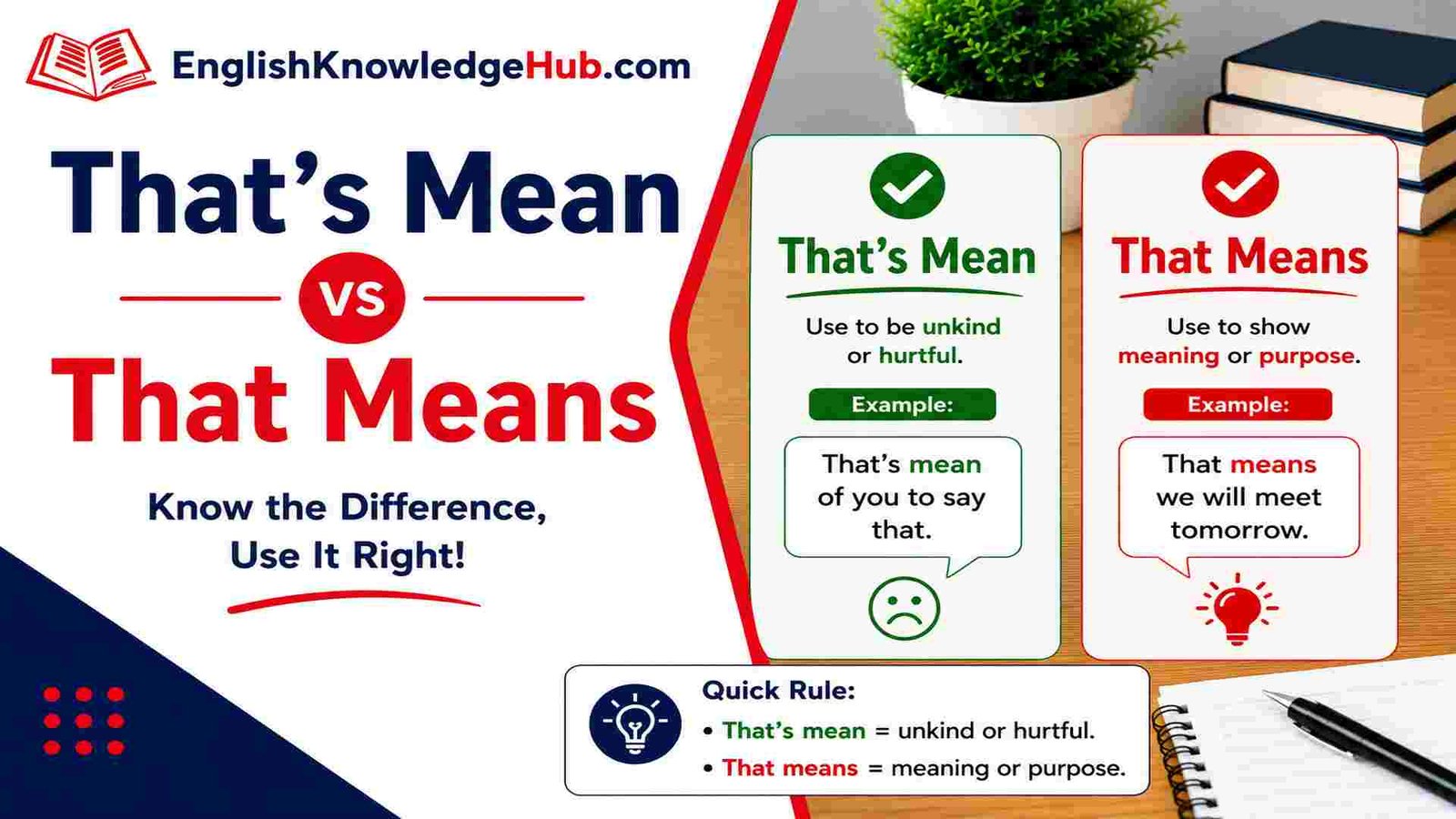
“That means” and “that’s mean” are both correct, but they do completely different jobs. “That means” uses the verb mean to explain a meaning, result, or consequence. “That’s mean” is the contraction of that is mean and describes an action, comment, or person as unkind.
In this article, you’ll learn That’s Mean vs That Means through contractions, subject-verb agreement, questions such as “Does that mean?”, and natural conversation examples. Cambridge confirms that that’s can contract that is, which is the key to understanding “that’s mean.”
The Fastest Way to Hear the Difference
Try expanding that’s. If “that is” still makes sense, the contraction may be correct. “You hid her notebook? That’s mean” becomes “You hid her notebook? That is mean.” Here, mean is an adjective meaning unkind.
Now consider, “The gate is locked. That means we need another entrance.” You cannot expand this to “that is mean.” Here, means is the third-person singular form of the verb mean. The sentence explains what the locked gate tells us.
Why “That Means” Has an S
In the simple present, a third-person singular subject normally takes the -s form of a verb. We say “I mean,” “they mean,” but “it means,” “this means,” and “that means.”
This pattern is common when one fact leads to an interpretation or consequence: “Your name is on the list. That means you qualified.” “The fuel light is on. That means we should stop soon.” In each case, the second sentence tells us what follows from the first.
Why “That’s Mean” Needs an Apostrophe
The apostrophe marks a contraction. In “That’s mean,” that’s = that is. The grammar is the same as “That’s rude,” “That’s unfair,” or “That’s thoughtful.” The adjective after is describes the behavior or situation.
In everyday conversation, “That’s mean” is a natural reaction to something unkind: “You changed his password as a joke? That’s mean.” The full form, “That is mean,” is also correct and can sound slightly more deliberate or emphatic.
The Mistake Learners Make Most Often
A very common error is writing “That’s mean we have to…” when the speaker wants to explain a result. The correct form is “That means we have to…”
Incorrect: That’s mean we have to wait outside.
Correct: That means we have to wait outside.
The expansion test exposes the problem. “That is mean we have to wait outside” does not form the intended sentence. Because you are explaining a consequence, you need the verb means.
“Does That Mean?” and “What Does That Mean?”
Questions create another common trap. After does, the main verb returns to its base form. That is why we say “Does that mean…?”, not “Does that means…?”
Compare “That means the meeting is canceled” with “Does that mean the meeting is canceled?” The same change happens in “She works here” and “Does she work here?” The auxiliary does carries the grammatical marking, so the following verb stays as mean.
The standard question for asking for an explanation is “What does that mean?” You can use it for a word, sign, comment, action, or idea whose meaning is unclear.
Can “That Mean” Ever Be Correct?
Yes, in a different structure. In “Words that mean nearly the same thing can have different tones,” that is a relative pronoun referring to the plural noun words, so the verb is mean. With a singular noun, you would write “a word that means…”
This is why it is safer to understand the sentence structure than to memorize “that must always be followed by means.” Sometimes that is the singular subject itself, and sometimes it introduces a relative clause whose verb agrees with an earlier noun.
Real-Life Examples
At home, you might hear, “You ate the piece she saved? That’s mean.” The speaker is judging the action. A moment later someone might say, “There’s no cake left. That means we need another dessert.” Now the phrase explains a result.
At work, “He blamed the new employee for his own mistake. That’s mean” comments on behavior. “The client signed the agreement. That means the project can start” explains a consequence. In academic writing, that means can also introduce an interpretation, though a more precise phrase such as “this suggests” or “this indicates” may sometimes fit formal analysis better.
“It Means” vs “That Means”
It means often refers directly to a word, phrase, sign, or thing already named: “What does ‘optional’ mean? It means you can choose.” That means often points back to a whole fact or situation: “The final step is optional. That means we can skip it.”
The difference is not about formality. It is mainly about what the pronoun points to.
A Simple Two-Question Test
Ask, “Am I describing something as unkind?” If yes, that’s mean is probably what you need. If you are explaining what a fact, sign, statement, or situation tells us, choose that means.
Then check questions separately. If does appears before the verb, use the base form: Does that mean…?
Frequently Asked Questions
Is “that’s mean” grammatically correct?
Yes. It means “that is mean,” with mean functioning as an adjective meaning unkind.
Is “that means” grammatically correct?
Yes. Here, that is the subject and means is the present-tense verb.
Is “that’s means” correct?
Not when you mean “that means.” Write “That means he already knows,” not “That’s means he already knows.”
Should I say “does that mean” or “does that means”?
Use does that mean. After does, the main verb stays in its base form.
What does “that’s mean” mean?
It normally means “that is unkind” or “that is hurtful.”
What does “that means” mean?
It introduces the meaning, implication, result, or consequence of something.
Final Takeaway
For That’s Mean vs That Means, do not choose by sound alone. Use that’s mean when you can expand it to “that is mean” and you are describing unkind behavior. Use that means when the verb means explains what something signifies or what follows from it.
For more practical grammar and word-choice lessons, continue exploring EnglishKnowledgeHub.com.
