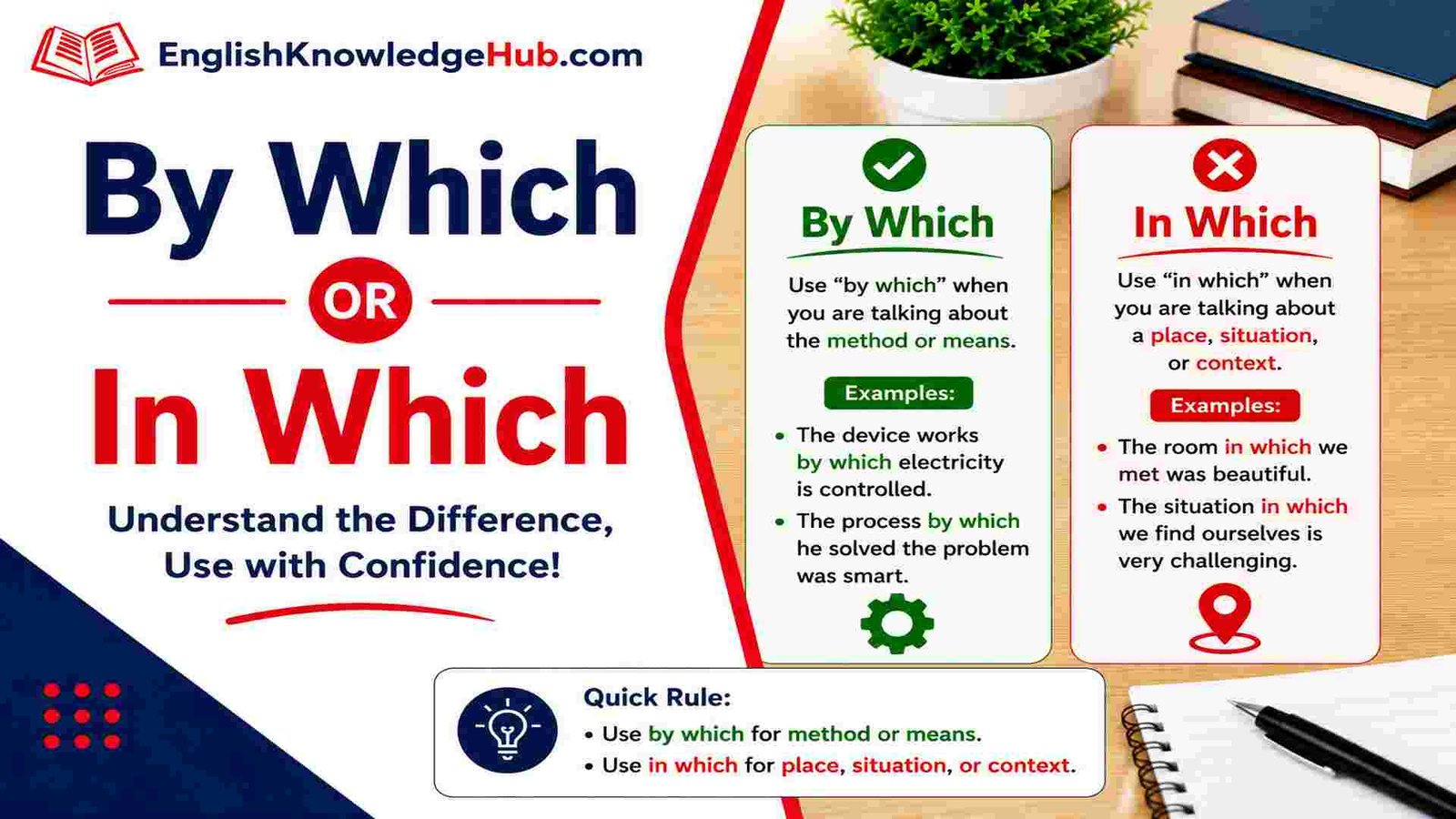
“By which” and “in which” are both correct, but the preposition changes the relationship. Use in which when something happens inside a place, situation, period, system, or context. Use by which when you mean by means of, according to, through, or no later than a particular point: “the method by which it works” and “the date by which you must reply.”
In this article, you’ll learn how By Which or In Which works in relative clauses, how to choose the right preposition from the meaning, when where or a sentence-ending preposition sounds more natural, and common patterns such as the way in which, the method by which, and the time by which. Cambridge Grammar confirms that which can be the complement of a preposition, with the preposition before which in more formal style or later in the clause in more informal style.
The Preposition Comes From the Meaning
There is no rule saying which prefers in or by. The correct preposition is the one you would use even if the relative clause were written as a separate sentence.
Take “This is the room in which we met.” The simpler sentence is “We met in the room,” so the relative clause keeps in.
Now take “This is the method by which the data were collected.” The simpler idea is “The data were collected by this method,” so by is the right preposition.
This reconstruction test is more reliable than memorizing isolated phrases.
Use “In Which” for Place and Containment
In which is natural when the noun refers to a place or container and the action happens inside it.
“The room in which we met was very small.” “They visited the village in which her grandfather was born.” “The box in which the documents were stored was damaged.”
In less formal English, these often become “the room which we met in” or simply “the room where we met.”
“In Which” for Situations, Systems, and Contexts
The noun does not have to be a physical place. English often treats situations and systems as contexts we are “in.”
“They created a system in which users can control their own data.” “We faced a situation in which no option was perfect.” “The study describes an environment in which children learn through play.”
In these sentences, in which means something close to “within which” or “where.”
“In Which” With Time Periods
You can also use in which for a period during which something happens.
“It was a year in which the company changed rapidly.” “The 1990s were a period in which internet access expanded quickly.”
In natural everyday English, when may be simpler: “It was a year when the company changed rapidly.” Both structures can be correct; the choice is often about style.
Use “By Which” for Method or Means
By which commonly explains how something is done or the means through which a result happens.
“The process by which water is purified has three stages.” “Researchers examined the mechanism by which the drug works.” “The method by which the samples were selected is explained below.”
You can often test this meaning with “by means of which” or “through which.” If that idea fits, by which is likely right.
“By Which” for Rules, Standards, and Principles
By can also mean according to a standard or principle.
“These are the rules by which the competition is judged.” “The principles by which the organization operates are public.”
The underlying ideas are “judged by these rules” and “operates by these principles.”
“By Which” for Deadlines
A very important pattern is the date/time/deadline by which. Here by means no later than.
“Friday is the date by which all applications must arrive.” “The contract sets a deadline by which payment must be made.”
This is different from in which. “The month in which payment is made” tells you the period containing the payment. “The date by which payment must be made” gives the latest permitted date.
“The Way In Which” vs “The Way By Which”
The way in which is common and means the manner in which something happens: “I like the way in which she explains difficult ideas.”
The way by which is possible in some contexts where way truly means a route or means, but it is much less common and often sounds stiff. In ordinary English, “the way she explains it” or “the way in which she explains it” is usually better.
Do not choose by simply because way seems related to “how.” Let the natural underlying phrase decide.
Formal vs Informal Word Order
Putting the preposition before which is common in formal writing: “the company for which she works,” “the room in which we met,” “the method by which it was measured.”
In conversation and less formal writing, English often moves the preposition to the end: “the company which she works for,” “the room which we met in,” “the method which they measured it by.”
Cambridge notes this formal-versus-informal contrast. Neither pattern is automatically wrong, although some combinations sound much more natural than others.
Can You Replace “In Which” With “Where”?
Often, especially with places and metaphorical environments.
“The house in which I grew up” can become “the house where I grew up.” “A situation in which nobody wins” can sometimes become “a situation where nobody wins,” especially in everyday usage.
In formal editing, some writers prefer in which for abstract nouns such as situation or case, but where is widespread in modern English.
“In Which Case” Is a Fixed and Useful Expression
In which case refers to a condition or possibility just mentioned and means roughly “if that is true.”
“The office may be closed, in which case we will return tomorrow.”
This phrase is not interchangeable with by which case. Merriam-Webster records in which case as an established idiom.
Common Mistakes
Wrong relationship: This is the room by which we met.
Correct: This is the room in which we met.
People meet in a room.
Wrong relationship: The report explains the method in which the samples were selected.
Better: The report explains the method by which the samples were selected.
The method is the means of selection.
Different meanings: “the week in which you submit” vs “the deadline by which you submit.”
The first identifies a containing time period. The second identifies the latest acceptable time.
Prepositions Are Often About the Relationship, Not the Noun Alone
The same noun can take different prepositions if the meaning changes. That is why memorizing “room = in which” or “method = by which” is helpful only as a starting point.
This meaning-first approach is also useful in everyday preposition choices such as In the Street vs On the Street, where both forms can be correct but describe different relationships.
Quick Decision Table
| Relationship | Natural form | Example |
|---|---|---|
| inside a place/context | in which | the room in which we met |
| during a period | in which | the year in which it changed |
| method/means | by which | the method by which it works |
| standard/rule | by which | the rules by which it is judged |
| deadline/no later than | by which | the date by which you must reply |
Frequently Asked Questions
Which is correct, by which or in which?
Both. Use the preposition required by the relationship: in for location/context and by for means, standards, or deadlines.
Can I end a sentence or relative clause with a preposition?
Yes. “The room which we met in” is standard informal English. “The room in which we met” is more formal.
Is “in which” the same as “where”?
Often with places and some situations, yes, though style and context can affect which sounds better.
What does “by which” mean?
Depending on context, it can mean by means of which, according to which, through which, or no later than which.
What does “in which case” mean?
It means roughly “if that is true” and refers to a situation just mentioned.
Is “the way in which” correct?
Yes, though “the way that…” or simply “the way…” is often more natural in everyday English.
Final Takeaway
For By Which or In Which, let the underlying preposition decide. If you would say “in the room,” “in the situation,” or “in the year,” use in which. If you would say “by the method,” “by the rules,” or “by the deadline,” use by which. The relative pronoun does not choose the preposition; the meaning does.
For more practical explanations of English prepositions and sentence structure, explore EnglishKnowledgeHub.com.
