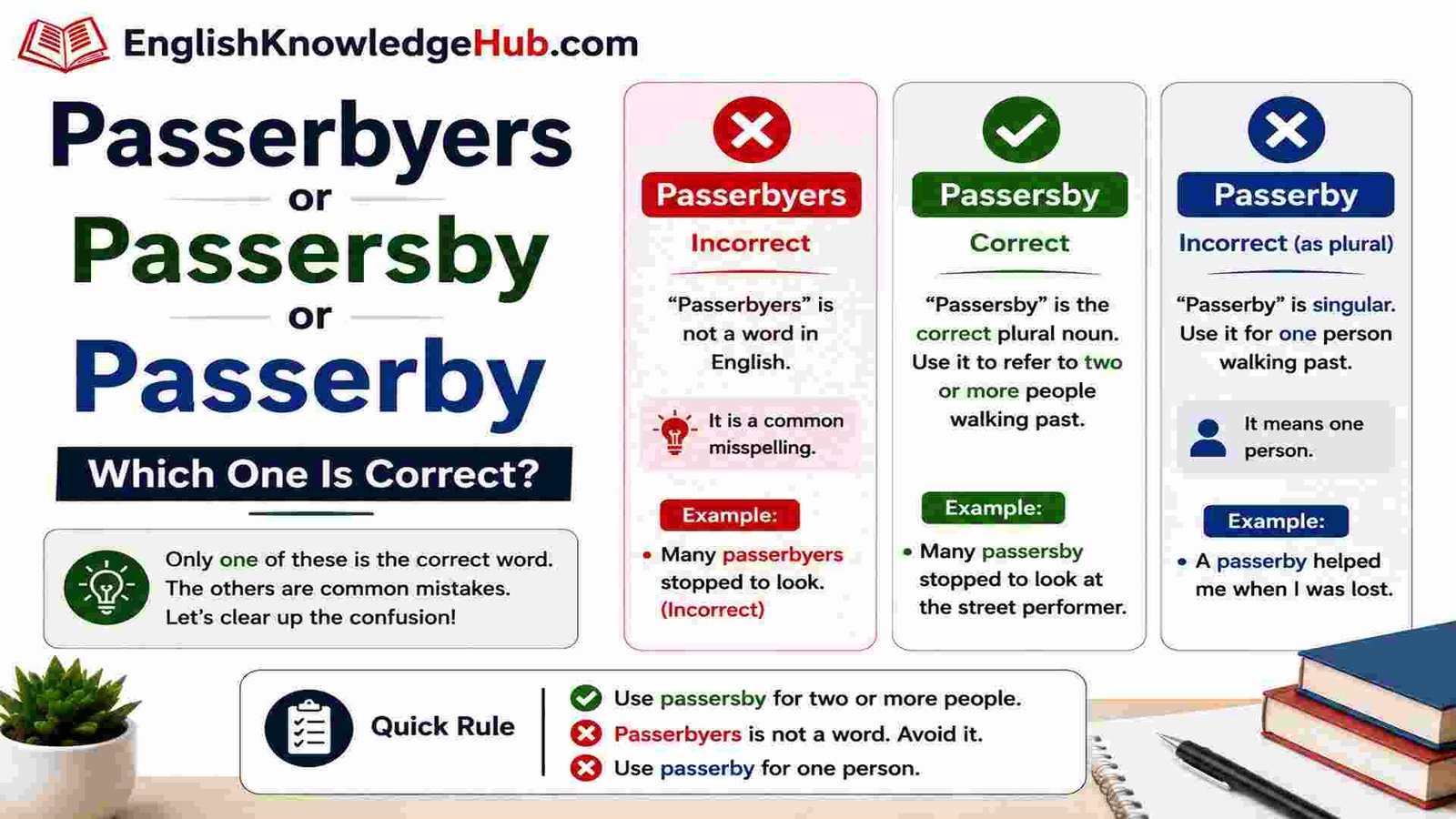
Passerby is singular, passersby is plural, and passerbyers is not the standard plural. The plural changes the main noun passer, not the final word by: one passerby, two or more passersby. This same pattern appears in a few compound nouns where the important noun comes before the final element.
In this article, you’ll learn Passerbyers or Passersby or Passerby through singular and plural grammar, pronunciation, possessives, sentence agreement, and natural examples from news, conversation, and formal writing. Merriam-Webster lists passerby with the plural passersby.
The Three Forms at a Glance
When learners compare Passerbyers or Passersby or Passerby, the biggest problem is usually not meaning. It is knowing where the plural s belongs.
This table makes the difference clear.
| Word | Correct? | Meaning | Example |
|---|---|---|---|
| passerby | Yes | One person passing a place | A passerby found the wallet. |
| passersby | Yes | Two or more people passing a place | Several passersby noticed the smoke. |
| passerbyers | No | Incorrect plural form | Avoid this spelling. |
The unusual-looking word is passersby, but it is completely correct.
What Does Passerby Mean?
A passerby is a person who happens to pass a particular place.
Imagine that you are standing outside a bakery. Someone you do not know walks past you. That person is a passerby.
If the person stops to help you pick up a dropped bag, you could say:
A passerby helped me pick up my groceries.
The word does not mean that the person knows you. It simply tells us that the person was passing the place.
Here are a few natural examples:
- A passerby told us where the bus station was.
- The lost child asked a passerby for help.
- A passerby noticed that the shop door was still open.
- One passerby called the building manager.
- A passerby picked up the papers that blew into the street.
Each sentence refers to one person, so we use passerby.
Why Does Passerby Become Passersby?
This is the most useful part of the lesson.
The word can be understood as:
passer + by
The important noun is passer.
A passer is the person who passes.
The word by does not name the person. It simply helps describe the idea of someone passing by.
So when we talk about more than one person, we make passer plural:
passer → passers
Then we keep by unchanged:
passers + by = passersby
That is why the plural looks different from most ordinary English plurals.
Compare:
- one passerby
- two passersby
- five passersby
- many passersby
The s belongs with the part that refers to the people.
Why Passerbyers Sounds Possible but Is Wrong
You may understand why someone writes passerbyers.
Many English nouns take a simple plural ending:
- teacher → teachers
- driver → drivers
- visitor → visitors
A learner may see passerby and assume that another -er or -ers should be added.
But the word already contains passer, which names the person.
There is no need to create passerbyer before making it plural.
That is why passerbyers is not the standard form.
When choosing between Passerbyers or Passersby or Passerby, remember that only two forms are needed:
passerby for one
passersby for more than one
A Simple Trick for Remembering the Plural
Try separating the word in your mind:
PASSER + BY
Now ask:
How many passers are there?
If there is one:
passer + by = passerby
If there are several:
passers + by = passersby
You do not pluralize by because by is not the person.
This small trick is often easier than trying to memorize the whole spelling.
Passerby or Passersby: How Do You Choose?
Look at the number.
Use passerby when you mean one person.
Examples
- A passerby waved at the dog.
- One passerby stopped near the gate.
- The passerby returned my dropped ticket.
- A passerby warned us about the wet floor.
Use passersby when you mean more than one person.
Examples
- Several passersby gathered near the entrance.
- Two passersby helped move the bicycle.
- The musician smiled at the passersby.
- Many passersby stopped to read the notice.
Words such as many, several, two, three, few, and numerous are strong clues that you need passersby.
Words such as a, one, and each normally point to passerby when the noun is singular.
Everyday Conversation Examples
Knowing a grammar rule is useful, but seeing it in normal situations makes it easier to remember.
At the Street
“Who helped you after you fell?”
“A passerby helped me stand up.”
Here, only one stranger helped.
Near a Shop
“The new window display attracted several passersby.”
There was more than one person, so the plural is required.
Asking for Directions
“A passerby showed us which road leads to the museum.”
Again, one person means passerby.
During a Street Performance
“Dozens of passersby stopped to watch the guitarist.”
The sentence refers to many people.
These examples show why Passerbyers or Passersby or Passerby is really a question about singular and plural number.
Workplace Examples
The word also appears in reports, emails, security notes, and workplace communication.
- A passerby reported the damaged sign to reception.
- Staff asked passersby to stay away from the repair area.
- A passerby informed security about the unattended bag.
- The promotional display caught the attention of passersby.
- Several passersby entered the store after seeing the outdoor sign.
In professional writing, use the same grammar rule. Formality does not change the plural.
Academic Examples
You may also see the word in research, observation notes, or academic writing.
- The researchers observed how passersby responded to the poster.
- A passerby was selected for a short interview.
- Students recorded the number of passersby entering the public square.
- The study examined how passersby reacted to background music.
- Each passerby was observed for less than one minute.
Notice the change between each passerby and many passersby.
That difference is based entirely on number.
Formal Writing Examples
Here are some examples that would fit formal reports or official writing:
- A passerby provided information about the incident.
- Several passersby witnessed the collision.
- The damaged barrier created a risk for passersby.
- A passerby contacted emergency services shortly afterward.
- Witnesses included employees, customers, and passersby.
The word works well when you do not know the person’s name or when the person’s role in the situation was simply passing the location.
Common Mistakes With Passerby and Passersby
The best way to avoid mistakes is to see exactly what goes wrong.
Mistake 1: Using Passerbyers
Incorrect:
Several passerbyers stopped near the broken traffic light.
Correct:
Several passersby stopped near the broken traffic light.
Explanation:
The standard plural is passersby. Do not create an extra -er ending.
Mistake 2: Keeping Passerby Singular After a Plural Number
Incorrect:
Three passerby saw the dog run across the road.
Correct:
Three passersby saw the dog run across the road.
Explanation:
Three tells us that the noun must be plural.
Mistake 3: Using Passersby for One Person
Incorrect:
A passersby offered me an umbrella.
Correct:
A passerby offered me an umbrella.
Explanation:
The article a refers to one person, so use the singular form.
Mistake 4: Writing Passerbys
Incorrect:
The artist spoke with a few passerbys.
Correct:
The artist spoke with a few passersby.
Explanation:
The plural s does not go at the end of the whole word. It goes after passer.
What About Passer-By and Passers-By?
You may also see:
- passer-by
- passers-by
These hyphenated spellings are also established in English.
The grammar works exactly the same way.
Singular:
passer-by
Plural:
passers-by
The important thing is to keep the plural s with passer.
You may encounter both the closed spelling passerby and the hyphenated spelling passer-by, depending on the dictionary, publication, or regional writing style.
For normal modern writing, passerby and passersby are clear and widely understood.
Is Passerby the Same as Pedestrian?
Not exactly.
A pedestrian is a person traveling on foot.
A passerby is someone who happens to pass a particular place.
The ideas can overlap.
For example:
A pedestrian crossed the road.
This sentence focuses on the person’s movement on foot.
A passerby noticed my lost keys.
This sentence focuses on the fact that the person happened to be passing the location.
A passerby may be a pedestrian, but the two words do not always emphasize the same idea.
Passerby vs Bystander
These words are also related, but they have different meanings.
A passerby is passing a place.
A bystander is present near an event but is not directly involved.
Example:
A passerby heard the crash and stopped.
Once that person stays and watches what happens, you might also describe them as a bystander.
So a passerby can become a bystander, but the words describe different roles.
Passerby vs Onlooker
An onlooker is someone who watches an event.
A passerby does not have to stop or watch anything.
For example:
Passersby walked past the street performer.
They may not have watched.
But:
Onlookers gathered around the street performer.
These people were watching.
The distinction can help you choose the most accurate word in your sentence.
Does American and British English Change the Rule?
The plural rule does not change.
In both major varieties of English, you may encounter forms such as passerby/passersby and passer-by/passers-by.
The spelling preference can vary between dictionaries, publishers, and style choices, but the basic grammar stays the same:
one passerby
several passersby
So you do not need a different plural rule for American and British readers.
One Final Test You Can Use
If you are still unsure about Passerbyers or Passersby or Passerby, replace the word with person or people.
Consider this sentence:
“Several ___ stopped outside the library.”
Would you say:
“Several person stopped outside the library”?
No.
You would say:
“Several people stopped outside the library.”
That means you need the plural:
Several passersby stopped outside the library.
Now try:
“A ___ showed me the correct platform.”
You would say:
“A person showed me the correct platform.”
So the correct form is:
A passerby showed me the correct platform.
This replacement trick works quickly when you are writing and do not want to overthink the grammar.
Frequently Asked Questions
Is passerby a correct word?
Yes. Passerby is the correct singular noun for one person who happens to be passing a place.
What is the plural of passerby?
The plural is passersby.
One passerby becomes two or more passersby.
Is passerbyers correct?
No. Passerbyers is not the standard plural form. Use passersby instead.
Is it two passerby or two passersby?
The correct phrase is two passersby because two requires a plural noun.
Is passersby singular or plural?
Passersby is plural. The singular form is passerby.
Which is correct, passerbys or passersby?
Passersby is correct. The s is added to passer, not to the end of the complete word.
Can I write passer-by?
Yes. Passer-by is an accepted hyphenated form. Its plural is passers-by.
What is the difference between Passerbyers or Passersby or Passerby?
Passerby refers to one person, passersby refers to two or more people, and passerbyers should be avoided because it is not the standard plural form.
Final Thought
The spelling may look unusual at first, but the rule is simple:
One person = passerby
More than one person = passersby
Passerbyers = incorrect in standard English
The easiest way to remember it is to focus on the word passer. If there is more than one passer, make that part plural and leave by unchanged.
Once you understand that small pattern, choosing between Passerbyers or Passersby or Passerby becomes easy.
For more simple explanations of confusing words, grammar rules, plurals, and everyday English usage, visit EnglishKnowledgeHub.com.
