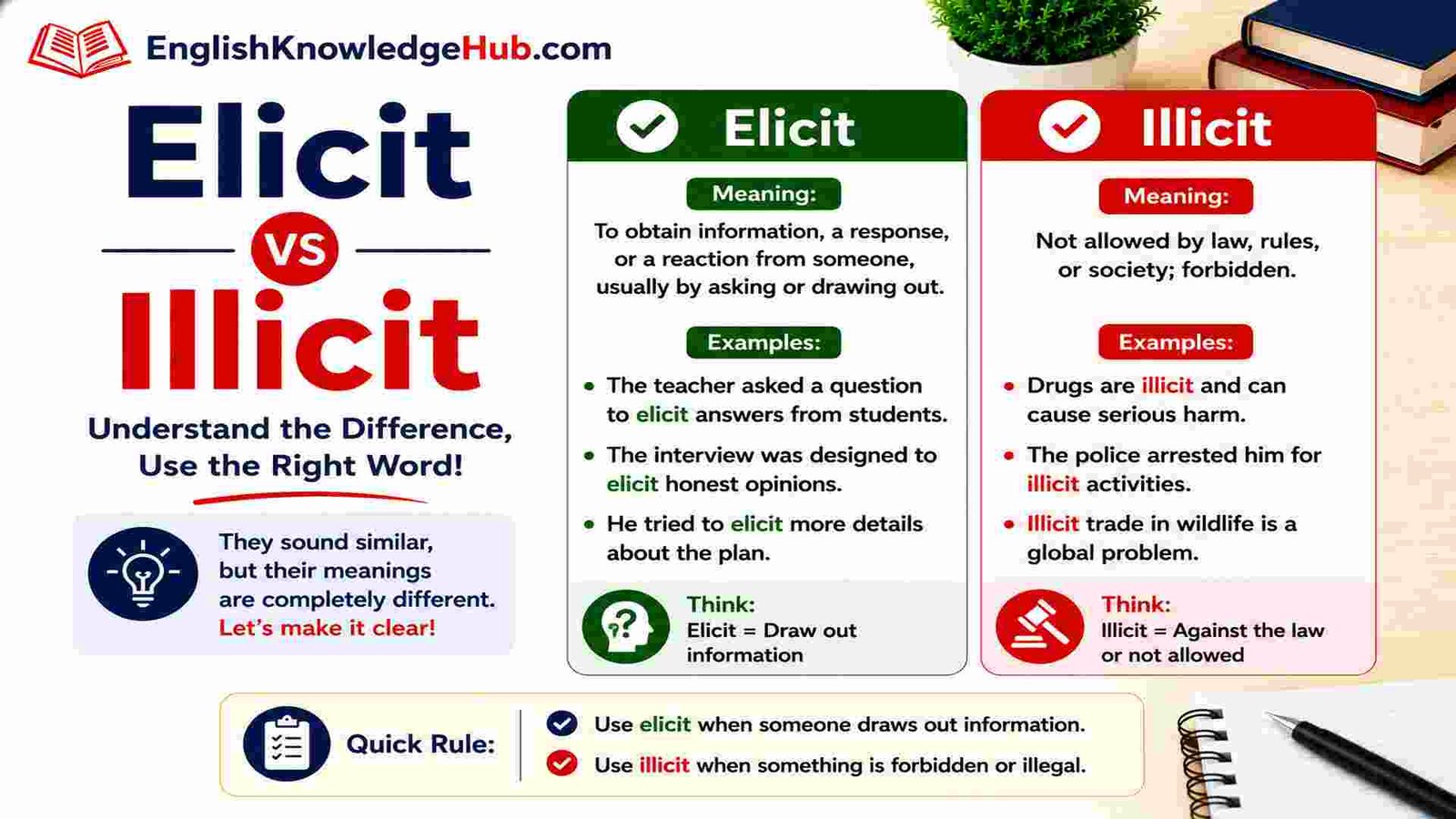
Elite vs Illicit : Elicit means to get a reply, answer, feeling, or reaction from someone. Illicit means illegal, not allowed, or against the rules. The two words sound almost the same, but they have very different meanings. This guide will help you know which word to use.
Here is the short rule:
- Elicit = get a response
- Illicit = not allowed
Examples:
- The teacher asked a question to elicit an answer.
- The police found an illicit business.
The first word is about getting something from someone.
The second word is about something that is not allowed.
Elicit vs Illicit: Why Are These Words Confusing?
The words elicit and illicit sound very close.
That is why many people spell them the wrong way.
But there is an easy way to tell them apart.
Elicit is a verb.
A verb shows an action.
Illicit is an adjective.
An adjective describes a person, place, thing, or action.
Elicit vs Illicit: Difference by simple table:
| Word | Type | Easy Meaning | Example |
|---|---|---|---|
| Elicit | Verb | Get a reply or reaction | The joke elicited a laugh. |
| Illicit | Adjective | Illegal or not allowed | They found illicit goods. |
What Does Elicit Mean?
Elicit means to get something from someone.
That something can be:
- an answer
- a reply
- a smile
- a laugh
- a feeling
- an idea
- some information
- a reaction
For example:
- Her joke elicited a smile.
- The teacher tried to elicit an answer.
- The question elicited a quick reply.
- His story elicited sadness.
In all of these examples, something caused a person to react.
Easy Examples of Elicit
Here are a few simple examples:
- The funny video elicited laughter.
- Mom asked a question to elicit the truth.
- The teacher used a picture to elicit ideas.
- His kind words elicited a smile.
- The news elicited surprise.
You can think of elicit as:
“bring out” or “get a response.”
What Does Illicit Mean?
Illicit means something is not allowed.
It can mean:
- illegal
- against the rules
- forbidden
- not accepted
Examples:
- Police found an illicit shop.
- The man was caught selling illicit goods.
- The group was involved in illicit trade.
- The company made an illicit payment.
In these sentences, illicit tells us that something is wrong or not allowed.
Does Illicit Always Mean Illegal?
No.
Sometimes it means illegal.
For example:
- illicit trade
- illicit goods
- illicit money
But sometimes it can also mean something that people do not accept or approve of.
For example:
- an illicit relationship
So the meaning can be:
against the law or against accepted rules.
Elicit vs Illicit in One Easy Example
Imagine a police officer talking to a witness.
The officer asks questions to elicit information.
The information is about an illicit business.
Now look at the difference:
- Elicit = get information
- Illicit = illegal business
This makes the difference much easier to see.
Elicit Is a Verb
Elicit is an action word.
It can change form:
- elicit
- elicits
- elicited
- eliciting
Examples:
- Good questions elicit good answers.
- Her smile elicits trust.
- The joke elicited laughter.
- The teacher is eliciting ideas from the class.
Illicit Is an Adjective
Illicit is a describing word.
It often comes before a noun.
Examples:
- illicit trade
- illicit money
- illicit goods
- illicit activity
- illicit business
Example sentence:
- Police found an illicit trading group.
Here, illicit describes the trading group.
Elicit vs Illicit: Common Mistakes
Mistake 1
Incorrect:
The teacher tried to illicit an answer.
Correct:
The teacher tried to elicit an answer.
Explanation:
The teacher wants to get an answer. So we need elicit.
Mistake 2
Incorrect:
Police found an elicit business.
Correct:
Police found an illicit business.
Explanation:
The business is illegal or not allowed. So we need illicit.
Mistake 3
Incorrect:
The joke illicit a laugh.
Correct:
The joke elicited a laugh.
Explanation:
The joke caused a reaction. We use elicited.
Mistake 4
Incorrect:
They were selling elicit goods.
Correct:
They were selling illicit goods.
Explanation:
The goods were not allowed. So illicit is correct.
Elicit vs Illicit: Easy Memory Trick
Here is a very simple trick.
Think:
Elicit = Extract
Both start with E.
You can think:
Elicit = get something out
Example:
- elicit an answer
- elicit a smile
- elicit information
Now think:
Illicit = Illegal
Both start with ill.
So remember:
- Elicit = get a response
- Illicit = illegal or not allowed
Elicit in Daily Life
You can use elicit in normal situations.
Examples:
- Her gift elicited a big smile.
- Dad asked a funny question to elicit a laugh.
- The sad movie elicited tears.
- My question elicited a short answer.
Elicit at School
Teachers may use this word when students give answers or ideas.
Examples:
- The teacher asked a question to elicit ideas.
- The picture elicited many answers.
- The story elicited a strong reaction from the class.
- The teacher tried to elicit the meaning of the word.
Elicit at Work
The word is also used in offices and meetings.
Examples:
- The manager asked questions to elicit feedback.
- The survey helped elicit customer opinions.
- Her talk elicited many questions.
- The meeting elicited new ideas.
Illicit in Formal Writing
You may see illicit in news, police reports, or legal writing.
Examples:
- Police stopped an illicit trade.
- The report found illicit payments.
- Officers found illicit goods.
- The group earned money from illicit activity.
In simple speech, people may use the word illegal instead.
Is There a British and American English Difference?
No major difference.
People in British English and American English use the words in the same main way.
- Elicit = get a response
- Illicit = illegal or not allowed
So you can use the same rule in both.
Quick Practice
Choose the correct word.
- The teacher tried to ___ an answer.
- Police found an ___ business.
- The joke ___ a laugh.
- They sold ___ goods.
- The question helped ___ more information.
Answers:
- elicit
- illicit
- elicited
- illicit
- elicit
FAQs
What does elicit mean?
Elicit means to get a reply, reaction, feeling, or information.
Example:
- The question elicited an answer.
What does illicit mean?
Illicit means illegal, forbidden, or not allowed.
Example:
- They were selling illicit goods.
Is elicit a verb?
Yes. Elicit is a verb.
It shows an action.
Is illicit a verb?
No. Illicit is an adjective.
It describes something.
Can I say “elicit information”?
Yes.
Example:
- The officer tried to elicit information from the witness.
What is the past tense of elicit?
The past tense is elicited.
Example:
- Her joke elicited a laugh.
Does illicit mean illegal?
Yes, it often means illegal. It can also mean not accepted or not allowed.
Final Thoughts
The difference in Elicit vs Illicit is easy when you remember one small rule.
Use elicit when you mean get a response, answer, feeling, or information.
Use illicit when you mean illegal, forbidden, or not allowed.
Remember:
Elicit = get something out.
Illicit = not allowed.
If you want more easy English lessons, simple grammar help, and word comparisons, visit EnglishKnowledgeHub.com.
