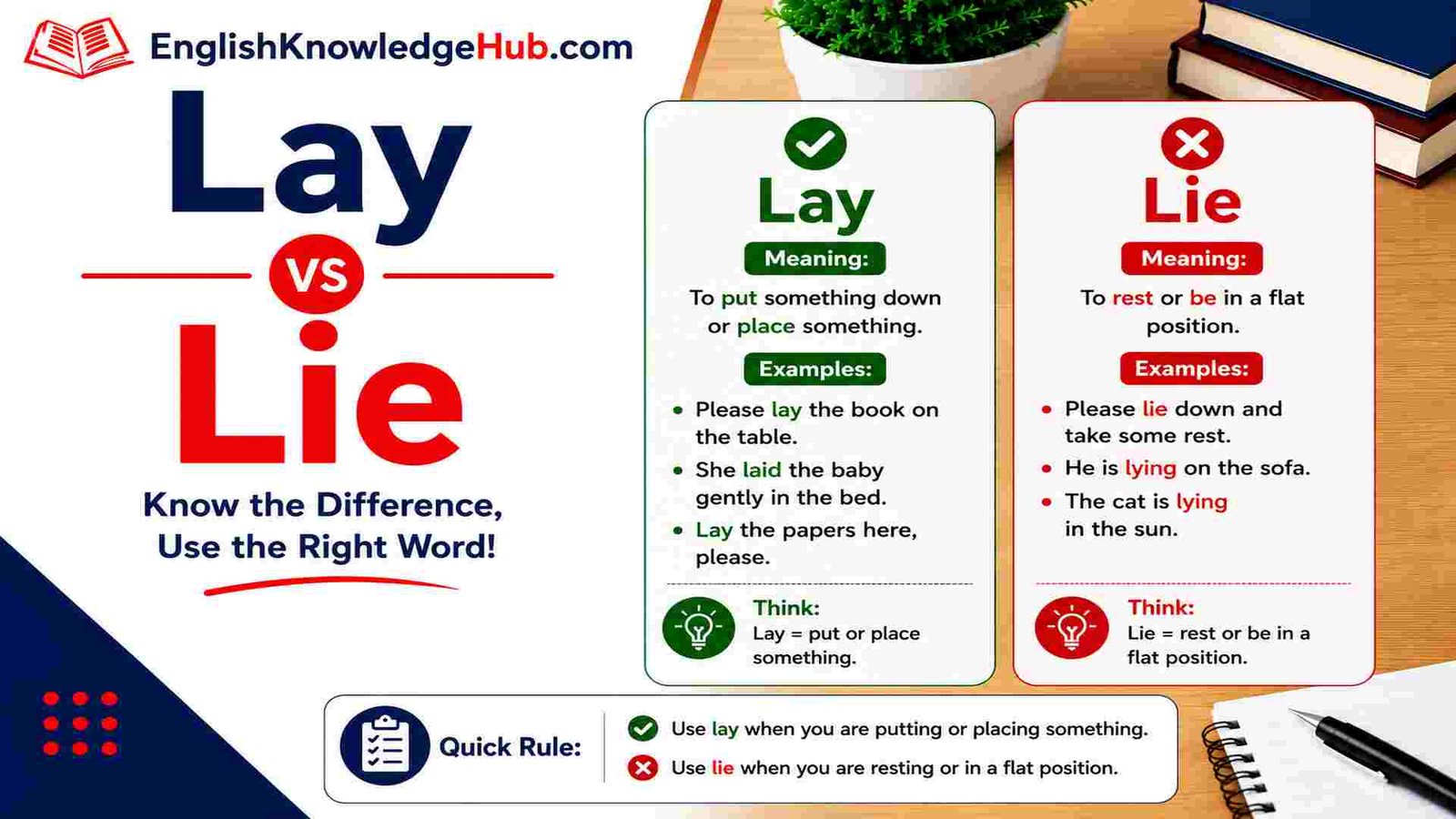
Lay vs Lie is easier to understand when you focus on the action. Lay means to put a person or thing somewhere, so it normally has something receiving the action. Lie means to rest or stay in a position. The subject does this itself. Their past forms cause most of the confusion, so learning those forms is important too.
Here are two simple examples:
- Please lay the newspaper on the table.
- I want to lie on the sofa.
In the first sentence, someone puts the newspaper somewhere.
In the second sentence, a person rests on the sofa.
That is the main difference.
The Simple Rule Behind Lay vs Lie
A useful way to choose the correct word is to look for the thing receiving the action.
Use lay when you put something somewhere.
- Lay the spoon beside the plate.
- She lays her coat across the chair.
- He laid the package near the front door.
In every sentence, something is being placed.
What did she lay?
Her coat.
What did he lay?
The package.
Now look at lie.
Use lie when someone or something rests, stays, or is located in a place.
- I lie on the floor when I stretch.
- The puppy lies beside my shoes.
- A small cabin lies near the lake.
Nothing is being placed by another person.
A quick memory trick is:
Lay = put something
Lie = rest or stay
Why Lay vs Lie Feels So Difficult
The basic meaning is not the hardest part. The verb forms create the real problem.
For easy understanding between Lay vs Lie: Look at this chart:
| Meaning | Present | Past | Past Participle | -ing Form |
|---|---|---|---|---|
| Put something somewhere | lay | laid | laid | laying |
| Rest or stay in a position | lie | lay | lain | lying |
Notice something unusual.
The word lay is:
- the present form of lay
- the past form of lie
For example:
- Today I lie on the grass.
- Yesterday I lay on the grass.
But:
- Today I lay the towel on the grass.
- Yesterday I laid the towel on the grass.
This is why the two verbs are often mixed up.
When to Use “Lay”
Use lay when a person puts someone or something in a place or position.
It usually needs an object after it.
For example:
- Please lay the cards on the desk.
- I always lay my watch beside the lamp at night.
- She laid the baby softly in the crib.
- We have laid the tools near the garage door.
The bold words after the verb receive the action.
A useful test is to ask:
Lay what?
If you can easily answer that question, lay may be the word you need.
For example:
- Lay what? The cards
- Lay what? My watch
- Lay what? The baby
Present Form of Lay
Use lay with I, you, we, and they.
Use lays with he, she, or it.
- I lay my school bag beside my desk.
- You lay the cups on the tray.
- She lays fresh clothes on the bed every morning.
- Dad lays his keys near the door.
Past Form of Lay
The past form is laid.
- I laid my phone beside the charger.
- Ben laid the blanket over the chair.
- The teacher laid the worksheets on each desk.
Do not write layed for this meaning.
The correct form is laid.
Past Participle of Lay
Use laid after has, have, or had.
- She has laid the documents on your table.
- We have laid clean towels in every room.
- He had laid his glasses somewhere in the kitchen.
The -ing Form
The -ing form is laying.
- She is laying the dishes neatly on the table.
- They are laying new carpet in the hall.
- I am laying my clothes out for tomorrow.
When to Use “Lie”
Use lie when a person, animal, or thing rests or remains in a position.
It does not need another object to receive the action.
For example:
- I like to lie near the window and read.
- The dog lies under the kitchen table.
- Your notebook is lying on the floor.
- The old bridge lies beyond the village.
In these examples, nothing is being put somewhere.
The subject itself is resting or staying in that place.
Present Form of Lie
Use lie with I, you, we, and they.
Use lies with he, she, or it.
- I lie on my back when I rest.
- We lie on the grass after lunch.
- The cat lies beside the heater.
- A narrow road lies behind the school.
Past Form of Lie
The past form is lay.
Yes, this is the strange part.
- I lay on the couch yesterday afternoon.
- The cat lay beneath the table all morning.
- He lay awake thinking about the exam.
In these sentences, lay does not mean “put something down.”
It is simply the past form of lie.
Past Participle of Lie
The past participle is lain.
Use it after has, have, or had.
- She has lain in bed since the morning began.
- The old book had lain in the drawer for years.
- The leaves have lain on the path since yesterday.
You may not hear lain very often in casual speech, but it is the standard form.
The -ing Form
The -ing form is lying.
- I am lying on the sofa.
- The cat is lying in the sun.
- Several boxes were lying near the wall.
The spelling is lying, not lieing.
One Question Can Help You Pick the Right Verb
When you are stuck between the two words, ask:
Am I putting something somewhere?
If yes, use a form of lay.
- Lay your pencil here.
- She laid her purse beside me.
- They have laid the papers on the counter.
If no, ask:
Is someone or something resting or staying somewhere?
If yes, use a form of lie.
- Lie on the bed.
- He lay on the carpet yesterday.
- The dog has lain there all afternoon.
This simple test solves many Lay vs Lie mistakes.
Lay Down or Lie Down?
Both forms may be correct, depending on how they are used.
Use lie down when the person or animal is going to rest.
- I need to lie down after lunch.
- Please lie down and close your eyes.
- The puppy went to lie down near its bed.
Use lay down when someone puts something down.
- Lay down the pencil when you finish.
- She laid down the box carefully.
- He laid the sleeping child down on the bed.
The main idea stays the same.
Lie down means the subject rests.
Lay something down means the subject puts something in a place.
You may hear people say:
“I need to lay down.”
This is common in informal speech in some places. However, in standard edited English, I need to lie down is the usual form when you mean “I need to rest.”
Common Mistakes With Lay and Lie
Mistake 1: Using “lay” when you mean rest
Incorrect:
I want to lay on the bed.
Correct:
I want to lie on the bed.
Explanation:
You are resting yourself. You are not putting another object on the bed.
Mistake 2: Using “lie” when placing something
Incorrect:
Lie the keys beside my bag.
Correct:
Lay the keys beside my bag.
Explanation:
The keys receive the action. You are placing them somewhere.
Mistake 3: Using “laid” for the past of “lie”
Incorrect:
Yesterday, I laid on the sofa after work.
Correct:
Yesterday, I lay on the sofa after work.
Explanation:
The person was resting. The past form of lie is lay.
Mistake 4: Writing “layed”
Incorrect:
She layed the papers on the chair.
Correct:
She laid the papers on the chair.
Explanation:
The standard past form of lay is laid, not layed.
Mistake 5: Saying “has laid” when you mean resting
Incorrect:
The dog has laid there all morning.
Correct:
The dog has lain there all morning.
Explanation:
The dog is resting. The past participle of lie is lain.
Everyday Examples
Here are some natural examples you might hear at home or with friends:
- Lay your wet umbrella near the door.
- I am going to lie on the couch for a while.
- Mom laid the clean towels on my bed.
- Our dog lay beside the window yesterday.
- I have laid your book next to the lamp.
- The cat has lain in that basket since breakfast.
- She is laying the forks beside the plates.
- He is lying on the carpet and watching TV.
Workplace Examples
The same rules apply at work.
- Please lay the signed forms on my desk.
- Nina laid the meeting notes beside the projector.
- Several folders were lying near the printer.
- The main issue lies in the missing information.
- We have laid the final plans before the team.
Notice the sentence:
The main issue lies in the missing information.
Here, lies does not mean physically resting.
It means the problem exists or is found there.
This use is common in professional and formal English.
Academic and Formal Examples
You can also use these verbs in school, research, and formal writing.
- The scientist laid the samples on a clean tray.
- The answer lies in the final paragraph.
- Several old records had lain unread for many years.
- The committee laid the proposal before the board.
- The greatest difficulty lies in collecting enough data.
The grammar rule stays the same even when the writing sounds more formal.
There Is Another Meaning of “Lie”
The word lie can also mean to say something that is not true.
This is a different verb.
Its forms are:
lie → lied → lied → lying
Examples:
- Do not lie to your teacher.
- He lied about losing the book.
- She has never lied to me.
- They were lying about what happened.
Compare these sentences:
- Yesterday, Ben lay on the sofa.
- Yesterday, Ben lied to his brother.
In the first sentence, Ben rested.
In the second sentence, Ben said something untrue.
The spelling of the past tense tells us which meaning is being used.
British and American English
The standard grammar rule is basically the same in British and American English.
For placing something:
lay → laid → laid
For resting:
lie → lay → lain
Informal speech may sometimes mix the two verbs, especially with phrases such as lay down and lie down.
For schoolwork, exams, business writing, and other careful writing, following the standard forms is the safest choice.
A Quick Tense Check
If you need a fast reminder, use these two lines:
Put something:
lay → laid → laid → laying
Rest somewhere:
lie → lay → lain → lying
Now compare:
- Today, I lay my jacket on the chair.
- Yesterday, I laid my jacket on the chair.
But:
- Today, I lie on the couch.
- Yesterday, I lay on the couch.
- I have lain on the sofa for the past hour.
Once you see the two verb patterns side by side, Lay vs Lie becomes much easier to understand.
FAQs
Is it “lay in bed” or “lie in bed”?
Use lie in bed when talking about the present.
- I like to lie in bed and read.
Use lay in bed for the simple past.
- I lay in bed until nine yesterday.
Is it “laying on the bed” or “lying on the bed”?
Use lying on the bed when a person or animal is resting there.
- The child is lying on the bed.
Use laying when someone is placing something.
- She is laying the clothes on the bed.
Is “I laid down” correct?
If you simply mean that you rested, standard English uses I lay down.
- I lay down after dinner.
Laid is normally used when something receives the action.
- I laid the book down.
What is the past tense of “lie down”?
The past tense is lay down.
- Today, I lie down after lunch.
- Yesterday, I lay down after lunch.
What is the past tense of “lay”?
The past tense of lay is laid.
- Today, I lay the papers on my desk.
- Yesterday, I laid the papers on my desk.
Is “lain” a real word?
Yes. Lain is the past participle of lie when it means to rest or remain somewhere.
- The bag has lain there for days.
Why do people mix up lay and lie?
The verbs have very similar meanings, and the past form of lie is lay. That overlap makes the forms easy to confuse.
Final Thoughts
The easiest way to understand Lay vs Lie is to focus on what happens in the sentence. Use lay when someone puts a person or thing somewhere. Use lie when the subject rests, stays, or is located somewhere without acting on another object.
The tense forms take a little practice, especially lie, lay, lain. Keep the two patterns separate, check whether an object receives the action, and the correct choice becomes much easier.
For more easy grammar lessons, confusing word comparisons, and clear English examples, visit EnglishKnowledgeHub.com and keep improving your English one useful rule at a time.
