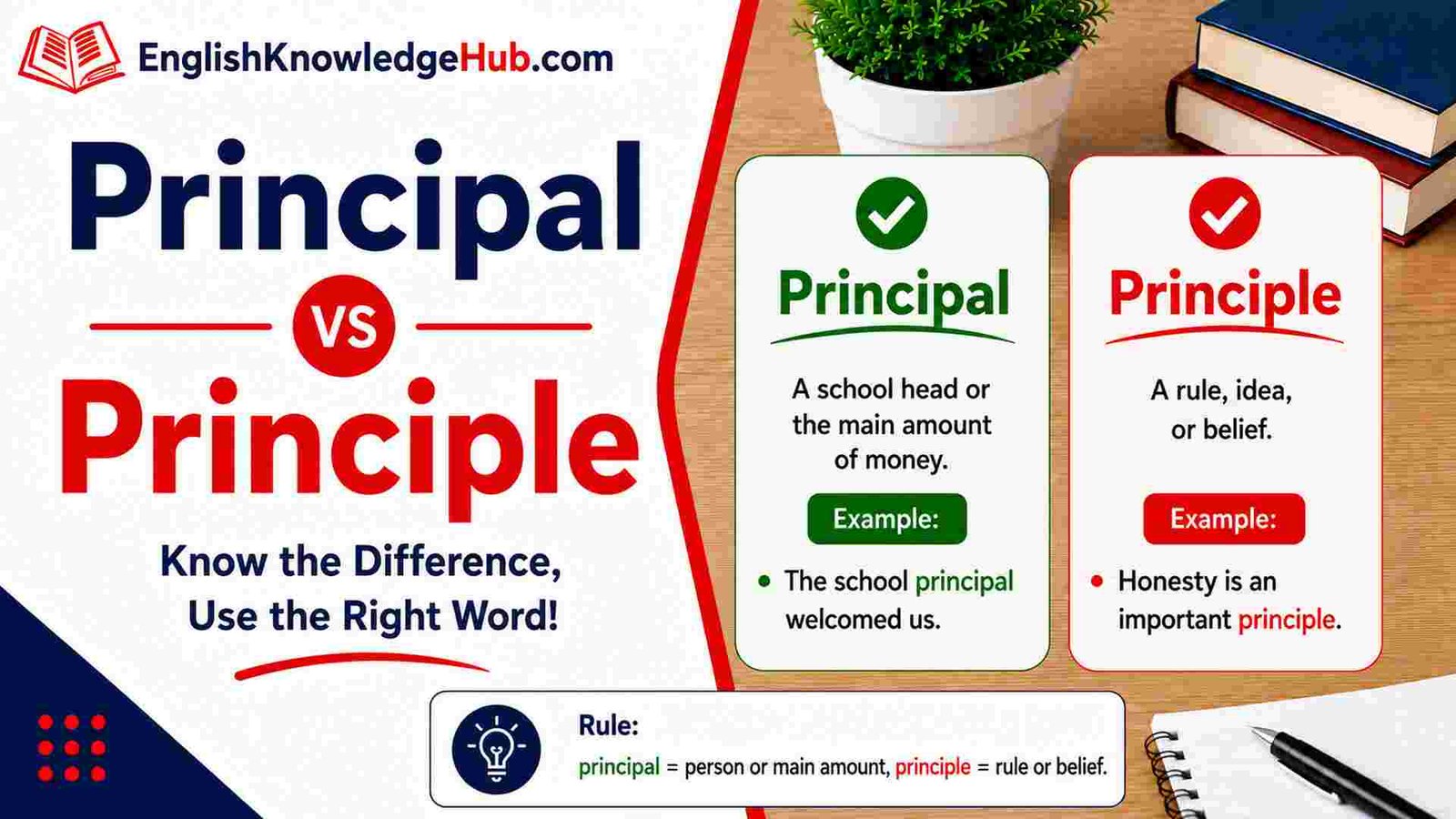
Principal vs Principle: Principal means the main or most important person or thing. It can also mean the head of a school. Principle means a rule, belief, or basic idea. The two words sound the same, but they have different spellings and meanings. This guide will help you choose the right word with simple rules and examples.
The difference may look small because only the last few letters change. However, each word has its own job.
Think of it this way:
- Principal can mean main, most important, or a person in charge.
- Principle means a rule, belief, value, or basic idea.
Once you look at the meaning of your sentence, choosing the right word becomes much easier.
Principal vs Principle: The Difference in One Simple Table
| Word | Easy Meaning | Used As | Example |
|---|---|---|---|
| Principal | Main, most important, or person in charge | Noun or adjective | Cost is our principal concern. |
| Principle | Rule, belief, or basic idea | Noun | Honesty is a good principle. |
There is one useful grammar point here.
Principal can be a noun or an adjective.
Principle is a noun.
That difference can help you when you are not sure which spelling to use.
When Should You Use Principal?
Use principal when you are talking about something main or most important.
You can often replace it with the word main.
For example:
Our principal goal is to finish the work by Friday.
You can also say:
Our main goal is to finish the work by Friday.
The meaning stays the same.
More examples:
- The principal reason for the trip was to visit my aunt.
- Food was their principal concern after the storm.
- The shop’s principal problem was a lack of workers.
- Our principal aim is to keep the room clean.
- The principal cause of the delay was heavy rain.
If main sounds correct, principal is often the word you need.
Principal Can Also Mean a Person
Principal can also be a noun.
A principal can be a person who leads a school.
For example:
- The principal came into our classroom.
- My father spoke to the school principal.
- The new principal greeted the students at the gate.
- Our principal announced the sports day dates.
- Sara went to the principal’s office.
This is easy to remember because a school principal is a person.
A principle cannot walk into a room or talk to students. A principal can.
When Should You Use Principle?
Use principle when you mean a rule, belief, value, or basic idea.
For example:
Being fair is an important principle.
Fairness is not a person or a main thing. It is a rule or belief about how people should behave.
More examples:
- Kindness is a good principle to follow.
- He believes in the principle of equal treatment.
- One basic principle of teamwork is trust.
- My parents taught me the principle of honesty.
- The class learned a simple science principle.
A principle may guide your actions.
It may also explain how something works.
Principal vs Principle: A Quick Question That Solves Most Mistakes
Before writing either word, ask:
Do I mean “main” or “most important”?
If yes, use principal.
The principal reason was the high cost.
Now ask:
Do I mean “rule,” “belief,” or “basic idea”?
If yes, use principle.
Saving water is an important principle in our home.
This meaning check is better than guessing from the sound because both words sound alike.
Principal vs Principle: Why Do People Mix Them Up?
The main reason is pronunciation.
Principal and principle usually sound the same when spoken.
You may hear this sentence:
That is an important principle.
Your ears cannot tell you which spelling the speaker used.
You need to understand the meaning.
That is why this mistake is much easier to make in writing than in speaking.
Compare these sentences:
The principal problem is the broken door.
Here, principal means main.
Respect is an important principle.
Here, principle means a belief or rule.
They sound alike, but their meanings are different.
Principal in Money and Loans
There is another meaning of principal that you may see in banking.
In money matters, the principal is the original amount of money borrowed or invested, not the interest.
Imagine you borrow $2,000 from a bank.
The $2,000 is the principal.
The extra money the bank charges you for borrowing it is called interest.
Examples:
- He paid $500 toward the loan principal.
- A larger payment can reduce the principal faster.
- Interest is added to the principal.
- She still owes part of the principal.
This meaning is common in banking, loans, and investments.
Principal vs Principle: Daily Life Examples
Here are some easy examples you may hear or use in normal life.
Using Principal
- My principal reason for staying home was the rain.
- The principal called my mother this morning.
- Safety is our principal concern.
- The principal problem is the broken heater.
Using Principle
- I try to follow the principle of being kind.
- Sharing is an important principle in our family.
- He will not lie because it goes against his principles.
- Fair play is a basic principle of the game.
Notice the pattern.
Principal points to importance or a person.
Principle points to a rule or belief.
Examples at Work
These words also appear in offices and business writing.
- Our principal goal is to improve customer service.
- The company’s main principle is to treat customers fairly.
- Cost is the principal problem with the new plan.
- Clear communication is an important principle at work.
- The principal designer checked the final work.
- Trust is a basic principle of a strong team.
You do not need a different rule for business English. The same meaning test still works.
Examples in School and Study
You may also see both words in school work.
- The principal welcomed the new students.
- The principal purpose of the lesson was to teach fractions.
- We learned the basic principles of good writing.
- The teacher explained a simple scientific principle.
- The principal reason for the test was to check our progress.
- Respect is an important classroom principle.
Again, ask whether the word means main/person or rule/idea.
Common Mistakes and How to Fix Them
Mistake 1
Incorrect:
The school principle called my parents.
Correct:
The school principal called my parents.
Explanation:
You are talking about a person who leads a school. Use principal.
Mistake 2
Incorrect:
Honesty is an important principal.
Correct:
Honesty is an important principle.
Explanation:
Honesty is a belief or rule about good behavior. Use principle.
Mistake 3
Incorrect:
The principle reason for the problem was bad weather.
Correct:
The principal reason for the problem was bad weather.
Explanation:
Here, the word means main reason. Use principal.
Mistake 4
Incorrect:
We follow the principal of treating everyone fairly.
Correct:
We follow the principle of treating everyone fairly.
Explanation:
You are talking about a rule or belief. Use principle.
Mistake 5
Incorrect:
She paid part of the loan principle.
Correct:
She paid part of the loan principal.
Explanation:
The original amount of a loan is called the principal.
What Does “In Principle” Mean?
In principle is a common phrase.
It means you agree with the main idea, even if you have not agreed on every small detail.
For example:
We agreed to the plan in principle, but we still need to choose a date.
This means the basic idea is accepted.
Another example:
Dad agreed in principle to the trip, but he wants to know the cost first.
Do not write in principal for this meaning.
What Does “On Principle” Mean?
On principle means you do something because of a strong belief or rule.
For example:
Mia never copies another student’s work on principle.
She does not copy because she believes it is wrong.
Another example:
He refused the unfair offer on principle.
His belief guided his choice.
Does British and American English Change the Rule?
The main spelling rule does not change.
Principal and principle have the same basic meanings in both British and American English.
There can be a small difference in school words.
In American English, principal is very common for the person who leads a school.
In British English, headteacher or head is often used for a primary or secondary school leader. Principal may still appear in some colleges, schools, and other institutions.
This difference does not change the meaning of principle.
Principal vs Principle: An Easy Memory Trick
Here is a simple way to remember the difference.
Think:
Principal = main or person
Think:
Principle = rule or idea
You can also look at the end of principal.
It ends in pal.
A pal is a person.
That may help you remember that a school principal is a person.
But do not depend only on this spelling trick because principal also means main and can refer to money.
The meaning of the sentence should always be your first check.
Principal vs Principle FAQs
1. Which is correct, principal reason or principle reason?
Principal reason is correct because it means the main reason.
Example:
The principal reason for leaving was the weather.
2. Is a school leader a principal or principle?
A school leader can be called a principal.
Principle does not mean a person.
3. Is honesty a principal or principle?
Honesty is a principle because it is a belief or rule about good behavior.
4. Is it principal amount or principle amount?
Use principal amount in banking and loans. It means the original amount of money before interest.
5. Can principal mean “main”?
Yes. Principal can be an adjective meaning main or most important.
Example:
Our principal concern is safety.
6. Can principle be an adjective?
No. Principle is a noun.
You can say:
That is an important principle.
But you cannot normally use principle to mean main.
7. What does “in principle” mean?
It means you agree with the basic idea, although some details may still need to be decided.
8. Do principal and principle sound the same?
Yes, they are usually pronounced the same. That is why people often choose the wrong spelling when writing.
Final Thoughts
The easiest way to understand Principal vs Principle is to look at the meaning of the sentence. Use principal for a main or important thing, a person in charge, or the main amount of money in a loan. Use principle for a rule, belief, value, or basic idea.
Remember one short test:
Main or person = principal.
Rule or belief = principle.
Keep practicing with simple sentences, and the difference will soon feel natural.
For more easy grammar lessons, word comparisons, meanings, and English writing help, visit EnglishKnowledgeHub.com.
