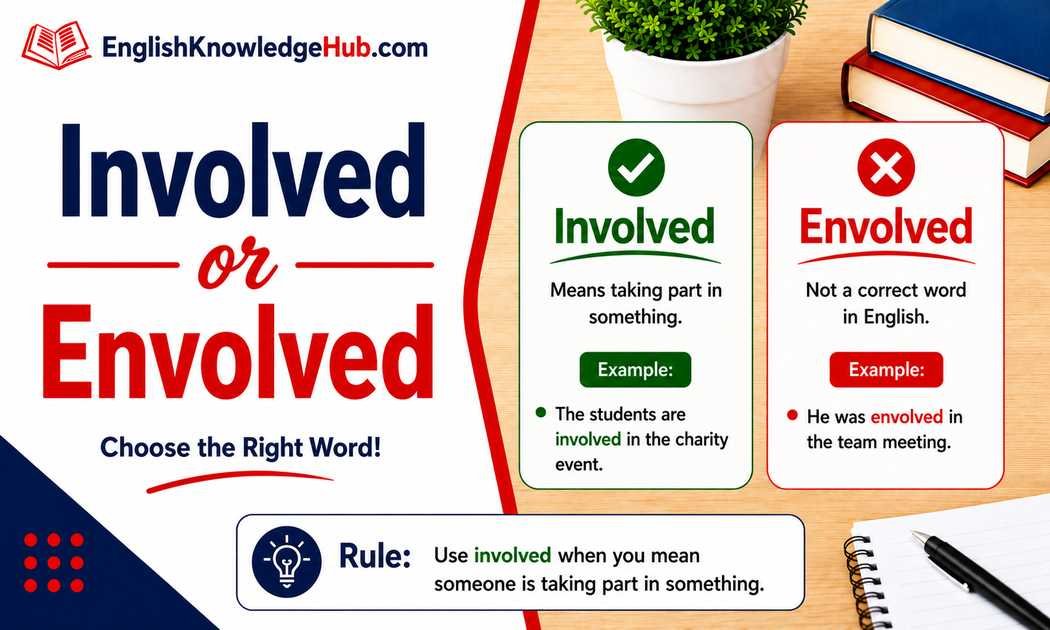
Involved is the correct standard English spelling. Envolved is not the normal modern form when you mean included, participating, connected, complicated, or affected. The word comes from the verb involve, so the correct forms are involve, involves, involved, and involving.
In this article, you’ll learn why Involved or Envolved causes confusion, what involved means in different contexts, how it differs from evolved, which prepositions normally follow it, and how to avoid the mistakes that show up in school, workplace, and everyday writing. Merriam-Webster lists involved for meanings such as taking part, being included, being affected, or being complicated.
Why “Envolved” Looks Possible
The misspelling often comes from sound. In quick speech, the first syllable of involved is weak, so some learners hear something closer to “en-” than a clear “in-.” English also has the word evolved, which looks and sounds similar.
That creates two common errors: writing envolved instead of involved, or choosing evolved when the intended meaning is “took part” rather than “developed over time.”
The safest spelling anchor is the base verb: involve → involved. If your sentence comes from involve, keep the opening in-.
What “Involved” Means
Involved has several common meanings, but they all connect to the idea of being part of something, connected with it, or affected by it.
In “Maya was involved in the project,” it means she took part. In “Several departments were involved in the decision,” it means they participated or were included. In “The case is very involved,” the word means complicated. In “The injury involved two muscles,” it means those muscles were affected.
That range is why a short definition can feel incomplete. The surrounding sentence tells you which sense is active.
“Involved In” Is the Most Common Pattern
When involved means participating or taking part, involved in is usually the natural pattern.
“She is involved in community work.” “Three teams were involved in the launch.” “He became involved in planning the event.”
You can also say get involved in when someone begins participating: “I want to get involved in the school club.”
The preposition matters. “Involved on the project” appears in some workplace varieties, but involved in the project is the safer general-English choice.
“Involved With” Has a Different Feel
Involved with can describe association with a person, organization, issue, or activity. “She is involved with a local charity” means she has an active connection to it.
With people, however, involved with can sometimes suggest a romantic relationship: “He was involved with a coworker.” Context usually makes the meaning clear.
If you simply mean participation in an activity, involved in often avoids ambiguity.
Involved vs Evolved
This is one of the most useful comparisons because many “envolved” mistakes come from mixing these two real words.
Involved comes from involve and means included, participating, connected, affected, or complicated. Evolved comes from evolve and means developed or changed gradually.
“The designer was involved in the project” means the designer participated. “The design evolved over six months” means the design changed and developed.
A person can be involved in something that evolves: “The researchers were involved in a study whose methods evolved over time.” The two words are related only by appearance, not meaning.
When “Involved” Means Complicated
Involved can also describe something with many connected parts that are difficult to follow.
“The explanation was too involved for a short meeting.” “The legal process became increasingly involved.” In these sentences, nobody is “participating.” The word means complex or complicated.
This use is common in formal writing and is worth knowing because it explains sentences that do not fit the participation meaning.
When “Involved” Means Affected
In technical or medical writing, involved can mean affected by a condition or included in an area of damage. Merriam-Webster records this sense as well.
A report might say, “The injury involved the surrounding tissue.” A medical note may refer to an “involved joint” or “involved region.” In ordinary conversation, people are more likely to say affected, but the technical use is standard.
Common Word Forms
The full word family is useful because spelling mistakes often spread from one form to another.
| Form | Example |
|---|---|
| involve | The job may involve travel. |
| involves | The process involves three steps. |
| involved | She was involved in the project. |
| involving | They discussed a case involving two companies. |
| involvement | His involvement lasted six months. |
Notice that none of these forms changes to en-.
Common Mistakes and Better Sentences
Incorrect: She was envolved in the meeting.
Correct: She was involved in the meeting.
The base verb is involve.
Incorrect meaning: The team evolved in the project.
Correct: The team was involved in the project.
Evolved means developed or changed, not participated.
Awkward: He is involved to the new program.
Better: He is involved in the new program.
Wordy: The task involved in many complicated steps.
Better: The task involved many complicated steps.
Here involved is the verb and takes a direct object, so in is unnecessary.
How It Works in Real Life
In everyday conversation: “I’m involved in organizing the party.” At work: “Legal and finance were both involved in the review.” In academic writing: “Students involved in the experiment completed a follow-up survey.” In formal reports: “The incident involved two vehicles.”
These examples show why learning only one definition is not enough. Involved changes slightly with context, but the spelling does not.
British and American English
There is no important British-versus-American spelling difference here. Both use involved. Pronunciation can vary slightly by accent, but the written form stays the same.
A Simple Memory Check
If you can replace the word with included, participated, connected, affected, or complicated, you probably need involved. If you mean “developed over time,” you probably need evolved.
And if you are deciding only between involved and envolved, choose involved.
For another spelling pair where an extra letter changes whether the form is a common word or a name, see Forest vs Forrest.
Frequently Asked Questions
Is envolved a correct English word?
Not as the standard form for involved. Use involved in normal modern English.
What does involved mean?
It can mean participating, included, connected, affected, or complicated, depending on context.
Is it involved in or involved with?
Both occur. Involved in is common for activities and projects. Involved with can describe association and may suggest a romantic relationship when used with a person.
What is the difference between involved and evolved?
Involved means included or participating. Evolved means developed or changed gradually.
What is the noun form of involved?
Involvement.
Can involved mean complicated?
Yes. “An involved explanation” can mean a complicated explanation.
Final Takeaway
For Involved or Envolved, use involved. The word comes from involve and can describe participation, inclusion, connection, complexity, or being affected. Do not confuse it with evolved, which means developed over time. Remember the base verb, and the spelling becomes much easier.
For more practical English spelling and usage guides, explore EnglishKnowledgeHub.com.
