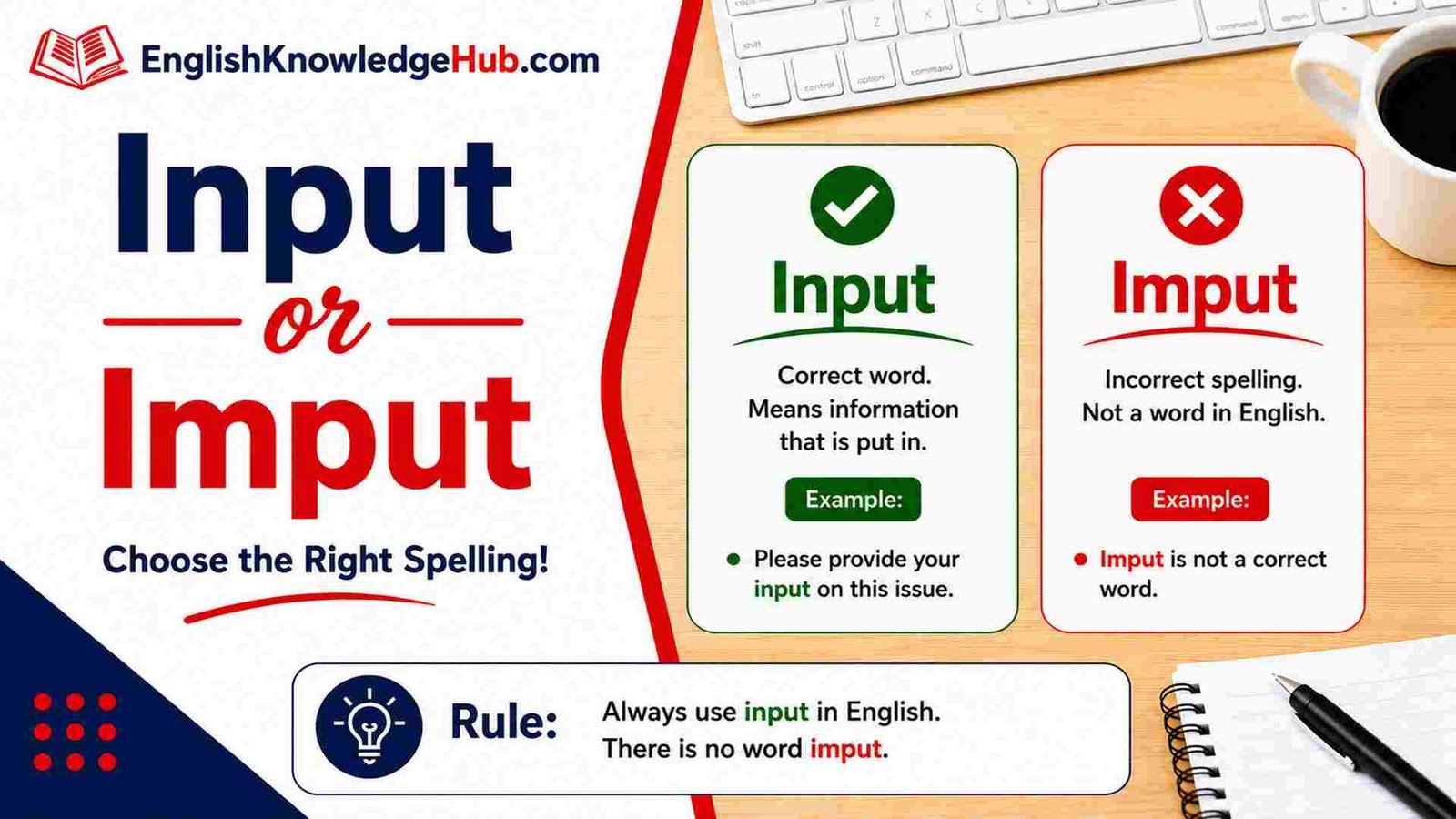
Input is the standard spelling to use in modern English. It can mean information, advice, data, effort, energy, or anything that goes into a system or process. It can also work as a verb when you enter information into a computer. This guide explains the meaning, grammar, spelling, and common mistakes in simple words.
If you are choosing between Input or Imput, write input in normal school, work, academic, technical, and everyday English.
A quick memory trick can help:
in + put = input
Think of something being put in. That makes the correct spelling much easier to remember.
Why Does the Word Use “Input”?
The word becomes easier when you stop looking at it as one long spelling.
Break it into two parts:
in + put
The basic idea is that something goes into something else.
For example:
- You put information into a form.
- You put numbers into a computer.
- You put ideas into a discussion.
- You put effort into a project.
- You put energy into a machine.
All of these ideas connect naturally with input.
That is why the spelling makes sense once you connect it with the meaning.
What Does Input Mean in Simple English?
The word input can have a few meanings, but they all share the same basic idea.
Something is being added, entered, supplied, or contributed.
You might use input for:
- advice
- ideas
- information
- computer data
- effort
- money
- energy
- signals
- resources
For example:
- I need your input before I choose the final design.
- Please input your email address.
- The machine needs more power input.
- Her input made the project stronger.
- The program checks the user’s input.
The word changes slightly with context, but the spelling stays the same.
Input Can Mean Advice or Ideas
One of the most common meanings is advice, opinion, or a useful contribution.
When someone asks for your input, they are often asking what you think.
For example:
- I would like your input on the new menu.
- The coach asked the players for input.
- Her input helped us solve the problem.
- We need more input before making a final choice.
- My brother gave useful input about the trip.
In these sentences, input is close in meaning to:
- advice
- feedback
- opinion
- ideas
- suggestions
- contribution
However, these words are not always exact replacements. The best choice depends on the sentence.
Input Can Mean Data Entered Into a Computer
You will also see input often in technology.
Here, it usually means information that enters a computer, device, app, machine, or system.
For example:
- The program rejected the wrong input.
- Voice can be used as input on some devices.
- The computer reads the user’s input.
- This box accepts only number input.
- Check the input before saving the file.
A keyboard, mouse, microphone, camera, and touchscreen can all send information into a device.
That information is called input.
Input Can Also Be a Verb
The word does not only work as a noun.
It can also be a verb.
As a verb, input means to enter information into a computer, form, program, or system.
For example:
- Please input your name.
- I need to input the sales numbers.
- She will input the customer details later.
- You can input the date by hand.
- The assistant input the new records yesterday.
This use is especially common in workplaces, technology, databases, and online forms.
Input as a Noun vs Input as a Verb
A small comparison can make the grammar clearer.
| Use | Meaning | Example |
|---|---|---|
| Noun | Information, ideas, data, or a contribution | We need your input. |
| Verb | To enter information | Please input the code. |
Look at these two sentences:
Noun:
Your input improved the plan.
Verb:
Please input the new price.
The spelling is the same, but the job of the word changes.
Input or Imput: What Is the Main Difference?
For practical modern English, the difference is simple.
Input is the form you should use.
Imput is not the spelling learners should normally choose in school, business, technology, or everyday writing.
So write:
- input data
- input device
- user input
- customer input
- input field
- input value
- input signal
Avoid writing:
- imput data
- imput device
- user imput
- imput field
If your goal is clear, standard English, input is the safe and natural choice.
Why Do Some People Write Imput?
This spelling mistake often happens because of sound.
When people say input quickly, the n comes just before the p sound.
That can make the word sound slightly different from the way it looks.
Some learners may hear something close to “im-put” and then spell it that way.
Another reason is that many English words begin with im, such as:
- impossible
- impatient
- imperfect
- improper
Because that pattern is common, a learner may guess that imput looks right too.
But this word follows a different pattern.
Remember:
in + put = input
That simple connection is much more useful than trying to spell the word only by sound.
Common Spelling Mistakes
Here are some natural examples of mistakes learners may make.
Asking for Advice
Incorrect:
Can you give me your imput on this plan?
Correct:
Can you give me your input on this plan?
Explanation:
The speaker wants advice or ideas. Use input.
Filling Out a Form
Incorrect:
Please imput your home address below.
Correct:
Please input your home address below.
Explanation:
Here, input is a verb meaning to enter information.
Talking About a Team
Incorrect:
Everyone’s imput helped us finish early.
Correct:
Everyone’s input helped us finish early.
Explanation:
The word means contribution or ideas, so input is the standard spelling.
Talking About Technology
Incorrect:
The screen shows the wrong imput value.
Correct:
The screen shows the wrong input value.
Explanation:
In computer and technical language, the usual spelling is input.
How to Use Input in Daily Conversation
You can use this word naturally in normal speech.
Examples:
- Thanks for your input.
- I want your input before I decide.
- Your input really helped me.
- Can I get your input on something?
- We asked everyone for input.
These sentences sound natural when you want someone’s opinion or ideas.
How to Use Input at Work
The word is also very common in offices, meetings, planning, and business communication.
Examples:
- The manager asked for team input.
- We need customer input before changing the service.
- Please input the order number.
- Her input improved the report.
- The design team shared useful input during the meeting.
- I will input the new prices this afternoon.
You may also see phrases such as:
- staff input
- client input
- expert input
- user input
- data input
How to Use Input in Academic Writing
Students and researchers may use input when talking about information, ideas, data, or resources.
Examples:
- Student input helped improve the activity.
- The researchers changed the input values.
- The model gave a different result after new input.
- Teacher input supported the final project.
- The study included input from several experts.
In academic work, always make sure the word fits the exact meaning of your sentence.
If you simply mean opinion, a word such as feedback or view may sometimes be more precise.
How to Use Input in Formal Writing
Input is also suitable in formal English.
For example:
- The committee requested public input.
- Expert input will help guide the decision.
- Applicants must input accurate details.
- Community input played an important role in the review.
- The board welcomed input from local businesses.
The word is not too casual, so you can use it in reports, emails, notices, and professional documents.
What Are the Forms of the Verb Input?
The verb has several forms.
You may see:
- input
- inputs
- inputting
- input
- inputted
Examples:
- She inputs the figures each morning.
- I am inputting the new names now.
- He input the data yesterday.
- He inputted the data yesterday.
Both input and inputted can appear as past forms.
For learners, the most important spelling point is this:
inputting has two t letters.
Write:
inputting
Not:
inputing
Input and Output: An Easy Way to Understand the Meaning
A useful way to understand input is to compare it with output.
Input is what goes in.
Output is what comes out.
Imagine a calculator.
You type:
7 + 5
That is the input.
The calculator shows:
12
That is the output.
Here are a few more examples:
| Situation | Input | Output |
|---|---|---|
| Calculator | Numbers | Answer |
| Computer | Data | Result |
| Microphone system | Voice | Sound |
| Meeting | Ideas | Decision |
| Learning | Study and practice | Knowledge |
This comparison makes the meaning much easier to picture.
A Simple Teacher Trick to Remember the Spelling
Try this sentence:
“Put it in.”
Now take the two key words:
in + put
Join them:
input
You can even picture an arrow going into a box.
IN → PUT
Every time you wonder about Input or Imput, think of something being put inside a box.
That mental picture can help you remember the spelling quickly.
Is Input Used the Same Way in British and American English?
Yes.
There is no important British and American spelling difference for this word.
Both forms of English normally use:
input
So you do not need to change the spelling for readers in the United States, United Kingdom, Canada, Australia, or other English-speaking regions.
Can Input Be Countable or Uncountable?
Yes, depending on meaning.
When input means general advice or contribution, it is often used as an uncountable noun.
For example:
- We need more input from students.
You usually would not say:
- We need three inputs from students.
However, in technical, scientific, or business settings, inputs can be correct when you mean separate things going into a system.
For example:
- The device receives three different inputs.
- Labor and materials are two important production inputs.
- The program compares several inputs.
So both input and inputs can be correct. The context decides which one you need.
Words Often Used With Input
Learning common word partners can help you use the word more naturally.
You may see:
- user input
- customer input
- public input
- teacher input
- expert input
- data input
- audio input
- input signal
- input device
- input field
- input value
- input method
Examples:
- The form checks each input value.
- We need more customer input.
- Connect the cable to the audio input.
- The software waits for user input.
These phrases are useful in everyday, professional, and technical English.
When Should You Use a Different Word?
Sometimes input is correct, but another word may sound more natural.
If you mean someone’s personal reaction, you might use:
feedback
Example:
- I would like your feedback on my essay.
If you mean a suggestion, use:
advice
Example:
- She gave me good advice about the interview.
If you mean information entered into a computer, use:
data
Example:
- The system stores customer data.
If you mean a personal view, use:
opinion
Example:
- What is your opinion about the new rule?
Choosing the most exact word makes your writing clearer.
FAQs
Which spelling is correct, Input or Imput?
Input is the standard spelling to use in modern English. It can refer to ideas, advice, information, data, energy, or something supplied to a system.
What is the simple meaning of input?
Input means something that goes into a system, process, discussion, machine, or activity. It may be information, ideas, effort, energy, or data.
Can input mean advice?
Yes. When someone asks for your input, they often want your ideas, suggestions, or advice.
Example:
- I need your input on this decision.
Is input a noun or a verb?
It can be both.
As a noun:
- Your input was helpful.
As a verb:
- Input the code below.
Is inputted correct?
Yes. Inputted can be used as a past form of input. The form input can also be used in the past.
Is inputting spelled with two t’s?
Yes. The correct spelling is inputting.
Example:
- She is inputting the numbers now.
What is the plural of input?
The plural can be inputs when you mean separate signals, resources, items, or pieces of information going into a system.
Example:
- The machine receives several inputs.
What is the opposite of input?
In many technical situations, the opposite is output.
Input goes in. Output comes out.
Final Thoughts
The choice between Input or Imput is easy once you connect the word with its meaning. Input is the standard spelling for ideas, advice, data, information, energy, and anything else that goes into a process or system. It can also work as a verb when you enter information.
Use this memory trick whenever you forget:
IN + PUT = INPUT
You are putting something in, so the spelling follows naturally.
For more simple lessons about spelling, grammar, confusing words, and everyday English, visit EnglishKnowledgeHub.com and keep improving your English with clear, practical explanations.
