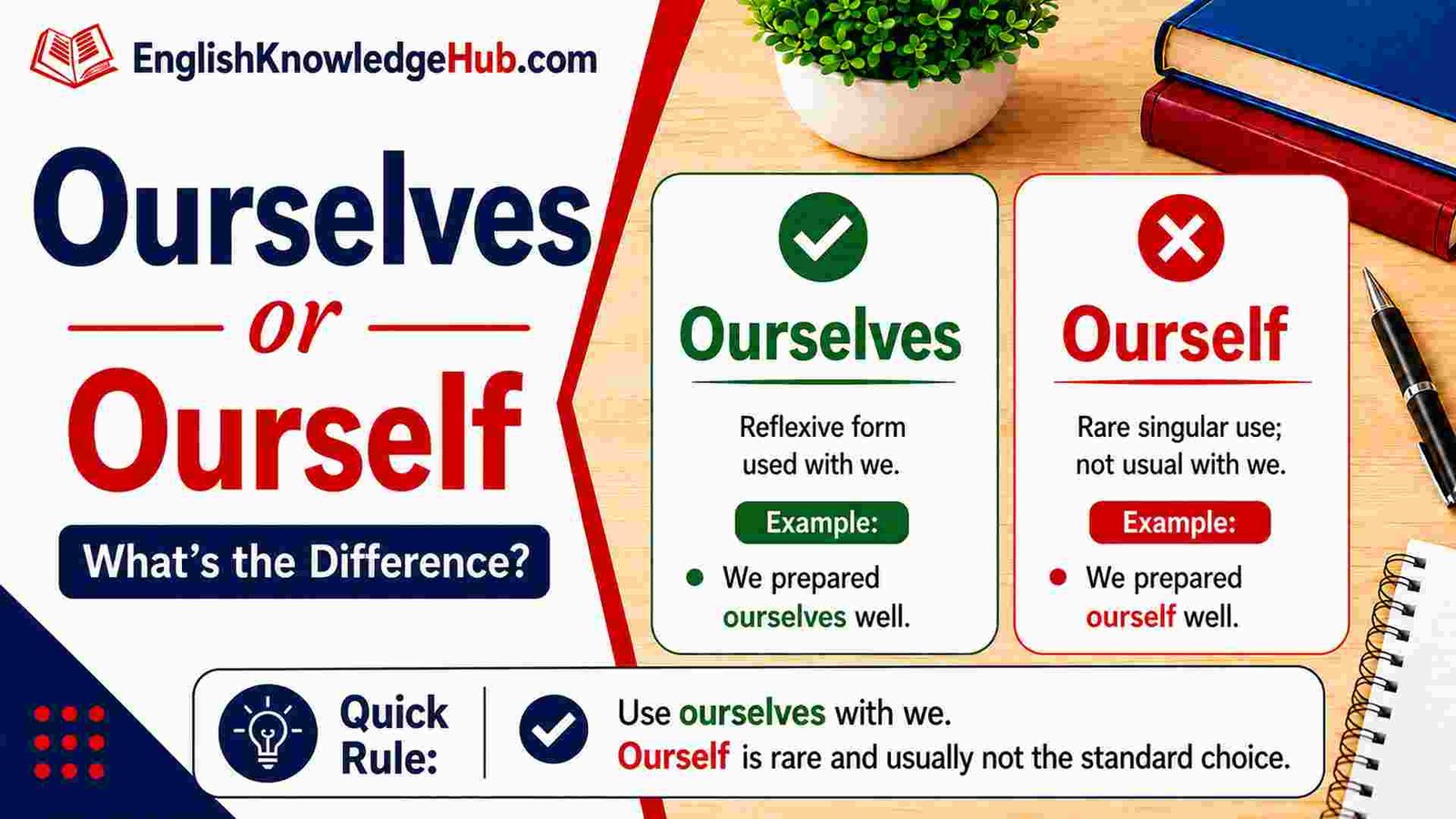
Ourselves vs Ourself: “ourselves” is the normal and standard word when “we” means two or more people. “Ourself” does exist, but it is rare and is not normally used for an ordinary group. In this guide, you will learn the difference, the grammar rule, and how to choose the right form easily.
If you are talking about yourself and at least one other person, ourselves is almost always the word you need.
For example:
We prepared ourselves for the long trip.
Here, we means more than one person, so ourselves matches it.
The word ourself can appear in special kinds of English, but most learners will rarely need it.
The Simple Rule Behind Ourselves
The easiest way to understand this topic is to start with we.
We normally means two or more people.
For example:
- My sister and I = we
- My coworkers and I = we
- My friends and I = we
- My classmates and I = we
Because we is plural, its reflexive form is also plural:
we → ourselves
Look at this sentence:
We gave ourselves enough time to finish dinner.
The people who gave the time and the people who received it are the same group.
That is why ourselves works.
Here is another example:
We reminded ourselves to bring water.
Again, we and ourselves refer to the same people.
What Does “Ourselves” Mean?
Ourselves is a reflexive pronoun connected to we.
You use it mainly in three ways.
When the Action Comes Back to the Same People
Use ourselves when the people doing an action are also affected by that action.
We introduced ourselves to the new coach.
We taught ourselves how to make fresh pasta.
We promised ourselves a quiet weekend.
In each sentence, we and ourselves refer to the same group.
When You Want to Add Emphasis
Sometimes ourselves tells the reader that the group did something personally.
We cleaned the room ourselves.
This means nobody else cleaned it for us.
More examples:
We designed the poster ourselves.
We checked every answer ourselves.
We moved the furniture ourselves.
Here, the word adds emphasis.
In the Phrase “By Ourselves”
By ourselves often means without help or without other people.
We fixed the broken gate by ourselves.
We stayed at the cabin by ourselves.
We completed the puzzle by ourselves.
The exact meaning depends on the sentence. It can mean alone or without help.
So, What Does “Ourself” Mean?
This is the part that causes most of the confusion in Ourselves vs Ourself.
Ourself is a real word, but it is uncommon in modern everyday English.
It may appear when we is being used to refer to only one person.
For example, in older royal or very formal language, a king or queen might use we instead of I.
A sentence could then use ourself because only one person is actually being discussed.
You might see a sentence such as:
We shall examine the matter ourself.
This is not normal everyday English.
You would not usually say:
We made ourself some tea.
if we means two people.
The normal sentence is:
We made ourselves some tea.
That is the most important difference to remember.
Ourselves vs Ourself: Quick Comparison
| Point | Ourselves | Ourself |
|---|---|---|
| Standard with normal plural we | Yes | No |
| Common in everyday English | Yes | No |
| Refers to a group | Yes | Usually no |
| Used in school and workplace writing | Yes | Rarely |
| Can be used for emphasis | Yes | Only in unusual contexts |
| Best choice for most learners | Yes | Usually not needed |
For normal English, ourselves is the safe and natural choice.
Why Does “Ourself” Look Correct?
Learners sometimes think about these forms:
my → myself
your → yourself
Then they see:
our → ourself
That pattern looks logical, but English does not work that way here.
The number of people matters.
Compare:
yourself = one person
yourselves = more than one person
The same idea applies to we:
we → ourselves
Since ordinary we is plural, the ending is selves, not self.
A good memory trick is:
One person = self
More than one person = selves
That simple rule works in many situations.
Ourselves vs Ourself: Daily Conversation Examples
Here are some natural examples you may hear in normal conversation.
We bought ourselves some ice cream after dinner.
We found ourselves on the wrong street.
We should give ourselves more time tomorrow.
We made the birthday cake ourselves.
We kept the surprise to ourselves.
Notice that all these examples describe more than one person.
That is why ourselves sounds natural.
Workplace Examples
The same rule applies at work.
We gave ourselves three days to prepare the report.
We checked the numbers ourselves before the meeting.
We asked ourselves whether the plan would save money.
We introduced ourselves to the new manager.
We organized the files by ourselves.
In professional writing, ourself would normally sound wrong if we refers to a team or group.
Academic Examples
Students and researchers also use ourselves.
We asked ourselves why the results were different.
We limited ourselves to five examples in the study.
We reminded ourselves to check each source carefully.
We completed the research ourselves.
These sentences are clear because the pronoun agrees with the plural subject we.
Formal Writing Examples
Formal English follows the same normal rule.
We consider ourselves responsible for reviewing the final document.
We have allowed ourselves enough time to examine the proposal.
We should remind ourselves of the main purpose of the policy.
The style may sound more formal, but the grammar does not change.
Ourselves vs Ourself: Common Mistakes to Avoid
Mistake 1: Using “Ourself” With a Plural “We”
Incorrect:
We prepared ourself for the interview.
Correct:
We prepared ourselves for the interview.
Explanation:
We refers to more than one person, so you need the plural reflexive form ourselves.
Mistake 2: Using “Ourself” After “By”
Incorrect:
We completed the garden work by ourself.
Correct:
We completed the garden work by ourselves.
Explanation:
The subject is a group. Because we is plural, use ourselves.
Mistake 3: Using “Ourselves” as the Normal Subject
Incorrect:
Ourselves will call you tomorrow.
Correct:
We will call you tomorrow.
Explanation:
Use we as the normal subject. Ourselves is not usually used by itself as the subject of a sentence.
You can use it for emphasis:
We ourselves will call you tomorrow.
Mistake 4: Using the Wrong Reflexive Pronoun With a Singular Noun
Incorrect:
Our company gave ourselves another week.
Correct:
Our company gave itself another week.
Explanation:
The subject company is singular, so itself matches it.
If you mean the people in the company, you can change the subject:
We gave ourselves another week.
“We Ourselves” or “We Ourself”?
When we refers to a normal group, use:
we ourselves
For example:
We ourselves noticed the mistake.
This means that we personally noticed it.
Do not normally write:
We ourself noticed the mistake.
That form would only make sense in a very unusual situation where one person is using we to talk about himself or herself.
For learners, we ourselves is the form worth remembering.
“By Ourselves” or “By Ourself”?
Use by ourselves when we means more than one person.
We traveled by ourselves.
We solved the problem by ourselves.
We prepared the food by ourselves.
Do not use by ourself for a normal group.
If one person is speaking, the usual expression is:
I did it by myself.
That gives you a helpful pattern:
I → by myself
we → by ourselves
Does British English Use “Ourself” More Than American English?
There is no everyday rule saying British speakers should use ourself while American speakers should use ourselves.
In both British and American English, ourselves is the normal form with plural we.
The difference is mainly about meaning and grammar, not country.
So you do not need separate rules for British and American English here.
Is “Ourself” Wrong?
Not in every possible situation.
Calling it completely nonexistent would be too simple.
The word has been used in special contexts, especially when a single person uses we instead of I.
However, it is uncommon, and it is generally nonstandard with ordinary plural we.
This difference matters.
If you and your friend say:
We bought ourself a new game.
the natural correction is:
We bought ourselves a new game.
But if you find ourself in very old, royal, literary, or unusual writing, it may have been chosen for a special reason.
A Five-Second Test
When you are unsure about Ourselves vs Ourself, ask:
Does “we” mean two or more people?
If yes, choose:
ourselves
Example:
We treated ourselves to lunch.
If we represents only one person in an unusual style, ourself may appear.
For normal speech and writing, you will almost always choose ourselves.
FAQs
Which is correct, ourselves or ourself?
Ourselves is correct when we refers to two or more people. Ourself is rare and normally appears only in special uses where we refers to one person.
Is “ourself” a real word?
Yes, but it is uncommon. It is not the normal reflexive pronoun for a group.
Can I say “we did it ourself”?
Not when we means several people. Say:
We did it ourselves.
Is “ourselves” singular or plural?
Ourselves is plural. It normally refers back to we.
What is the difference between “ourselves” and “ours”?
Ourselves is a reflexive or emphatic pronoun.
We taught ourselves to swim.
Ours shows possession.
The blue bags are ours.
Can “ourselves” come after “we”?
Yes. It can add emphasis.
We ourselves made the final decision.
Should I use “ourself” in formal writing?
Usually not. If we refers to a normal group, use ourselves in formal writing too.
Final Thoughts
The easiest way to understand Ourselves vs Ourself is to remember that ordinary we is plural. When we means two or more people, use ourselves.
Say:
We introduced ourselves.
We gave ourselves a break.
We completed the work ourselves.
Ourself exists, but it belongs to rare or special uses and is not a normal replacement for ourselves.
If you want more simple grammar lessons, word comparisons, and clear English examples, visit EnglishKnowledgeHub.com.
