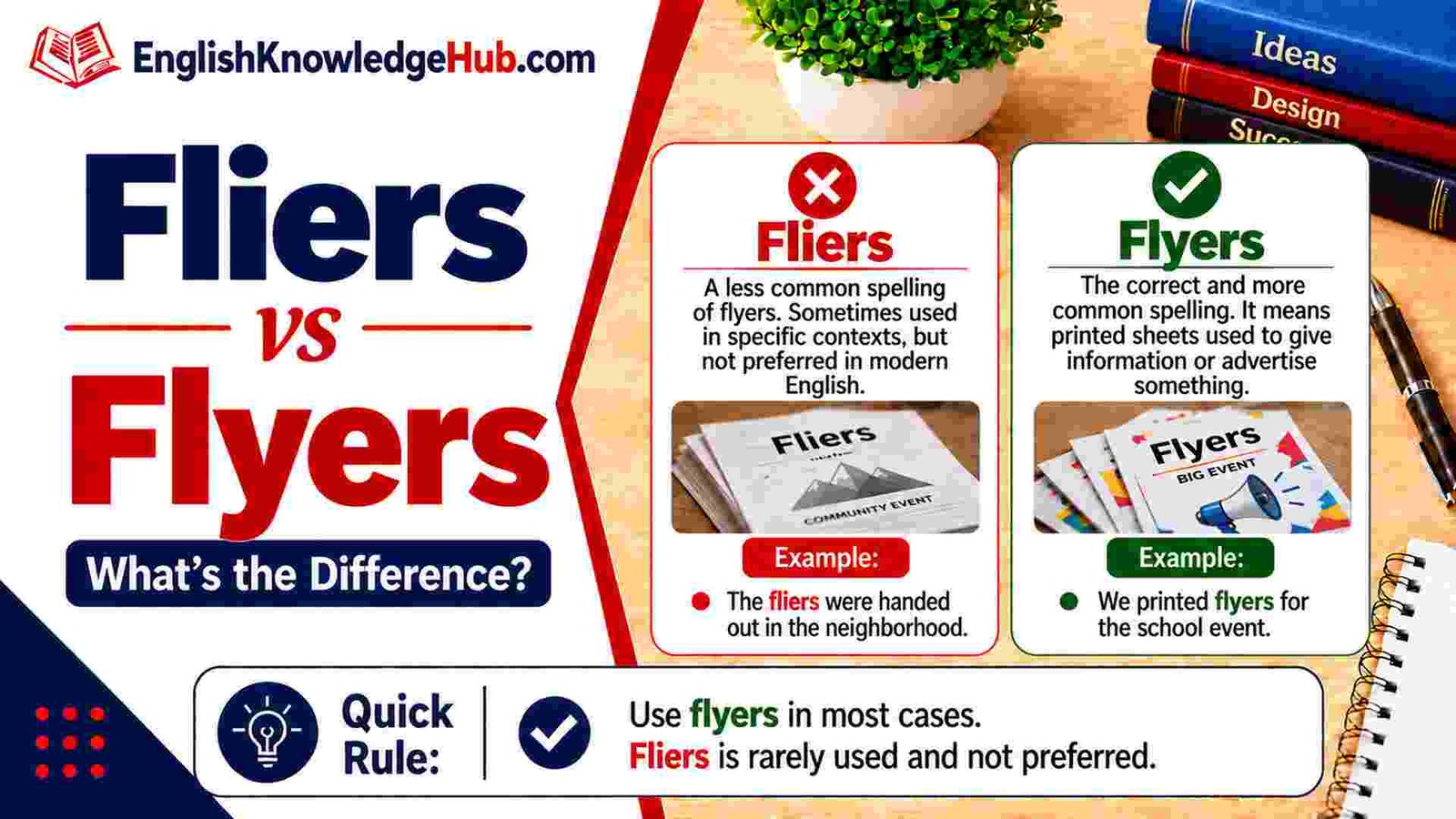
Fliers vs Flyers has no single one-word winner because both spellings are correct. In modern English, flyer is especially common for an advertising handout, while flier is also accepted for a person or thing that flies. Some dictionaries and style choices prefer one spelling in certain meanings, so context and consistency matter.
If you came here because you were about to write about a concert handout, an airline passenger, a bird, or the phrase “take a flier,” you are asking the right question. The spelling can change with the meaning, the publication style, and the variety of English you use.
Fliers vs Flyers: The Quick Answer
Both forms are standard English nouns. For most everyday writing, flyer is a safe choice, especially when you mean a printed or digital advertisement. Flier remains well established for someone or something that flies and in the expression take a flier, meaning to take a risk.
| Context | Good choice | What it means |
|---|---|---|
| Advertising sheet | flyer | A small notice used to promote or explain something |
| Air traveler or pilot | flier or flyer | A person who flies or travels by air |
| Bird, insect, or other flying thing | flier or flyer | Something capable of flying |
| A risky attempt | take a flier | Take a chance on something uncertain |
| Fixed name or brand | Use the official spelling | Keep the spelling used in the proper name |
Why Are Both Spellings Correct?
The confusion comes from the noun built from the verb fly. English has kept both flier and flyer in use. Major dictionaries recognize the two forms, but they do not always give them exactly the same emphasis.
For example, Merriam-Webster gives flier as its main form for one that flies and notes that an advertising circular is usually spelled flyer. Oxford Learner’s Dictionaries lists flyer and flier as alternatives across several meanings, including air travelers, flying creatures, and advertising sheets. Cambridge also recognizes both spellings.
This means the question is not simply “Which spelling exists?” Both do. A better question is “Which spelling fits this meaning and my audience best?”
When “Flyers” Is the Clearest Choice
If you mean small sheets used to advertise an event, business, service, sale, or public message, flyers is a very natural modern spelling. Readers immediately understand that you mean promotional material.
- The café placed flyers near the front door to announce its poetry night.
- Our class designed flyers for the weekend book drive.
- The manager asked me to email the digital flyer before lunch.
- Volunteers handed out flyers outside the community center.
A flyer does not have to be physically handed to someone. People also use the word for a one-page promotional design shared online, although terms such as digital flyer, graphic, or event notice may be more exact depending on the format.
When “Fliers” Works Well
Fliers is a traditional and accepted spelling for people or things that fly. It can describe pilots, passengers, birds, insects, or other things viewed in relation to flight.
- The young pilots became confident fliers after months of training.
- These tiny bats are quick fliers even in narrow spaces.
- Nervous fliers may prefer a seat away from the window.
- The researcher watched the strongest fliers return to the nesting area.
However, flyers can also appear in these meanings. That is why you may see both frequent fliers and frequent flyers. Neither spelling becomes automatically wrong just because another writer chose the other form.
What About “Frequent Flier” and “Frequent Flyer”?
This is one of the most common follow-up questions in Fliers vs Flyers. Both phrases can refer to a person who travels often by plane. In general prose, either spelling can be understood and supported by dictionary usage.
There is one important practical rule: if you are writing the official name of an airline program, company service, award, or other branded term, copy its official spelling. Proper names are not the place to “correct” a brand to match your personal spelling preference.
For your own article, report, or email, choose one spelling and keep it consistent unless a proper name requires something different.
The Special Phrase “Take a Flier”
Take a flier is an idiom meaning to take a risk or try something with an uncertain result. Here, flier is the spelling you will commonly see.
Example: Nina knew the new product idea might fail, but she decided to take a flier on it.
Example: The small publisher took a flier on an unknown writer, and the novel became a surprise success.
This meaning is different from a promotional flyer. No paper advertisement is involved. Think of it as a figurative leap into an uncertain situation.
American and British English
You may see claims that one spelling is strictly American and the other strictly British. That rule is too simple. Both forms appear in English, and dictionary treatment overlaps.
Cambridge describes flier as mainly a US spelling of flyer in one of its entries, while Oxford recognizes both spellings. In practical British writing, flyer is a familiar form, especially for a leaflet or advertising sheet. American writing also uses flyer widely, although flier remains established.
So do not mark every use of flier as “American only” or every use of flyer as “British only.” The real pattern is more flexible.
Fliers vs Flyers in Everyday, Work, and Formal Writing
The best spelling often becomes clearer when you look at the sentence’s purpose.
Daily conversation
“I picked up a flyer for the food festival at the library.”
“My brother is a nervous flier, so he avoids very small planes.”
Workplace writing
“Please send the revised flyer to the marketing team before 3 p.m.”
“The survey asked frequent fliers what they value most during long trips.”
Academic writing
“The study compared the wing shapes of strong and weak fliers within the species.”
Formal communication
“A copy of the public-information flyer is attached for review.”
Notice that these choices help the reader understand the meaning quickly. They are not based on a rule that makes the alternative spelling universally incorrect.
Common Mistakes to Avoid
The biggest mistake in Fliers vs Flyers is treating the pair as if one spelling is always wrong. A sentence can use a less preferred spelling without being grammatically incorrect.
Mistake 1: Calling “flier” a misspelling
Incorrect claim: “Flier is never a real word.”
Better explanation: Flier is a recognized noun. It can refer to a person or thing that flies, and it appears in the idiom take a flier.
Mistake 2: Using two spellings randomly
Less suitable: The report calls passengers “fliers” in one paragraph and “flyers” in the next for no reason.
Better: Pick one house style for the same meaning and stay consistent.
Mistake 3: Changing a proper name
Incorrect: Rewriting an organization or program name because you prefer the other spelling.
Correct: Keep the official spelling used by that organization or program.
A Simple Memory Method
If you need a quick choice and no style guide tells you what to do, use this practical method:
- If you mean an advertising handout, choose flyer.
- If you mean a person or thing that flies, both forms are possible. Choose the form your dictionary, editor, or house style prefers.
- For the risk-taking idiom, use take a flier.
- For a proper name, copy the official spelling.
- Once you choose a spelling for a repeated meaning, keep it consistent.
This method is more useful than trying to force every sentence into one universal rule.
Quick Practice
Choose the spelling that fits naturally. Then check the answers below.
- We printed 300 _____ for the school fair.
- Some birds are powerful _____ even in strong coastal winds.
- Marcus decided to take a _____ on the unusual business idea.
- The airline interviewed frequent _____ about its new check-in system.
Suggested answers: 1. flyers, 2. fliers or flyers, 3. flier, 4. fliers or flyers.
The flexible answers in questions 2 and 4 are important. English usage does not always give us a neat one-form-only rule.
Frequently Asked Questions
Is fliers or flyers correct?
Both are correct. Flyer is especially common for an advertising sheet, while flier and flyer can both refer to a person or thing that flies.
Should I write fliers or flyers for advertisements?
Flyers is a clear and widely used choice for printed or digital promotional sheets.
Is “flier” a spelling mistake?
No. It is an accepted English spelling with established dictionary support.
Is it frequent flier or frequent flyer?
Both forms are used. Follow your chosen style guide, and use the official spelling when the phrase is part of a named airline program.
Can flyer mean a pilot?
Yes. Flyer can refer to someone who flies an aircraft. Flier can carry the same meaning.
Which spelling should I use in formal writing?
Use the form required by your style guide. Without one, flyer is a straightforward choice for an advertising sheet, and consistency matters for other senses.
Is “take a flyer” correct?
You may encounter that spelling, but take a flier is the conventional form commonly recommended for the idiom meaning “take a risk.”
Final Thoughts
The easiest way to understand Fliers vs Flyers is to stop looking for a rule that declares one spelling wrong everywhere. Both are legitimate. Use flyer confidently for an advertising handout, recognize both forms for people and things that fly, and remember take a flier for the risk-taking idiom.
Want more clear explanations of tricky English words? Explore more practical grammar and vocabulary guides at EnglishKnowledgeHub.com.
