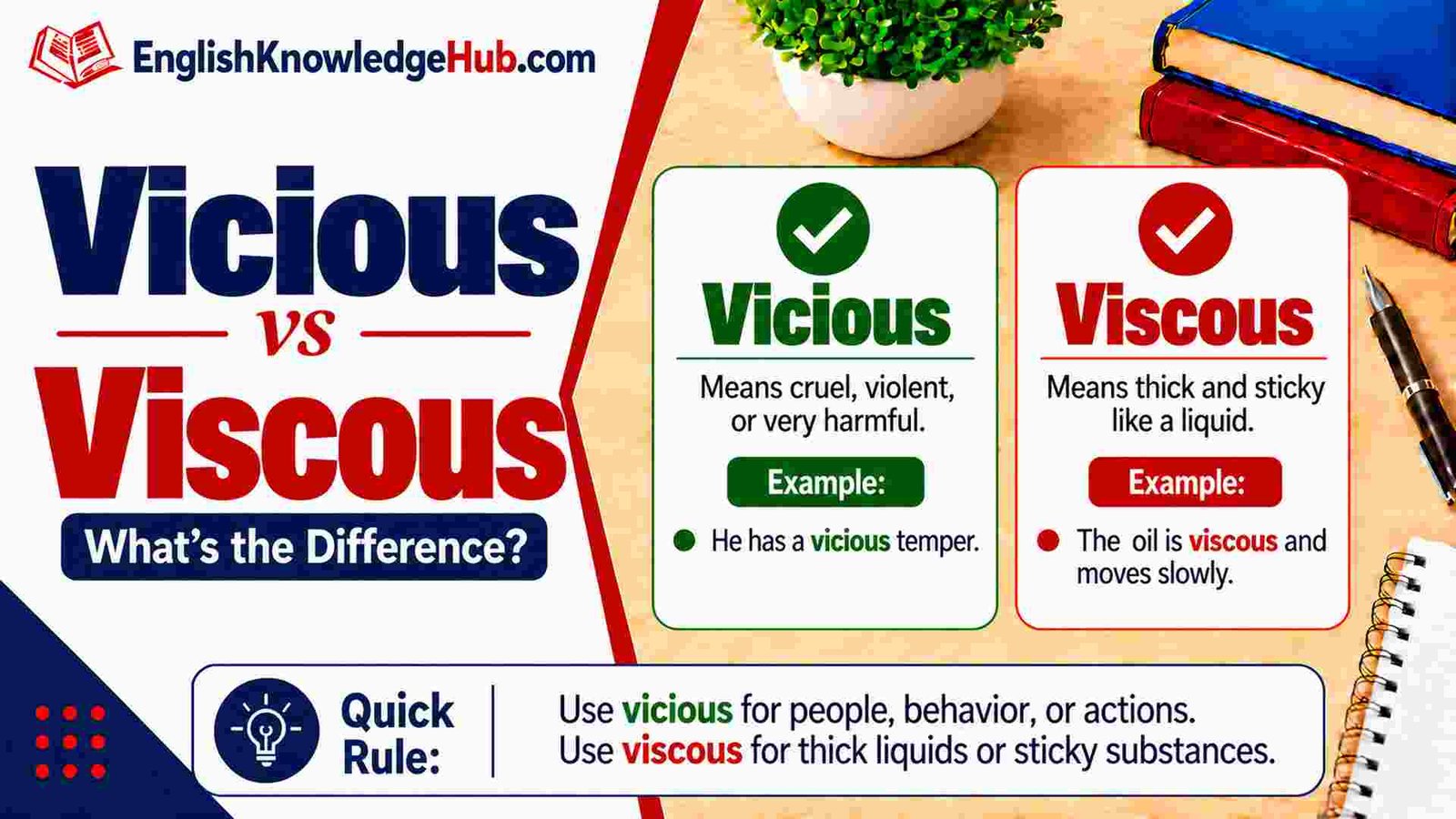
Vicious Vs Viscous are two correct words, but they do not mean the same thing. Vicious means cruel, dangerous, or harmful. Viscous means thick and slow to flow, like syrup or thick oil. This guide will show you their meanings, pronunciation, uses, and easy ways to remember which word you need.
Here is the short rule:
Vicious = cruel or harmful
Viscous = thick and slow-flowing
Think about these two sentences:
The dog became vicious.
The dog became dangerous or aggressive.
The oil became viscous.
The oil became thick and did not flow easily.
That is the main difference.
Are Vicious and Viscous Both Correct Words?
Yes. Both words are correct English words.
The problem is that they look very much alike.
They are also both adjectives. An adjective is a word that tells us more about a person, animal, place, thing, or idea.
For example:
a vicious dog
Here, vicious tells us what the dog is like.
a viscous liquid
Here, viscous tells us what the liquid is like.
Vicious Vs Viscous: The words may look close, but you cannot normally switch one for the other.
| Word | Easy meaning | Simple example |
|---|---|---|
| Vicious | Cruel, harmful, or dangerous | a vicious attack |
| Viscous | Thick and hard to pour | viscous oil |
What Does Vicious Mean?
Vicious means very cruel, violent, harmful, or dangerous.
Cambridge uses the word for people or actions that show a wish to hurt someone badly.
You can use vicious for a person:
The vicious man shouted threats at the shop owner.
You can use it for an animal:
The farmer kept the vicious dog behind a strong gate.
You can use it for an action:
The town was shocked by the vicious attack.
You can also use it for hurtful words:
She ignored the vicious comments online.
The comments did not cause physical harm, but they were very cruel.
Vicious Can Mean Very Harsh
Sometimes vicious means very bad, harsh, or strong.
For example:
A vicious storm knocked down several trees.
The storm is not a cruel person. The word tells us that the storm was very strong and harmful.
Another example:
He had a vicious headache after the long trip.
Here, vicious means very painful or severe.
This use is stronger than simply saying bad.
What Does Viscous Mean?
Viscous is mainly used for a liquid that is thick and does not flow easily.
Cambridge describes a viscous liquid as thick and sticky and not easy to flow. Merriam-Webster also connects the word with thickness and resistance to flow.
Think about water.
Water pours very fast.
Now think about thick syrup.
Syrup pours more slowly.
We can say:
The syrup is viscous.
Other things can also be viscous:
- thick oil
- some paints
- melted materials
- thick sauces
- some kinds of glue
- thick mixtures
For example:
The cold oil was too viscous to pour quickly.
The cook stirred the viscous sauce with a spoon.
The worker added water because the paint was too viscous.
Vicious Vs Viscous: A Very Easy Picture to Keep in Your Mind
Imagine two scenes.
In the first scene, a dog is growling and trying to bite.
That dog may be vicious.
In the second scene, you slowly pour thick syrup from a bottle.
That syrup is viscous.
So remember:
Biting and hurting = vicious
Thick and pouring slowly = viscous
This small picture can help you choose the right spelling.
Vicious Vs Viscous: How Do You Pronounce Them?
The words do not sound the same.
Vicious
Pronounce it like:
VISH-us
The middle sounds like sh.
Cambridge gives the pronunciation as /ˈvɪʃ.əs/.
Viscous
Pronounce it like:
VIS-kus
You can hear an sk sound in the middle.
Cambridge gives the pronunciation as /ˈvɪs.kəs/.
Say them slowly:
VISH-us
VIS-kus
The sound can help you remember the spelling.
What Does “Vicious Cycle” Mean?
You may often hear the words vicious cycle.
A vicious cycle is a bad situation that keeps making itself worse.
Here is a simple example.
Ben stays awake too late.
Then he feels tired at school.
Because he feels tired, he does not finish his work.
He becomes worried about the unfinished work.
The worry makes it harder for him to sleep.
Now the same problem starts again.
That is a vicious cycle.
The word vicious works here because the cycle causes harm.
Do not write viscous cycle when you mean this kind of problem. A cycle is not a thick liquid.
What Is Viscosity?
The noun related to viscous is viscosity.
Do not worry about the long word. Its basic idea is easy.
Viscosity tells us how easily a fluid flows.
A thick fluid that moves slowly has higher viscosity than a thin fluid that moves easily.
Cambridge explains viscosity as the quality of being viscous and, in science, as how much a fluid resists flowing.
For example:
The class tested the viscosity of two liquids.
They may compare how fast water and syrup move.
You do not need to use the word viscosity in normal daily talk very often. It appears more in science, engineering, food work, and other technical subjects.
Easy Examples from Daily Life
Here are a few simple examples.
The vicious dog barked at everyone near the gate.
Vicious means dangerous or aggressive.
Mia was hurt by the vicious joke.
The joke was very cruel.
The honey became more viscous in the cold room.
The honey became thicker and moved more slowly.
This sauce is too viscous to pour from the small bottle.
The sauce is very thick.
Examples at Work
Both words can also appear at work.
The manager asked both workers to stop the vicious argument.
The argument had become angry and hurtful.
The company took action after a vicious online attack on an employee.
The attack was cruel or harmful.
The machine can pump viscous liquids.
The machine can move thick fluids.
The engineer checked whether the oil was too viscous for the system.
The engineer checked the thickness and flow of the oil.
Examples in School and Academic Writing
You may see viscous more often in science lessons.
The students watched a viscous fluid move down the tube.
The study looked at how heat changed the viscous material.
You may see vicious in writing about people, behavior, history, or society.
The writer described the vicious fight between the two groups.
The report looked at the harm caused by vicious online messages.
Vicious Vs Viscous: Common Mistakes
Mistake 1
Incorrect:
The dog became viscous when strangers came near.
Correct:
The dog became vicious when strangers came near.
Explanation:
The sentence talks about dangerous behavior. Use vicious. Viscous describes a thick fluid.
Mistake 2
Incorrect:
The mechanic said the vicious oil was hard to pour.
Correct:
The mechanic said the viscous oil was hard to pour.
Explanation:
The sentence talks about thick oil. Use viscous.
Mistake 3
Incorrect:
Bad sleep can start a viscous cycle.
Correct:
Bad sleep can start a vicious cycle.
Explanation:
A harmful pattern is called a vicious cycle. It has nothing to do with a liquid.
Mistake 4
Incorrect:
The teacher told us that syrup is vicious.
Correct:
The teacher told us that syrup is viscous.
Explanation:
Syrup can be thick and slow to flow. That makes viscous the right word.
One Question Can Help You Pick the Right Word
When you get stuck, ask yourself:
Am I talking about harm or thickness?
If you mean:
- cruel
- dangerous
- violent
- harmful
- very harsh
use vicious.
If you mean:
- thick
- sticky
- slow to pour
- hard to flow
use viscous.
That one question can solve most mistakes.
Vicious and Viscous in British and American English
Both British and American English use these two words.
Their main meanings stay the same.
A British speaker and an American speaker can both use vicious for cruel or harmful behavior.
They can both use viscous for a thick liquid.
Cambridge also gives the same basic pronunciation pattern for the two words in UK and US English.
So you do not need to learn a different rule for each country.
Related Words You May See
It can help to know a few words from the same families.
Viciously
Viciously is an adverb.
It means in a cruel or violent way.
The dog barked viciously at the stranger.
Viciousness
Viciousness is a noun.
It means the quality of being cruel or violent.
The viciousness of the attack shocked the town.
Viscosity
Viscosity is a noun.
It tells us about how much a fluid resists flowing.
The scientist measured the viscosity of the oil.
These related words make the two word families easier to keep apart.
A Quick Memory Trick
Try this:
Vicious has a “sh” sound. Think of a harsh shout.
Viscous has an “sk” sound. Think of science and thick liquids.
You can also remember this tiny rule:
Vicious hurts.
Viscous pours slowly.
It is short, but it gives you the main idea.
Frequently Asked Questions
Is vicious the same as viscous?
No. Vicious means cruel, dangerous, or harmful. Viscous means thick and slow to flow.
Which is correct, vicious dog or viscous dog?
Vicious dog is correct when the dog is aggressive or dangerous.
A dog is not normally called viscous because that word describes the way a fluid flows.
Is honey vicious or viscous?
Honey can be viscous because it is thick and flows slowly.
Is it vicious cycle or viscous cycle?
The correct phrase is vicious cycle. It means a bad pattern where one problem causes another problem and makes the first problem worse.
Can a person be viscous?
Not in the normal meaning of the word. We use viscous mainly for liquids, fluids, and similar materials.
A cruel person can be called vicious.
Can words be vicious?
Yes.
A comment, joke, rumor, or attack can be called vicious when it is very cruel or hurtful.
What is the easiest way to remember Vicious Vs Viscous?
Think vicious hurts, viscous flows slowly.
If the sentence is about cruelty or harm, use vicious. If it is about a thick fluid, use viscous.
What is the noun form of viscous?
The noun is viscosity. It refers to how strongly a fluid resists flowing.
Final Thoughts
These two words look close, but their meanings are far apart.
Vicious is about cruelty, danger, harm, or something very harsh.
Viscous is about a fluid that is thick and does not flow easily.
Remember this simple line:
Vicious hurts. Viscous pours slowly.
Once you know that rule, choosing the right word becomes much easier.
Keep learning simple word differences, grammar rules, spelling tips, and everyday English with EnglishKnowledgeHub.com.
