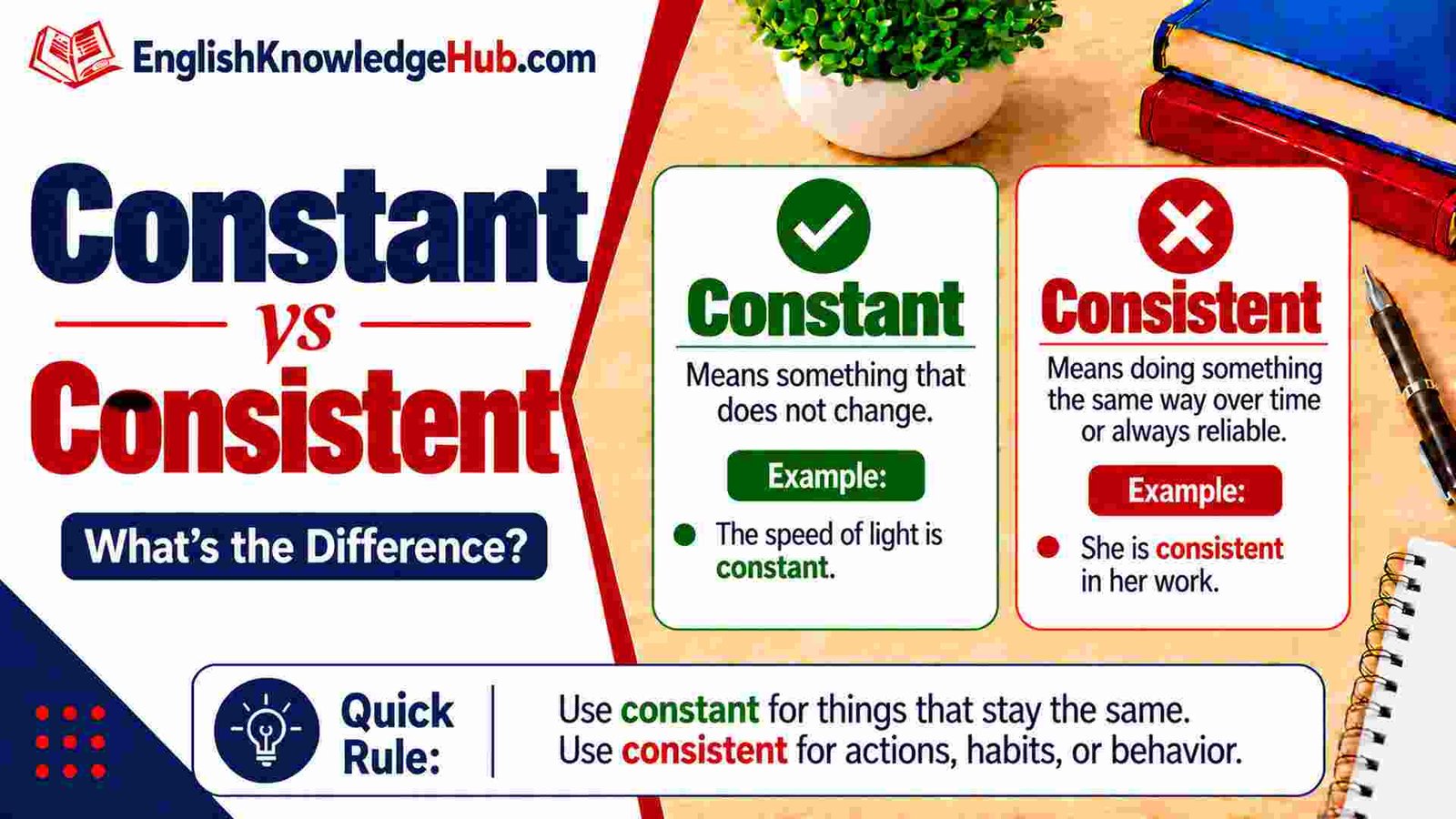
Constant Vs Consistent describes two different kinds of steadiness. Constant usually means something keeps happening, happens very often, or stays at the same level. Consistent means something happens in a regular, reliable, or similar way over time. Both words can look similar, but choosing the right one depends on the meaning you want.
For example, a loud fan may make a constant noise because the noise does not stop.
A student may show consistent effort because the student keeps working hard each week.
The easiest way to remember the difference is:
Constant = keeps going or stays fixed.
Consistent = keeps following a regular pattern.
What Does Constant Mean?
The word constant is usually an adjective.
It can have two main meanings.
First, it can describe something that continues for a long time or happens very often.
Examples:
- constant rain
- constant noise
- constant calls
- constant pain
- constant questions
- constant movement
The constant barking woke everyone in the house.
Here, the barking kept happening.
She received constant phone calls during the morning.
The calls came again and again.
Second, constant can mean that something stays at the same level, amount, or value.
Keep the oven at a constant temperature.
This means the temperature should not change.
The car moved at a constant speed.
Its speed stayed the same.
So, constant does not always mean only “unchanging.” It can also mean something continues or happens again and again.
What Does Consistent Mean?
Consistent usually means regular, reliable, or similar over time.
It often describes:
- effort
- work
- habits
- quality
- behavior
- results
- performance
- progress
Sara makes consistent progress in reading.
She keeps improving in a steady way.
The shop gives consistent service every week.
Customers usually receive the same good level of service.
His test scores have been consistent this term.
His results are fairly similar each time.
Something does not need to happen every minute to be consistent.
For example, a child may read for twenty minutes every night. The child is consistent because the habit happens regularly.
The child is not reading constantly because the reading stops after twenty minutes.
Constant Vs Consistent in a Simple Table
| Word | Main Meaning | Simple Idea | Example |
|---|---|---|---|
| Constant | Continuing or staying fixed | It keeps going or does not change | The machine made a constant sound. |
| Consistent | Regular, reliable, or similar | It keeps following a pattern | Mia showed consistent effort. |
A quick question can help:
Does it keep going or stay at one level?
Use constant.
Does it happen in a regular or dependable way?
Use consistent.
The Difference Is Easy to See With the Same Noun
Some nouns can be used with both words.
The meaning changes depending on which adjective you choose.
Constant Effort and Consistent Effort
Constant effort suggests that the effort continues almost all the time.
The rescue team made a constant effort to clear the flooded road.
They kept working for a long time.
Consistent effort means regular effort over time.
Leo made consistent effort on his writing skills each week.
He did not work every minute. He simply kept practicing.
For school, work, exercise, and long-term goals, consistent effort is often the more natural phrase.
Constant Communication and Consistent Communication
Constant communication means communication happens very often or almost all the time.
The pilot stayed in constant communication with the control tower.
Contact continued during the flight.
Consistent communication means regular and reliable communication.
A good manager keeps consistent communication with the team.
The manager gives updates and stays in contact regularly.
Constant Speed and Consistent Speed
A constant speed stays exactly the same.
The machine moved at a constant speed of 10 meters per minute.
A consistent speed may change a little but stays close to the same level.
The runner kept a consistent speed for most of the race.
The runner may have gone slightly faster or slower at times, but the pace stayed fairly steady.
Constant Quality and Consistent Quality
Consistent quality is common when talking about products, food, work, or service.
Customers like the café because it offers consistent quality.
The food is not exactly identical every day, but the standard stays good.
Constant quality may sound more exact or technical because it suggests the quality does not change at all.
In normal business English, consistent quality is often the better choice.
A Very Useful Meaning of “Consistent With”
There is another important use of consistent.
The phrase consistent with means that one thing agrees with or matches another thing.
The student’s answer was consistent with the facts.
The answer matched the facts.
The new rule is consistent with school policy.
The rule agrees with the policy.
The results were consistent with the teacher’s prediction.
The results matched what the teacher expected.
You cannot use constant with in this meaning.
Incorrect:
The report is constant with the evidence.
Correct:
The report is consistent with the evidence.
Explanation:
Use consistent with when two ideas, facts, actions, or results agree.
Why “Constant Change” Is Correct
Some learners see the phrase constant change and think it must be wrong.
It is correct.
Remember that constant can also mean something keeps happening.
The town went through constant change during the building project.
This means changes happened again and again.
The changes were not all the same. The act of changing kept happening.
Other common examples include:
- constant travel
- constant movement
- constant complaints
- constant questions
- constant updates
So, do not think constant always means that nothing changes.
Its meaning depends on the sentence.
Constant Vs Consistent: Common Mistakes Learners Make
Mistake 1: Using Constant for a Regular Habit
Incorrect:
Emma is constant with her daily reading.
Correct:
Emma is consistent with her daily reading.
Explanation:
Her reading follows a regular habit. It does not continue all day. Consistent is the better word.
Mistake 2: Using Consistent for an Exact Fixed Number
Less precise:
The machine kept the heat consistent at exactly 80°C.
Better:
The machine kept the heat constant at exactly 80°C.
Explanation:
The number must stay exactly the same. Constant is more precise.
Mistake 3: Using Constant When You Mean Regular Contact
Incorrect for the intended meaning:
Our company needs constant emails to customers every month.
Better:
Our company needs consistent communication with customers.
Explanation:
You probably mean regular communication, not emails every minute of the day.
Mistake 4: Using Constant With “With”
Incorrect:
His story was constant with the video.
Correct:
His story was consistent with the video.
Explanation:
Consistent with means the story and video agree.
Mistake 5: Thinking Consistent Means Exactly the Same
Incorrect idea:
Her scores changed by two points, so they were not consistent.
Better understanding:
Her scores stayed consistent even though they changed slightly.
Explanation:
Consistent does not always mean identical. Small changes can still form a steady pattern.
Constant Vs Consistent: Daily Conversation Examples
The constant buzzing from my phone was annoying.
The buzzing kept happening.
Jake is consistent about walking his dog every evening.
He follows the same routine.
We had constant rain during the afternoon.
The rain continued for a long time.
Nora has been consistent with her bedtime this week.
She goes to bed at a regular time.
Workplace Examples
The machine needs constant attention while it is running.
Someone must watch it almost all the time.
Our team needs consistent updates from the project manager.
The updates should come regularly.
The company has delivered consistent service for years.
Its service stays at a reliable level.
Constant interruptions made the meeting difficult.
People kept interrupting.
Academic Examples
The students showed consistent improvement during the term.
Their progress followed a steady pattern.
The experiment required a constant temperature.
The temperature had to stay the same.
The second result was consistent with the first result.
The two results agreed.
The researchers kept the amount of water constant.
The amount did not change during the test.
Formal Writing Examples
The department has maintained consistent standards across all offices.
Constant pressure may damage the material over time.
The evidence is consistent with the final conclusion.
The system must keep the voltage constant during testing.
Both words work well in formal writing when they match the intended meaning.
Constantly and Consistently Are Different Too
The difference also appears in the adverbs constantly and consistently.
Constantly means very often or almost all the time.
My neighbor’s dog is constantly barking.
The barking happens again and again.
Consistently means regularly or reliably.
Ava consistently finishes her homework before dinner.
She follows the same good habit.
Compare these sentences:
He constantly checks his phone.
He checks it very often.
He consistently checks his work before sending it.
He regularly checks his work as part of a good habit.
That is a useful difference.
Is Constant a Noun Too?
Yes.
Constant can also be a noun, especially in mathematics and science.
A constant is a number or value that does not change in a certain situation.
For example:
The value stayed the same, so it was treated as a constant.
The word can also describe something that remains an important part of life.
Music has been a constant in her life.
Here, music has always been present.
Consistent is normally used as an adjective.
Its related noun is consistency.
Her consistency helped her improve.
Its adverb form is consistently.
She consistently arrives on time.
Which Word Should You Use?
The easiest way to solve Constant Vs Consistent is to replace the word with a simpler idea.
If you mean:
- nonstop
- continuing
- happening very often
- fixed
- unchanged
choose constant.
If you mean:
- regular
- reliable
- steady in quality
- following a pattern
- matching something else
choose consistent.
Try this sentence:
He made ___ progress for six months.
You mean regular, steady progress.
Use consistent.
Now try:
The room had a ___ humming sound.
You mean the sound kept going.
Use constant.
One more:
The temperature remained ___ at 20°C.
You mean it did not change.
Use constant.
And:
Her statement was ___ with the report.
You mean it matched the report.
Use consistent.
Is There a British and American English Difference?
There is no important difference in the main meanings.
British English and American English both use constant for things that continue or stay fixed.
Both also use consistent for regular behavior, reliable quality, similar results, and agreement with something.
The pronunciation may sound a little different between speakers, but the grammar rule stays the same.
Frequently Asked Questions
Is constant the same as consistent?
No. Constant usually means something continues or stays unchanged. Consistent means something follows a regular, reliable, or similar pattern.
Is it better to say constant effort or consistent effort?
Consistent effort is usually better for learning, fitness, work, or long-term goals. It means you keep making an effort regularly.
Can something be consistent but not constant?
Yes. A person who studies for thirty minutes every evening is consistent, but the person does not study constantly.
Can something be constant but not consistent?
Yes. Noise may continue all day but change in volume and type. It can be constant without being very consistent.
What does consistent with mean?
It means that something agrees with or matches something else.
The answer is consistent with the evidence.
Should I say constant progress or consistent progress?
Consistent progress is usually more natural when improvement happens regularly over time.
Does consistent mean perfect?
No. Something can be consistent without being perfect. It only needs to stay reliable or follow a similar pattern.
What is the main difference between constantly and consistently?
Constantly means very often or almost all the time. Consistently means regularly and reliably.
Final Rule to Remember
The main difference in Constant Vs Consistent is simple.
Use constant when something keeps happening or stays at the same level.
Use consistent when something happens in a regular, dependable, or similar way.
A constant sound keeps going.
A consistent habit keeps returning.
A constant temperature stays fixed.
Consistent work keeps a reliable standard.
Once you focus on continuation or fixed value for constant and regular pattern or reliability for consistent, choosing the right word becomes much easier.
For more simple word comparisons, grammar help, and easy English lessons, visit EnglishKnowledgeHub.com and keep building your English one clear rule at a time.
