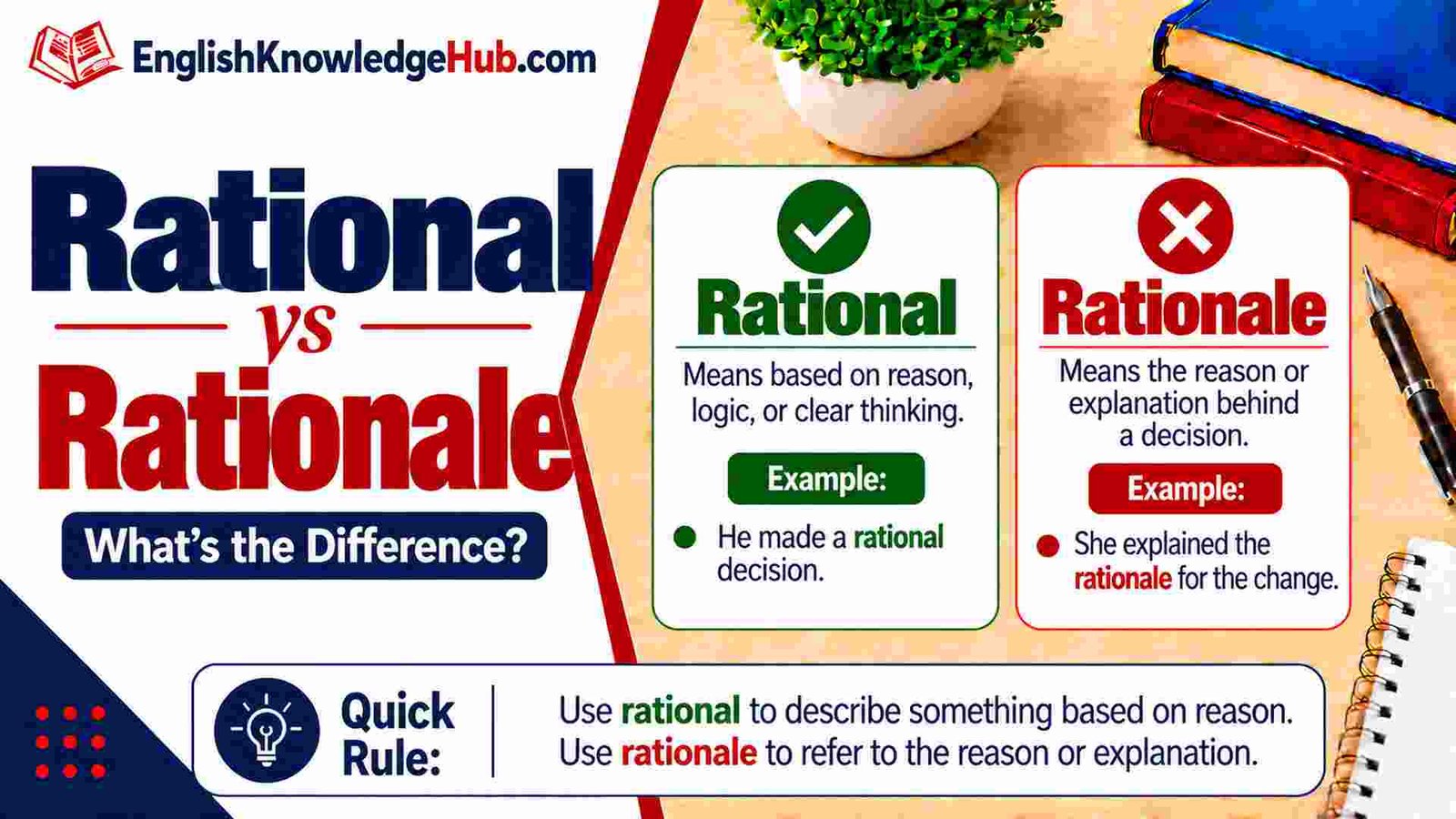
Rational Vs Rationale is easy to understand once you know their jobs. Rational means logical or based on good thinking. Rationale means the reason behind a choice, plan, or action. You can make a rational choice, but you explain the rationale for that choice. This guide shows how to use both words correctly.
These two words look very similar. They also come from the same idea of using reason. However, they do different jobs in a sentence.
Rational usually describes something.
Rationale names the reason behind something.
For example:
Taking a coat was a rational choice because it was cold.
My rationale for taking a coat was the cold weather.
The first sentence tells us what kind of choice it was.
The second sentence tells us why the choice was made.
Rational Means Logical or Sensible
Rational is usually an adjective.
An adjective describes a person, thing, idea, action, or choice.
Rational means that something comes from clear thinking instead of fear, anger, or another strong feeling.
You can say:
- a rational choice
- a rational person
- a rational plan
- a rational thought
- a rational answer
- a rational decision
Here is a simple example:
Ben made a rational choice and saved some money for later.
The word rational describes Ben’s choice. His choice was sensible.
Another example:
We need a rational plan before we start the project.
The plan should make sense and be based on good thinking.
Rationale Means the Reason Behind Something
Rationale is a noun.
A noun can name a person, place, thing, idea, or reason.
Rationale means the reason or thinking that explains why someone did something.
For example:
Sara explained her rationale for leaving early.
This means Sara explained why she left early.
Another example:
The teacher gave the rationale for changing the class rules.
The teacher explained the reason behind the change.
Rationale is more common in formal writing, school work, business, reports, and serious discussions. In everyday speech, people often use the simpler word reason.
Compare:
What is your reason for doing that?
What is your rationale for doing that?
Both can be correct. The second sounds more formal.
Rational Vs Rationale: The Main Difference in One Table
| Word | Word Type | Simple Meaning | Example |
|---|---|---|---|
| Rational | Adjective | Logical or sensible | It was a rational choice. |
| Rationale | Noun | The reason behind something | Explain your rationale. |
The easiest rule is:
Rational = logical
Rationale = reason why
That small rule can help you choose the correct word very quickly.
How to Use Rational in a Sentence
Use rational when you want to describe something as sensible or logical.
With a Person
Mia stayed rational during the problem.
This means Mia stayed calm and used clear thinking.
With a Choice
Buying the cheaper notebook was a rational choice.
The choice made sense.
With a Plan
We need a rational plan for saving water.
The plan should be sensible.
With an Answer
His answer sounded rational.
His answer made sense.
At Work
The team found a rational way to lower costs.
The method was sensible and logical.
At School
Emma gave a rational answer to the science question.
Her answer followed clear thinking.
How to Use Rationale in a Sentence
Use rationale when you want to talk about the reason behind a choice, action, rule, plan, or idea.
In Daily Life
My rationale for walking was that the shop was close.
The sentence explains why the person chose to walk.
At Work
The manager explained the rationale for the new schedule.
The manager explained why the schedule changed.
At School
The student gave a clear rationale for choosing that topic.
The student explained the reason for the choice.
In Formal Writing
The report explains the rationale behind the new rule.
The report explains why the rule exists.
Rational Vs Rationale: A Very Easy Memory Trick
When you are unsure about Rational Vs Rationale, ask yourself one question:
Am I saying something is logical, or am I giving the reason why?
If you mean logical, use:
rational
a rational idea
If you mean the reason why, use:
rationale
the rationale for the idea
You can also try two replacement words.
Replace rational with logical:
That was a rational plan.
That was a logical plan.
Both make sense.
Now replace rationale with reason:
What is your rationale for leaving?
What is your reason for leaving?
Again, both make sense.
This is one of the easiest ways to check your sentence.
Common Mistake: Using Rational Instead of Rationale
A very common mistake is using rational when the sentence needs a noun.
Incorrect:
What was your rational for changing the plan?
Correct:
What was your rationale for changing the plan?
Explanation:
The sentence asks for a reason. Rationale means reason or thinking behind something. Rational does not have that meaning in normal everyday use.
Here is another one.
Incorrect:
The boss explained his rational for the new rule.
Correct:
The boss explained his rationale for the new rule.
Explanation:
The boss is explaining why the rule was made. That means we need the noun rationale.
Common Mistake: Using Rationale as an Adjective
Some learners make the opposite mistake.
Incorrect:
It was a rationale decision.
Correct:
It was a rational decision.
Explanation:
The word describes the decision. We need an adjective, so rational is correct.
Another example:
Incorrect:
She gave a rationale answer.
Correct:
She gave a rational answer.
Explanation:
The answer is being described as logical. Use rational.
Rational Decision or Rationale for a Decision?
Both phrases can be correct, but they mean different things.
A rational decision is a sensible decision.
Choosing the safer road was a rational decision.
A rationale for a decision is the reason behind the decision.
Safety was the main rationale for choosing that road.
This is an important part of understanding Rational Vs Rationale.
One word describes the decision.
The other explains why the decision was made.
Rationale For or Rationale Behind?
Both rationale for and rationale behind are correct.
You can say:
What is the rationale for this rule?
You can also say:
What is the rationale behind this rule?
Both sentences ask why the rule exists.
Here are more examples:
The teacher explained the rationale for giving less homework.
The teacher explained the rationale behind giving less homework.
The meaning is almost the same.
Is Rationale the Same as Reason?
Rationale and reason are close in meaning, but they are not always used in the same way.
Reason is very common and simple.
What is your reason for leaving?
Rationale sounds more formal.
What is your rationale for leaving?
You may see rationale more often in:
- school papers
- business reports
- research
- company rules
- official plans
- formal discussions
In normal conversation, reason often sounds more natural.
For example:
Why did you leave early?
This sounds very natural in daily speech.
What was your rationale for leaving early?
This sounds more formal.
Rational and Reasonable Are Not Always the Same
Rational and reasonable can sometimes have a similar meaning.
However, they are not always the same.
Rational mainly means logical.
Her plan was rational.
Reasonable can mean fair, sensible, or not too much.
The shop charged a reasonable price.
Here, reasonable price means a fair price.
We would not normally say:
a rational price
So, do not treat rational and reasonable as perfect replacements.
Rationale and Justification
Rationale and justification can also seem similar.
A rationale explains the thinking behind an action.
He explained the rationale for the rule.
A justification gives a reason to show why something is right or acceptable.
She gave a justification for missing the meeting.
The two words can overlap, but rationale usually focuses more on the thinking or reason behind a choice.
Can Rationale Be Plural?
Yes.
The plural of rationale is rationales.
Singular:
The teacher gave one rationale for the change.
Plural:
The teachers gave several rationales for the change.
You may not use the plural form very often, but it is correct English.
Can Rational Be a Noun?
In normal everyday English, rational is mainly an adjective.
However, there is a special use in mathematics.
A rational number is a number that can be written as a fraction of two whole numbers.
In some math writing, people may also use rational as a noun when talking about rational numbers.
This special math use does not change the normal grammar rule.
If you mean the reason behind a decision, use rationale.
How Do You Pronounce Rational and Rationale?
The words look similar, but they sound different.
Rational sounds roughly like:
RASH-uh-nuhl
Rationale sounds roughly like:
rash-uh-NAL
The ending of rationale is stronger.
The spelling is the same in British and American English, though pronunciation may sound a little different depending on the speaker.
More Common Errors to Avoid
Incorrect:
Her rationale thinking helped solve the problem.
Correct:
Her rational thinking helped solve the problem.
Explanation:
Thinking is being described as logical, so we need rational.
Incorrect:
I do not understand the rational behind this rule.
Correct:
I do not understand the rationale behind this rule.
Explanation:
The speaker wants to know the reason for the rule. Use rationale.
Incorrect:
Staying home during the storm was a rationale choice.
Correct:
Staying home during the storm was a rational choice.
Explanation:
The word describes the choice as sensible. Use rational.
Incorrect:
Please give a rational for your answer.
Correct:
Please give a rationale for your answer.
Explanation:
The sentence asks for the reason behind the answer. Use rationale.
A Simple Three-Second Test
If you still get stuck with Rational Vs Rationale, use this quick test.
Ask:
Can I replace the word with “logical”?
If yes, choose rational.
a rational idea
a logical idea
Ask:
Can I replace the word with “reason”?
If yes, choose rationale.
explain your rationale
explain your reason
That is usually all you need.
Frequently Asked Questions
Is rational or rationale correct?
Both are correct words. Use rational when you mean logical or sensible. Use rationale when you mean the reason behind something.
What is the simple meaning of rational?
Rational means logical, sensible, or based on clear thinking.
What is the simple meaning of rationale?
Rationale means the reason or thinking behind a choice, rule, plan, or action.
Is it “rational for the decision” or “rationale for the decision”?
Use rationale for the decision when you mean the reason behind the decision.
You can say rational decision when you mean the decision was logical.
Is “rationale behind” correct?
Yes. Rationale behind is correct.
Example:
She explained the rationale behind the change.
Can I say “my rationale”?
Yes.
Example:
My rationale was simple. I wanted to save time.
Is rationale formal?
Yes, it often sounds more formal than reason. It is common in school, business, research, reports, and official writing.
What is the easiest way to remember Rational Vs Rationale?
Remember:
Rational = logical
Rationale = reason why
Final Rule
The difference between these words is simple once you focus on grammar.
Use rational when you describe something as logical or sensible.
It was a rational choice.
Use rationale when you talk about the reason behind something.
She explained the rationale for her choice.
If logical fits, choose rational.
If reason fits, choose rationale.
Keep this small rule in mind, and choosing the correct word will become much easier.
For more simple grammar lessons, word comparisons, and easy English examples, keep learning with EnglishKnowledgeHub.com.
