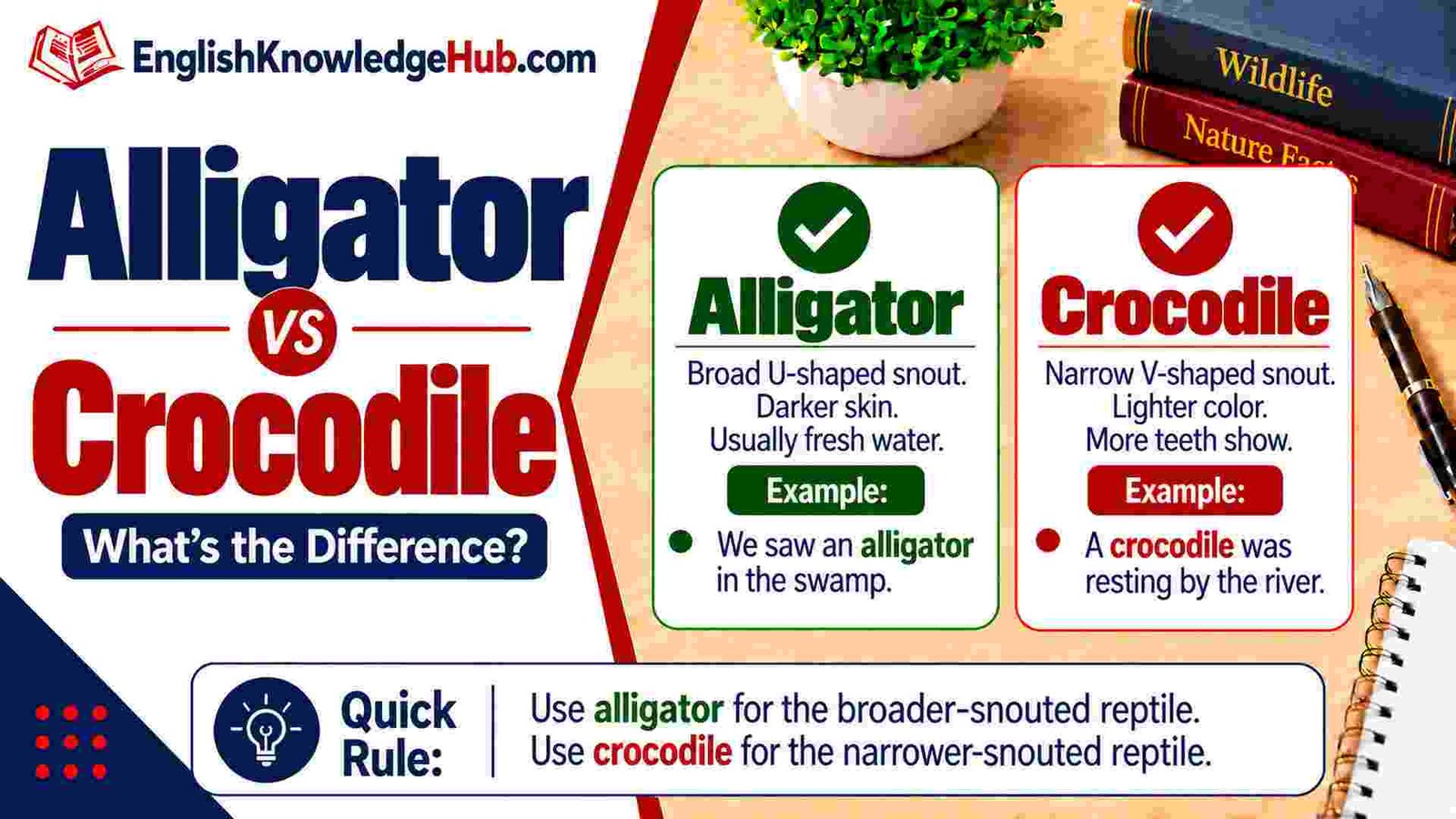
Alligator vs Crocodile is easy to understand when you look at the face, teeth, and home of each animal. An alligator usually has a wide, round snout and lives mostly in fresh water. A crocodile often has a narrower, pointed snout and can handle salty water better. You can also check their teeth and color.
They may look like the same animal from far away. Both have long bodies, strong tails, short legs, sharp teeth, and thick skin.
But they are not the same animal.
Learning a few simple clues can help you tell them apart in a photo, book, zoo, or nature show.
Alligator vs Crocodile at a Glance
Here are the easiest differences to remember:
| Feature | Alligator | Crocodile |
|---|---|---|
| Snout | Wide and round | Narrower and pointed |
| Snout shape | Often looks like a U | Often looks like a V |
| Lower teeth | Mostly hidden when mouth is shut | Some lower teeth can be seen |
| Color | Often dark gray or black | Often lighter gray, green, or brown |
| Water | Likes fresh water most | Can live in fresh, salty, or mixed water |
| Head | Usually wider | Usually narrower |
| Where found | Mainly U.S. and China | Found in many warm parts of the world |
These clues work well, but nature does not always follow perfect shapes. Some crocodile species can have wider snouts than others.
Start With the Nose
The snout is the long front part of the animal’s head.
It is one of the easiest things to check.
An alligator usually has a wide and rounded snout. From above, it may look like the letter U.
A crocodile often has a longer, narrower snout. It may look more like the letter V.
The Smithsonian describes the American alligator as having a long, rounded snout. Florida wildlife experts also use the wider alligator snout and the narrower crocodile snout as useful ways to tell the two animals apart.
A simple memory trick is:
Alligator = rounder nose
Crocodile = pointier nose
Do not worry about making a perfect U or V in your mind. Just ask, “Does the nose look wide or narrow?”
That is often enough to give you a good clue.
The Teeth Tell Another Part of the Story
The teeth can also help.
Look at the animal when its mouth is closed.
On an alligator, most of the lower teeth are hidden. One large lower tooth fits into a space in the upper jaw, so you normally do not see it from the side.
A crocodile is different.
When its mouth is closed, you can often see teeth from both the top and bottom jaws. Florida wildlife experts point to the visible fourth lower tooth as an important clue for the American crocodile.
Remember it this way:
Alligator: fewer lower teeth show.
Crocodile: more teeth show.
Of course, never walk close to a wild animal just to look at its teeth. A photo or safe viewing spot is much better.
Their Homes Are Different Too
Water gives us another clue.
American alligators usually live in fresh water. They are often found in:
- Ponds
- Lakes
- Swamps
- Marshes
- Slow rivers
The Smithsonian says American alligators are usually found in freshwater areas and can only handle salt water for short periods.
Crocodiles can deal with salty water much better.
For example, American crocodiles often live near the coast. They may live in salty water or brackish water, which is water that has both fresh water and salt water in it. They can also enter freshwater areas.
So do not learn this rule:
Alligator = only fresh water
Crocodile = only salt water
That rule is too strict.
A better rule is:
Alligators prefer fresh water. Crocodiles can usually handle salty water better.
Color Can Give You a Clue
You may also notice a color difference.
Adult American alligators often look very dark. Their skin may look dark gray or almost black.
American crocodiles often look lighter. Their skin may look gray, gray-green, or brownish.
Florida wildlife experts use color as one way to help tell the American alligator and American crocodile apart.
Still, do not use color by itself.
Mud, sunlight, water, age, and shadows can change how an animal looks.
A dark crocodile does not suddenly become an alligator.
Use color with other clues, such as the snout and teeth.
Alligator vs Crocodile: Which Animal Is Bigger?
People often think every crocodile is bigger than every alligator.
That is not true.
There are different kinds of crocodiles, and they do not all grow to the same size. Age and sex also matter.
An adult male American alligator is about 11.2 feet long on average, according to the Smithsonian. Females are smaller on average. Very large males can grow even bigger.
Some crocodile species can grow much larger than an American alligator. Other crocodile species stay smaller.
So size is not the best way to name the animal.
A big reptile is not always a crocodile.
A smaller one is not always an alligator.
Check the head first.
Where Do Alligators Live?
There are two living species that we usually call alligators.
They are:
- The American alligator
- The Chinese alligator
American alligators live in the southeastern United States.
Chinese alligators are native to China. They are much smaller than American alligators and live mainly in slow-moving freshwater areas near the lower Yangtze River.
Crocodiles live across a much wider part of the world.
Different crocodile species live in warm parts of:
- Africa
- Asia
- Australia
- North America
- Central America
- South America
This means the place where you see the animal may also help you identify it.
Florida Has Both Animals
Florida is special because wild American alligators and American crocodiles both live there.
In fact, the Florida Fish and Wildlife Conservation Commission says Florida is the only place in the world where alligators and crocodiles naturally live together in the wild.
Alligators are found across much more of the state.
American crocodiles are mainly found in the coastal areas of South Florida and the Florida Keys.
So if you see a large reptile in Florida, its location alone may not give you the answer.
Check its nose and teeth too.
Are Crocodiles More Dangerous?
Both animals are wild predators.
You may hear people say that crocodiles are always aggressive and alligators are friendly. That is not a safe way to think about them.
Behavior can change from one animal to another.
An animal may also act differently when it is:
- Hungry
- Protecting eggs
- Protecting young
- Feeling trapped
- Used to people feeding it
The Smithsonian warns that both animals can behave in unexpected ways and should be given plenty of space.
The safe rule is simple:
Never go close to either animal in the wild.
Do not feed one.
Do not touch one.
Do not try to take a close photo.
Are “Alligator” and “Crocodile” Two Words for the Same Thing?
No.
This is also important for English learners.
Alligator is the name of one type of reptile.
Crocodile is the name of another type.
Both belong to a larger animal group called crocodilians.
You can think of “crocodilian” as a family-group word.
It includes alligators, crocodiles, and some of their close relatives.
So this sentence is correct:
The zoo keeps several kinds of crocodilians.
That sentence may include both alligators and crocodiles.
But if you know the exact animal, use its exact name.
How to Use the Words in English
Both words are nouns.
Singular
alligator
“The alligator rested beside the pond.”
crocodile
“The crocodile moved slowly into the river.”
Plural
alligators
“We saw two alligators from the boat.”
crocodiles
“The guide told us where crocodiles live.”
The spelling stays the same in both British and American English.
You may also hear the word gator in the United States.
“Gator” is an informal short form of “alligator.”
For example:
“Look, there is a gator near the water.”
That is fine in casual speech.
In school work, reports, or formal writing, alligator is usually the better choice.
Alligator vs Crocodile: Fresh Examples From Everyday English
Here are some simple examples made for this lesson.
Daily conversation
“My brother thought the animal was a crocodile, but its wide nose made me think it was an alligator.”
“We saw an alligator while walking near the lake.”
Workplace example
“The park worker placed a warning sign near the pond after an alligator was seen there.”
School example
“Our class compared pictures of crocodiles and alligators.”
“The student drew a wide snout on the alligator.”
Academic example
“The report compares the jaw shape and habitat of the two reptiles.”
Formal writing example
“The animal was identified as an American crocodile because of its narrow snout and visible lower tooth.”
These examples show that the words work like normal animal names in a sentence.
Alligator vs Crocodile: Common Mistakes to Avoid
Mistake 1: Using both names as if they mean the same animal
Incorrect:
Every alligator is a crocodile.
Correct:
Alligators and crocodiles are different kinds of crocodilians.
Explanation:
They are close relatives, but the words name different groups of animals.
Mistake 2: Thinking every alligator lives only in fresh water
Incorrect:
An alligator can never enter salty water.
Correct:
Alligators prefer fresh water, but they can sometimes enter saltier water for a short time.
Explanation:
Fresh water is their main home, but “never” makes the first sentence too strong.
Mistake 3: Naming the animal only by its size
Incorrect:
That animal is huge, so it must be a crocodile.
Correct:
That animal is huge, but we should check its snout and teeth before naming it.
Explanation:
Some alligators grow very large too.
Mistake 4: Thinking “gator” means crocodile
Incorrect:
We saw a crocodile, or gator, at the zoo.
Correct:
We saw an alligator, or gator, at the zoo.
Explanation:
“Gator” is a short, informal word for “alligator,” not crocodile.
A Three-Part Trick You Can Remember
You do not need to learn many hard facts.
Remember these three words:
Nose. Teeth. Water.
Nose:
Wide and round often means alligator. Narrow and pointed often means crocodile.
Teeth:
Most lower teeth hide on an alligator. More lower teeth can be seen on a crocodile.
Water:
Alligators like fresh water most. Crocodiles can handle salty water better.
This quick check works well for most pictures people see.
FAQs
What is the biggest difference between an alligator and a crocodile?
The face is one of the easiest differences to see. Alligators usually have wider, rounder snouts. Crocodiles often have narrower, more pointed snouts.
Which one has a U-shaped snout?
An alligator usually has the wider snout that looks a little like the letter U.
Which one has a V-shaped snout?
A crocodile often has the narrower snout that looks more like the letter V. This is a useful clue, but not every species has the exact same shape.
Can crocodiles live in fresh water?
Yes. Some crocodiles live in fresh water, and others can live in fresh, brackish, or salty water.
Can alligators swim in salt water?
Yes, they can sometimes enter salty water. However, American alligators mainly prefer fresh water and cannot handle salt water as well as crocodiles can.
Which animal shows more teeth?
A crocodile usually shows more lower teeth when its mouth is closed. An alligator’s wider upper jaw hides most of its lower teeth.
Are there both alligators and crocodiles in Florida?
Yes. Florida has both American alligators and American crocodiles living naturally in the wild. Crocodiles are mainly found in South Florida.
Is a gator an alligator or a crocodile?
A gator is an alligator. “Gator” is simply a short and informal form of the word “alligator.”
Final Answer
The easiest way to remember Alligator vs Crocodile is to check the nose, teeth, and water. An alligator normally has a wider, rounder snout, hides most of its lower teeth, and prefers fresh water. A crocodile often has a narrower snout, shows more teeth, and can handle salty water better.
Both are strong wild reptiles, but they are not the same animal. Once you know these simple clues, telling them apart becomes much easier.
For more easy word meanings, comparisons, grammar lessons, and simple English guides, visit EnglishKnowledgeHub.com.
