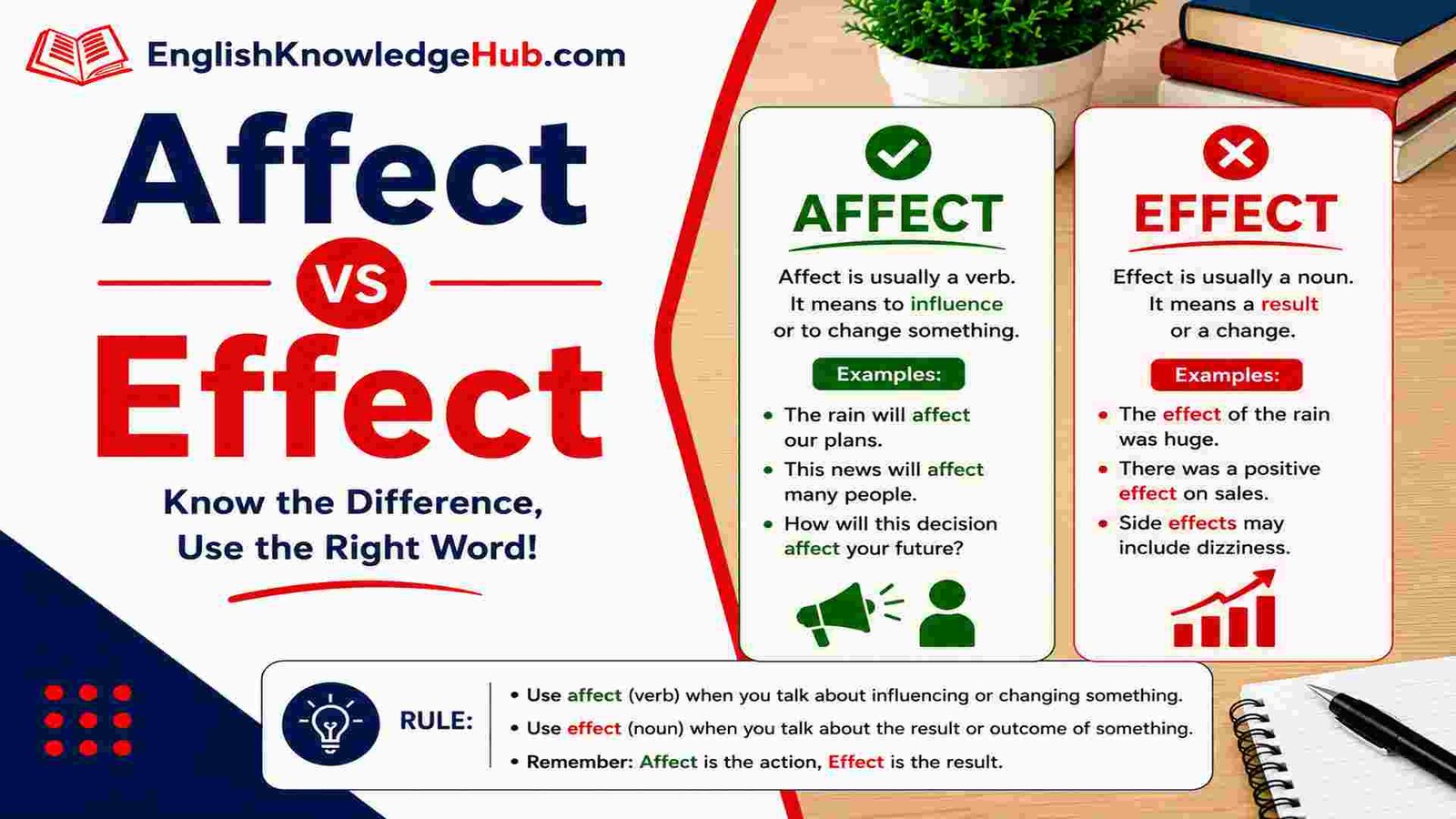
Affect is usually a verb, while effect is usually a noun. Affect normally means to influence or change something: “The weather affected our plans.” Effect normally means the result or change produced: “The weather had an effect on our plans.” This shortcut works in most everyday sentences, but both words have less common uses worth knowing.
In this article, you’ll learn how Affect vs Effect works in real sentences, how pronunciation and sentence structure help, why phrases such as take effect and side effect always use effect, and when the rare verb effect or noun affect appears. Merriam-Webster’s Affect vs Effect guide confirms the practical rule: affect is usually the verb and effect is usually the noun.
The Most Useful Rule: Action vs Result
Think of affect as the action of influencing something and effect as the result that follows.
“Lack of sleep affects concentration.” Here, sleep changes concentration. “Lack of sleep has an effect on concentration.” Here, effect names the result or influence.
That action-result relationship makes the pair easier to remember than spelling alone.
How to Use “Affect” as the Common Verb
Affect usually means influence, change, or have an impact on someone or something.
“The price increase affected demand.” “Cold weather can affect battery life.” “Her comment affected him more than she expected.”
The verb can describe physical, emotional, financial, social, scientific, or practical influence. The object comes directly after the verb: affect people, affect performance, affect results, affect health.
How to Use “Effect” as the Common Noun
Effect usually means a result, consequence, or change caused by something else.
“The medicine had no effect.” “The new rule had an immediate effect on attendance.” “One effect of the storm was a long power outage.”
Common phrases include have an effect on, cause an effect, produce an effect, side effect, special effect, and long-term effect.
“Affect Something” vs “Have an Effect on Something”
These two patterns often express the same basic idea with different grammar.
“The delay affected sales.”
“The delay had an effect on sales.”
The first is shorter and uses the verb. The second uses the noun phrase an effect on. Both are correct.
This gives you an excellent proofreading test: if you can write have an ___ on, the blank is almost always effect.
Take Effect, Go Into Effect, and In Effect
Several fixed phrases always use effect.
Take effect means begin to work or become operative: “The medicine should take effect soon.”
Go into effect means become officially active: “The new policy goes into effect next month.”
In effect can mean currently operating or, in another sense, essentially: “The rule is still in effect.” “The decision was, in effect, a refusal.”
Learning these as complete phrases prevents many spelling mistakes.
Side Effect and Special Effect
A side effect is an additional result, often an unwanted one, especially in medicine but also in general use. A special effect is a visual, sound, or practical effect created for film, entertainment, or presentation.
Both are nouns, so they use effect, not affect.
The Rare Verb “Effect”
Effect can also be a verb, but its meaning is not simply “affect.” As a verb, effect means to cause something to happen, bring it about, or accomplish it.
“The new leadership effected major changes.” This means the leadership caused or brought about the changes.
Compare: “The new leadership affected the changes” would mean it influenced changes that already existed or were happening. “The leadership effected the changes” means it made them happen.
This distinction is uncommon in casual conversation but useful in formal, legal, academic, and business writing.
The Rare Noun “Affect”
Affect can be a noun in psychology and related fields. In this use, it refers to an observable expression of emotion or feeling.
You might read “The patient showed a flat affect.” The pronunciation is also different from the usual verb: the noun typically has stress on the first syllable.
Most general readers will rarely need this sense, but knowing it exists prevents the misleading claim that affect is never a noun.
Affect vs Impact
Impact can also function as a verb or noun in modern English. “The change impacted sales” and “The change had an impact on sales” are common, though some writers prefer affected in formal prose when a simpler verb works.
If you want the clearest general wording, “The change affected sales” is direct and natural.
Common Mistakes and Better Choices
Incorrect: The noise had a bad affect on my sleep.
Correct: The noise had a bad effect on my sleep.
The structure needs a noun after a bad.
Incorrect: The new schedule will effect everyone’s routine.
Correct: The new schedule will affect everyone’s routine.
The meaning is influence or change, so use the common verb affect.
Correct but advanced: The committee effected a major change in policy.
Here effected means brought the change about. Replacing it with affected would change the meaning.
How the Pair Works in Different Contexts
Everyday: “The heat affected my sleep.” “The heat had a noticeable effect on my sleep.”
Workplace: “The outage affected several departments.” “One effect of the outage was delayed processing.”
Academic: “Temperature affected the reaction rate.” “The study measured the effect of temperature on reaction rate.”
Medical: “The medication may affect alertness.” “Drowsiness is a possible side effect.”
A Quick Grammar Test
| Clue | Usually choose | Example |
|---|---|---|
| influence/change as an action | affect | Stress can affect sleep. |
| result/consequence | effect | Stress has an effect on sleep. |
| “an ___ on” | effect | an effect on sales |
| bring about/accomplish | effect (verb) | effect change |
| clinical emotional expression | affect (noun) | flat affect |
The noun-versus-verb shortcut is similar to the one in our Advice vs Advise guide, but remember that affect/effect has two important specialist exceptions.
Frequently Asked Questions
Is affect a verb or noun?
Usually a verb. It can also be a noun in psychology.
Is effect a noun or verb?
Usually a noun. It can also be a verb meaning bring about or accomplish.
Is it “affect me” or “effect me”?
Usually affect me when you mean influence me.
Is it “effect on” or “affect on”?
Use effect on in phrases such as “have an effect on.”
What does “effect change” mean?
It means cause or bring about change.
What does “take effect” mean?
It means begin to work, apply, or become active.
Final Takeaway
For Affect vs Effect, use the practical rule first: affect is usually the action; effect is usually the result. Say “The change affected us” and “The change had an effect on us.” Then remember the two less common exceptions: effect can be a verb meaning bring about, and affect can be a noun in psychology. That gives you an accurate rule without pretending English has no exceptions.
For more practical grammar and word-choice explanations, explore EnglishKnowledgeHub.com.
