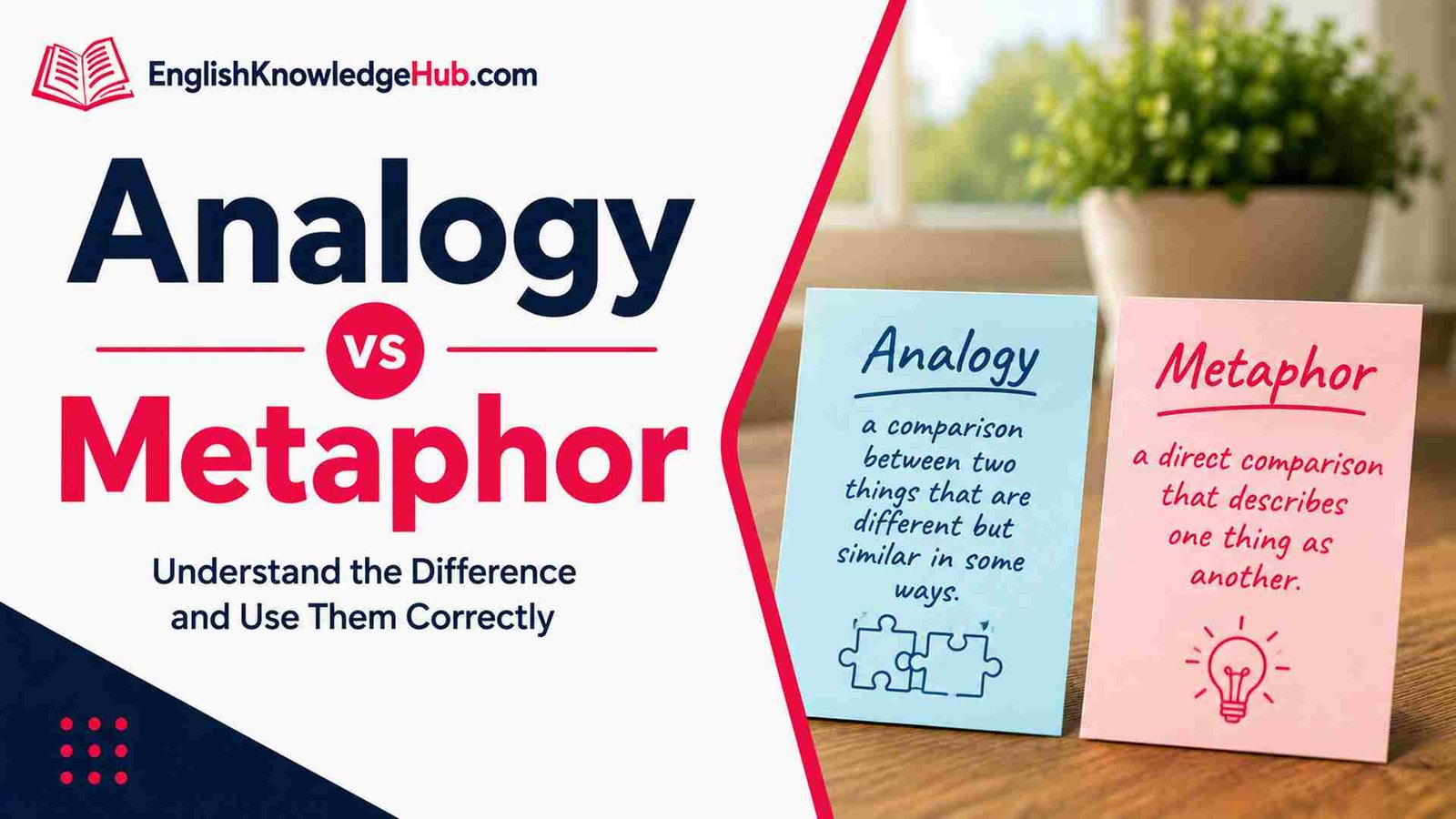
An analogy explains an idea by comparing how two different things are alike, while a metaphor describes one thing as if it were another. An analogy usually gives more detail to help you understand something. A metaphor often creates a strong image or feeling in fewer words.
Still confused? You are not alone. The two tools both use comparison, so they can look very similar at first.
In this guide, you will learn the difference between analogy vs metaphor, see simple examples, understand how they relate to similes, and learn when to use each one.
Analogy vs Metaphor at a Glance
Here is the easiest way to see the difference.
| Feature | Analogy | Metaphor |
|---|---|---|
| Main purpose | Explains an idea | Creates an image or meaning |
| Type | Comparison or reasoning tool | Figure of speech |
| Length | Often a sentence or several sentences | Often a short phrase or sentence |
| How it works | Shows how two things are similar | Says one thing is another |
| Common use | Teaching, explaining, arguing | Stories, poems, speeches, daily language |
| Example | Learning to drive is like learning to ride a bike because practice builds skill. | Life is a journey. |
The key idea is simple: an analogy develops a comparison, while a metaphor expresses a comparison.
Merriam-Webster describes an analogy as a comparison between things that are different but similar in a certain way. It describes a metaphor as a figure of speech that uses one thing in place of another to suggest a likeness.
What Is an Analogy?
An analogy is a comparison used to explain an idea, relationship, or process.
It connects something that may be hard to understand with something more familiar. This makes the first idea easier to picture.
For example:
Learning a language is like building a house. You learn basic words first, just as you build the foundation first. Then you add grammar and longer sentences, just as builders add walls and rooms.
This is an analogy because the comparison does more than create an image. It explains how learning works.
Merriam-Webster also notes that an analogy can support reasoning. If two things share some features, a person may use those shared features to explain or predict another connection.
What Does an Analogy Do?
A good analogy can help you:
- explain a hard idea
- teach a new topic
- show how a process works
- connect new knowledge with familiar knowledge
- support an argument
- make an idea easier to remember
Think about a computer.
Someone might say:
A computer’s memory works a little like a desk. The more space you have available, the more things you can keep ready to use.
The desk is not computer memory. However, comparing the two helps explain the idea.
Simple Analogy Examples
Here are a few easy examples.
| Analogy | What It Explains |
|---|---|
| The brain is like a library because it stores information. | Memory |
| A good team works like a machine because every part has a job. | Teamwork |
| Saving money is like planting a seed because small steps can grow over time. | Saving |
| Learning is like climbing stairs because you move forward one step at a time. | Education |
| A password is like a key because it gives access to something protected. | Online security |
Notice something important?
Many analogies use words such as like or as, but they do not have to. What makes something an analogy is the way the comparison explains a connection.
What Is a Metaphor?
A metaphor is a figure of speech that describes one thing as another thing.
It does not usually mean the statement in a literal way.
For example:
Her voice was music.
Her voice is not really music. The sentence suggests that her voice sounds pleasant, beautiful, or calming.
Merriam-Webster explains that a metaphor connects two things by treating one as the other. This makes metaphor different from a direct literal statement.
What Does a Metaphor Do?
Writers and speakers use metaphors to:
- create a clear picture
- express feelings
- make writing more lively
- describe an idea in fewer words
- add meaning to a sentence
- make readers think about something in a new way
For example:
The classroom was a zoo.
The writer does not mean that the room contained wild animals. The metaphor suggests that the classroom was loud, busy, or hard to control.
Simple Metaphor Examples
| Metaphor | Meaning |
|---|---|
| Time is a thief. | Time takes things away from us. |
| His heart is stone. | He seems cold or uncaring. |
| The world is a stage. | People play different roles in life. |
| Her smile was sunshine. | Her smile felt warm and cheerful. |
| My mind is a blank page. | I cannot think of anything. |
| The news hit me like a wave. | The news caused a strong feeling. |
One note about the final example: because it uses like, many teachers would call it a simile rather than a metaphor. This shows why knowing the difference between these comparison tools matters.
What Is the Main Difference Between an Analogy and a Metaphor?
The main difference is purpose.
A metaphor mainly creates an image or gives an idea extra meaning. An analogy mainly explains how two things are alike.
Here is a simple example.
Metaphor
The internet is a highway.
This creates a picture of information moving from place to place.
Analogy
The internet works like a highway system. Websites are like places, data moves like cars, and network connections act like roads that carry traffic from one point to another.
Now the comparison explains several matching parts.
That is one of the easiest ways to understand analogy vs metaphor.
A metaphor may give you the comparison. An analogy often takes that comparison further and explains it.
Can a Metaphor Be an Analogy?
Sometimes, yes.
A metaphor can form part of a larger analogy.
For example:
Your mind is a garden. Good ideas are seeds. Learning waters those seeds, and practice helps them grow.
The first sentence works as a metaphor.
Once the writer develops the comparison between the mind and a garden, it starts working as an analogy too.
This is why the two terms can overlap. However, they are not exactly the same thing.
Merriam-Webster makes a similar distinction. It explains that an analogy covers the comparison or reasoning itself, while metaphors and similes are forms of expression.
Analogy vs Metaphor vs Simile
Analogy, metaphor, and simile all compare things, but they do different jobs.
| Term | Simple Meaning | Common Clue | Example |
|---|---|---|---|
| Analogy | Explains through comparison | Often gives several matching points | Running a business is like sailing a ship because you need direction and quick choices. |
| Metaphor | Says one thing is another | Often uses “is,” “are,” or direct description | The office is a battlefield. |
| Simile | Says one thing is like another | Often uses “like” or “as” | She runs like the wind. |
What Is a Simile?
A simile compares two things directly, often with “like” or “as.”
For example:
His hands were as cold as ice.
The hands are compared with ice, but the sentence does not say his hands actually are ice.
A metaphor makes the comparison more direct:
His hands were ice.
Merriam-Webster explains that metaphors often treat one thing as another, while similes state that one thing is similar to another.
Can a Simile Also Be an Analogy?
Yes.
A short simile usually gives one quick comparison.
The baby slept like a log.
But a longer comparison can become an analogy:
Starting a new business is like planting a garden. You prepare the ground, plant seeds, care for them, and wait before you see results. A business also needs planning, work, and patience before it grows.
This comparison uses “like,” but its main job is explaining an idea. So it works as an analogy.
Analogy vs Metaphor Examples Side by Side
Seeing both forms together can make the difference much clearer.
Example 1: Education
Metaphor:
Knowledge is a key.
Analogy:
Knowledge is like a key because it can open new opportunities, just as a real key opens a locked door.
Example 2: Friendship
Metaphor:
A true friend is an anchor.
Analogy:
A true friend is like an anchor because they can help you stay steady when life becomes difficult.
Example 3: Time
Metaphor:
Time is money.
Analogy:
Time is like money because you have a limited amount of it. You can spend it wisely, waste it, or use it on things that matter.
Example 4: Stress
Metaphor:
Stress is a heavy backpack.
Analogy:
Stress can feel like carrying a heavy backpack. One small problem may not feel difficult, but many problems can build up until the load becomes hard to carry.
See the pattern?
The metaphor is often short. The analogy explains why the comparison makes sense.
How to Tell If Something Is an Analogy or Metaphor
Not sure what you are reading? Ask these questions.
1. Does the sentence say one thing is another?
If yes, it may be a metaphor.
Example:
His words were knives.
Words are not real knives. The sentence uses “knives” to show that his words caused pain.
2. Does the comparison explain how something works?
If yes, it may be an analogy.
Example:
The heart works like a pump because it pushes blood through the body.
The comparison helps explain the heart’s job.
3. Does it use several matching points?
That often points to an analogy.
For example, a writer may compare a company to a ship, then compare the leader to the captain, workers to the crew, and goals to the destination.
4. Is the main goal to create a strong image?
That often points to a metaphor.
Fear wrapped its hands around him.
Fear does not have hands. The image helps the reader feel how powerful the fear seems.
When Should You Use an Analogy?
Use an analogy when your reader may struggle to understand an idea.
Analogies work well in:
- lessons
- school essays
- business writing
- science explanations
- speeches
- guides
- presentations
- technical topics
For example, explaining cloud storage to a beginner can feel difficult.
You could say:
Cloud storage is like renting a storage unit. Your files stay in another place, but you can reach them when you need them.
The comparison turns an unfamiliar idea into something easier to understand.
When Should You Use a Metaphor?
Use a metaphor when you want your words to feel more vivid, emotional, or memorable.
Metaphors work well in:
- stories
- poems
- speeches
- articles
- ads
- songs
- daily conversation
Instead of saying:
She felt very hopeful.
You could write:
A light had appeared at the end of the tunnel.
The second sentence creates a stronger picture.
Why Writers Use Analogies and Metaphors
Both tools can make communication better when you use them with care.
They Make Hard Ideas Easier
A reader may not understand a new idea right away. A familiar comparison can give them a starting point.
They Make Writing Memorable
People often remember pictures and comparisons better than plain facts.
Saying “the mind is a muscle” can stay in someone’s memory more easily than a long statement about mental practice.
They Connect New and Familiar Ideas
An analogy can connect a hard topic to something readers already know.
That is why teachers often use analogies when they explain science, technology, math, or history.
They Add Emotion
Metaphors can turn a basic sentence into something readers can feel.
Compare:
He felt sad.
with:
A dark cloud followed him all day.
Both can express sadness, but the second creates a stronger mood.
Common Mistakes to Avoid
Understanding analogy vs metaphor also means knowing what can go wrong.
Making the Comparison Too Complicated
A comparison should make an idea clearer.
If your analogy needs a long explanation before readers understand it, choose a simpler one.
Comparing Things That Do Not Match Well
Every analogy has limits.
For example, saying the human brain works exactly like a computer can cause confusion. The two may share some useful similarities, but they do not work in exactly the same way.
Use comparisons to explain a specific point, not to claim that two things match in every way.
Mixing Different Metaphors
A mixed metaphor combines images that do not fit together.
For example:
We need to plant the seeds of this plan before the train leaves the station.
Seeds and trains create two different pictures.
A clearer sentence would choose one image:
We need to plant the seeds of this plan now so it can grow.
Taking Figurative Language Literally
Metaphors do not usually describe real events.
If someone says:
My inbox is a mountain.
They do not have a real mountain inside their email account. They mean they have many messages to deal with.
How to Write a Good Analogy
Want to create your own analogy? Use this simple method.
Step 1: Choose the Idea You Want to Explain
Start with the harder idea.
Example: building confidence.
Step 2: Find Something Familiar
Choose something readers already understand.
Example: building a muscle.
Step 3: Find the Shared Connection
Ask what both things have in common.
Confidence improves with repeated effort. Muscles also become stronger through repeated use.
Step 4: Explain the Match
Now write the analogy:
Building confidence is like building a muscle. The more you practice difficult tasks, the stronger your confidence can become.
Keep the comparison focused on the part that helps the reader understand the idea.
How to Write a Good Metaphor
A strong metaphor should feel clear and natural.
Start with the idea or feeling you want to describe.
Imagine you want to describe a busy city.
Instead of saying:
The city was very busy.
You might write:
The city was a machine that never stopped.
The metaphor connects the city with a machine to suggest constant movement and activity.
Try not to force unusual comparisons just to sound creative. A simple image often works best.
Quick Test: Analogy or Metaphor?
Try these examples before checking the answers.
| Sentence | Answer |
|---|---|
| Her eyes were stars. | Metaphor |
| Learning to cook is like learning a language because both improve with practice. | Analogy |
| The meeting was a circus. | Metaphor |
| The lungs work like bellows because they move air in and out. | Analogy |
| His mind was a locked door. | Metaphor |
A useful shortcut is to look at what the comparison does.
If it paints a picture, think metaphor.
If it explains a connection, think analogy.
FAQs About Analogy vs Metaphor
What is the simple difference between analogy and metaphor?
An analogy explains one thing by comparing it with another. A metaphor describes one thing as another to create an image, idea, or feeling.
Is an analogy a figure of speech?
An analogy is mainly a form of comparison or reasoning. It can use figures of speech, including metaphors and similes, but an analogy itself usually develops a connection between two things.
Is every metaphor an analogy?
No. A metaphor may suggest a comparison without explaining it. However, a writer can develop a metaphor into a longer analogy.
Does an analogy always use “like” or “as”?
No. An analogy can use “like” or “as,” but those words do not define an analogy. Its main purpose is to explain a similarity or relationship.
Does a metaphor use “like” or “as”?
A metaphor usually makes a direct comparison rather than saying one thing is “like” another. Comparisons using “like” or “as” are often similes.
Which is longer, an analogy or a metaphor?
An analogy is often longer because it may explain several points of similarity. A metaphor can be as short as a few words.
Which one should I use in an essay?
Use an analogy when you need to explain a difficult point. Use a metaphor when you want to make your writing more vivid or expressive. You can use both if they improve clarity.
Conclusion
The analogy vs metaphor difference comes down to how the comparison works. An analogy usually explains an idea by showing how two different things connect. A metaphor directly describes one thing as another to create meaning or a strong image.
Here is the easiest way to remember it: an analogy helps explain, while a metaphor helps describe.
Want to make English terms like these easier to understand? Explore more simple grammar, vocabulary, and writing guides at EnglishKnowledgeHub.com and keep building your English skills one clear lesson at a time.
