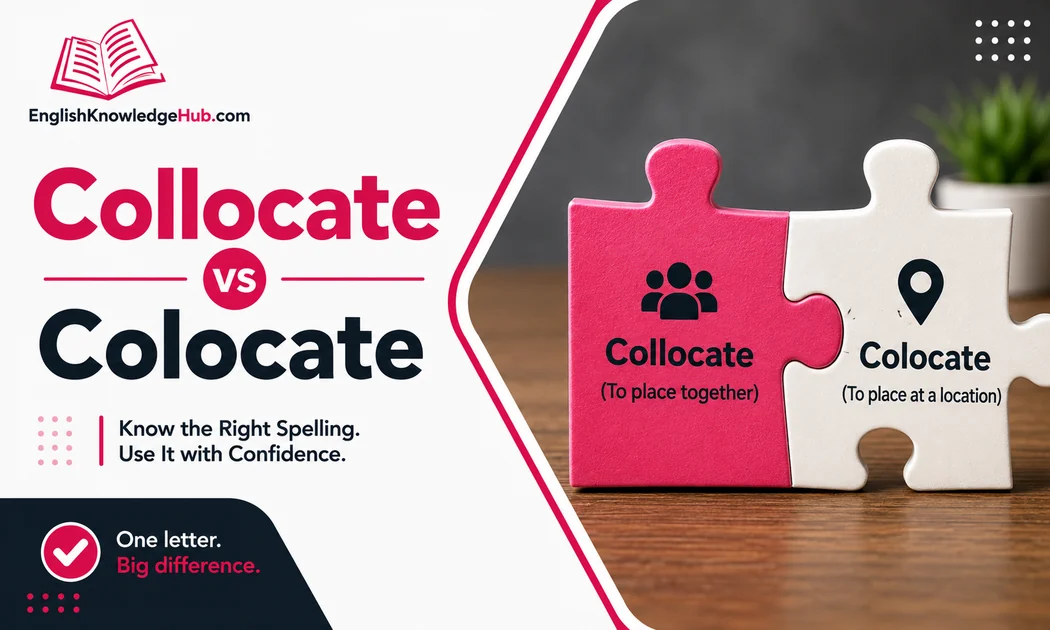
Confused about collocate vs colocate and wondering which word is correct? Collocate and colocate are both correct words, but they are usually used in different ways. Use collocate when talking about words that often appear together, such as heavy rain. Use colocate when people, servers, equipment, or services share the same place.
There is one useful detail to know. Collocate can also mean to place or arrange things together. This is an older meaning, and it is still correct today.
So, how do you choose the right word? Look at the meaning of your sentence. This guide explains Collocate vs Colocate difference in simple words, with clear examples, word history, spelling tips, and common uses.
Collocate vs Colocate at a Glance
| Word | Main Meaning | Common Use | Example |
|---|---|---|---|
| Collocate | Words often appear together | Language | Heavy collocates with rain. |
| Collocate | Place or arrange things together | Older use | The items were collocated. |
| Colocate | Put people or things in the same place | Business and tech | The servers were colocated. |
| Co-locate | Same meaning as colocate | Alternative spelling | The teams will co-locate. |
A simple way to remember the difference is:
Words collocate. People and things colocate.
This rule works in most modern writing.
What Does Collocate Mean?
Collocate is a verb.
Today, people often use it when talking about language. Two words collocate when they are commonly used together.
For example:
- heavy rain
- strong coffee
- make a decision
- deep sleep
You can say:
Heavy often collocates with rain.
This means English speakers often use those words together.
What Is a Collocation?
The noun form of collocate is collocation.
A collocation is a group of words that naturally go together.
For example:
- fast food
- strong opinion
- take a break
- pay attention
These word pairs sound natural because people use them often.
This is useful for English learners. A sentence can be grammatically correct but still sound strange if the word combination is unusual.
For example:
heavy rain sounds natural.
But:
strong rain sounds unusual.
This is why learning collocations can help your English sound more natural.
Can Collocate Also Mean “Place Together”?
Yes.
This is one point that often causes confusion.
Collocate also has an older meaning: to place or arrange things together.
For example:
The files were collocated for review.
This meaning is still correct.
However, in modern writing, colocate often makes the location meaning easier to understand.
What Does Colocate Mean?
Colocate means to put two or more people or things in the same place or close together.
For example:
The company decided to colocate its sales and support teams.
You may also see:
The business colocated its servers in one data center.
The word is common in:
- business
- technology
- offices
- data centers
- networking
- government services
A quick way to remember it is to look at the word locate inside colocate.
If your sentence is mainly about a place, colocate is often the clearer choice.
What Is the Main Difference?
The main difference is simple.
Use Collocate for Words
Use collocate when words often appear together.
Make collocates with decision.
Strong collocates with coffee.
This use is common in dictionaries, English lessons, and language study.
Use Colocate for Shared Places
Use colocate when people or things share a location.
The company colocated both teams.
The servers are colocated in the same building.
This use is common in business and technical writing.
Collocate vs Colocate Examples
Here are a few clear examples.
| Situation | Better Word | Example |
|---|---|---|
| Two words often appear together | collocate | Highly collocates with successful. |
| Two teams share an office | colocate | The company colocated the teams. |
| Servers share one building | colocate | The servers were colocated. |
| Studying word pairs | collocate | Which verbs collocate with decision? |
| Items are arranged together | collocate | The samples were collocated. |
The last example shows why the words can overlap.
Still, for most modern writing, the word choice is easy once you know the context.
Collocated or Colocated: Which Is Correct?
Both spellings can be correct.
Collocated
Collocated is the past form of collocate.
It can refer to words or to things placed together.
Example:
The two terms were often collocated in the text.
Colocated
Colocated is the past form of colocate.
It usually means that people or things were placed in the same location.
Example:
The servers were colocated in one facility.
So, neither spelling is automatically wrong.
The right form depends on the word you are using.
What Does “Collocated Team” Mean?
A collocated team is a team whose members work in the same physical place.
They may work in:
- the same office
- the same room
- the same building
- the same work site
For example:
The company uses a collocated team so members can talk face to face.
You may also see co-located team or colocated team.
All three forms appear in real writing, but co-located team and colocated team make the location meaning clearer.
Is It Colocate or Co-Locate?
Both forms are used:
- colocate
- co-locate
They usually mean the same thing.
For example:
We plan to colocate the teams.
We plan to co-locate the teams.
Both sentences are correct.
The difference is mainly style.
Some style guides prefer colocate without a hyphen. Other writers still use co-locate.
If you are writing for a company, website, or school, follow its style guide.
If there is no rule, choose one form and stay consistent.
What About “Co Locate”?
Writing co locate as two separate words is usually not the best choice.
Use:
- colocate
- co-locate
Avoid:
- co locate
The prefix co- normally stays attached to the word.
Why Do the Words Look So Similar?
The words both connect to the idea of things being together.
But their history is different.
Origin of Collocate
Collocate is the older word.
It comes from Latin roots linked to the idea of placing things together.
Its first meaning was about physical placement.
Later, language experts began using it for words that often appear together.
That is why collocate can still have two meanings today.
Origin of Colocate
Colocate became common much later.
It is easy to understand as:
co + locate
The prefix co- means together.
The word locate means to place something somewhere.
So, colocate simply gives the idea of locating things together.
This spelling became useful in business and technology.
Collocation vs Colocation
The noun forms are also easy to mix up.
Collocation
Collocation usually means a natural word combination.
Examples:
- heavy rain
- make a mistake
- strong opinion
- deep sleep
This word is common in English learning and language study.
Colocation
Colocation means sharing a location.
For example:
The company uses colocation for its servers.
In technology, the word has a more specific use.
What Is a Colocation Data Center?
A colocation data center is a place where a company can keep its own servers and other computer equipment.
The company owns the hardware, but another business runs the building.
The data center may provide:
- space
- electricity
- cooling
- internet access
- security
For example, a small company may not want to build its own data center.
Instead, it can place its servers in a shared facility.
This is called data center colocation.
Is Collocate a Misspelling of Colocate?
No.
Collocate is a real English word.
It is not a spelling mistake.
It is most common when talking about word combinations, but it can also mean to place things together.
Is Colocate a Misspelling of Collocate?
No.
Colocate is also a correct word.
It usually means to place people or things in the same location.
So, the real question is not which spelling is correct.
The better question is:
Which meaning fits your sentence?
Is “Colloccate” Correct?
No.
Colloccate, with three c’s, is a spelling mistake.
The correct forms are:
- collocate
- colocate
- co-locate
Be careful because the words already look very similar.
Synonyms for Collocate
The best synonym depends on the meaning.
When collocate means to place things together, you can use:
- arrange
- group
- place together
- set together
When it refers to language, simple phrases often work better:
- appear together
- occur together
- be used together
For example:
These words often collocate.
can also mean:
These words often appear together.
Synonyms for Colocate
Possible alternatives include:
- place together
- locate together
- house together
- share a location
- put in the same place
For example:
The company colocated the teams.
can become:
The company put the teams in the same office.
The second version may be easier for general readers.
How to Pronounce Collocate
Collocate is usually pronounced roughly like:
KOL-uh-kayt
The stress comes near the start of the word.
You may hear small differences between British and American English, but the meaning stays the same.
Colocate sounds closer to:
co + locate
Thinking about the word locate can also help you remember its meaning.
Common Word Forms
| Base Word | Past Form | -ing Form | Noun |
|---|---|---|---|
| collocate | collocated | collocating | collocation |
| colocate | colocated | colocating | colocation |
| co-locate | co-located | co-locating | co-location |
For example:
The words were often collocated in the text.
The company colocated its servers in one building.
Common Mistakes to Avoid
Using Colocate for Word Pairs
Less natural:
Heavy colocates with rain.
Better:
Heavy collocates with rain.
When you are talking about language, use collocate.
Thinking Collocate Only Refers to Words
That is not fully correct.
The word can also mean to place or arrange things together.
Mixing Colocate and Co-Locate
Both forms may be correct, but using both in the same article can look messy.
Choose one spelling and stay with it.
Mixing Up Collocation and Colocation
The extra l changes the usual meaning.
Remember:
collocation = words together
colocation = places together
How to Choose the Right Word
Ask yourself one simple question:
Am I talking about words, or am I talking about a place?
If you are talking about words, choose:
collocate
If you are talking about people or things sharing a location, choose:
colocate
If you are using the older meaning of placing things together, collocate can also be correct.
This simple check solves most cases.
Frequently Asked Questions
Is collocate a real word?
Yes. Collocate is a real word. It often refers to words that commonly appear together.
Is colocate a real word?
Yes. Colocate is also correct. It usually means to place people or things in the same location.
Which is correct, collocate or colocate?
Both are correct. Use collocate mainly for language and colocate mainly for shared locations.
Is collocated the correct spelling?
Yes. Collocated is the past form of collocate.
Is colocated the correct spelling?
Yes. Colocated is the past form of colocate.
What does a collocated team mean?
A collocated team has members who work in the same physical location.
What is a collocation?
A collocation is a common word combination, such as heavy rain or make a decision.
What is colocation?
Colocation means sharing a location. In technology, it can also mean keeping servers in a shared data center.
Is co-locate wrong?
No. Co-locate is an accepted form. Colocate is also common.
Final Thoughts on Collocate vs Colocate
The difference between collocate vs colocate is easier than it first looks.
Use collocate when words often appear together. Use colocate when people, servers, equipment, or services share the same place.
Just keep this simple rule in mind:
Words collocate. People and things usually colocate.
There is some overlap because collocate also has an older placement meaning. Still, this rule will help you choose the clearest word in most modern writing.
For more simple English guides, spelling help, and commonly confused words, visit EnglishKnowledgeHub.com and write with more confidence every day.
