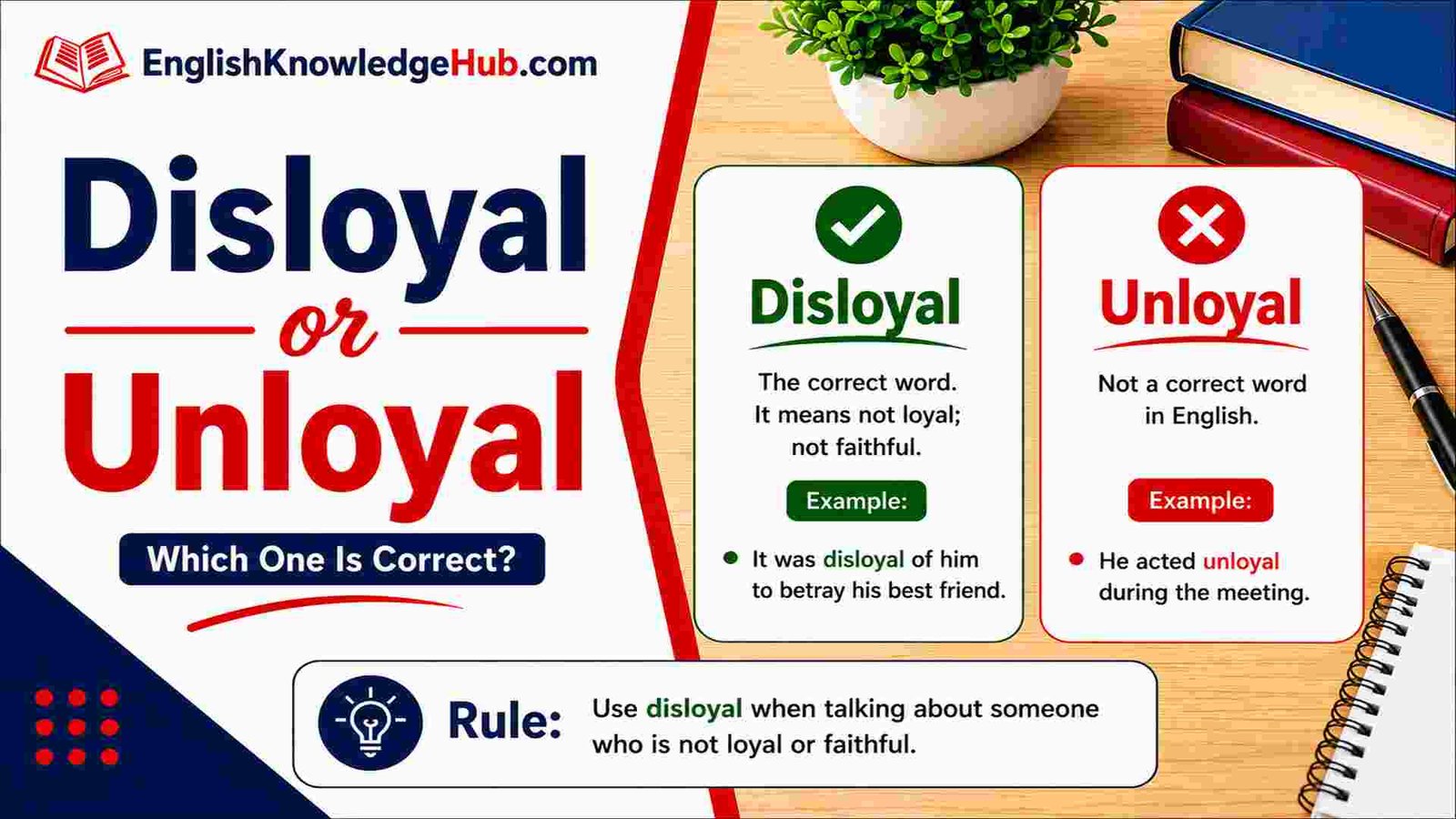
Disloyal is the normal modern English opposite of loyal. It means lacking loyalty, faithfulness, support, or allegiance. Unloyal may appear occasionally, but it is rare and sounds unnatural to many readers. In school, workplace, academic, and everyday writing, disloyal is the safer and more idiomatic choice.
In this article, you’ll learn how Disloyal or Unloyal differ in modern usage, why English prefers the prefix dis- here, how to use disloyal naturally, and how it differs from words such as dishonest, unfaithful, treacherous, and unpatriotic. Merriam-Webster defines disloyal as lacking in loyalty or showing an absence of allegiance, devotion, faith, or support.
Why “Disloyal” Is the Word Most English Speakers Use
English does not build every opposite with the same prefix. We say unhappy, unfair, and unsafe, so it is understandable that a learner might expect unloyal. But established vocabulary does not always follow a single pattern.
With loyal, standard modern English overwhelmingly prefers disloyal. That is the form readers expect in news writing, workplace communication, essays, and ordinary conversation. The choice is lexical rather than a rule you can calculate every time, so it is best to learn loyal → disloyal as a pair.
Is “Unloyal” Actually Wrong?
It is more accurate to call unloyal rare or nonstandard in most present-day contexts than to pretend the form has never existed. Readers will usually understand it, and occasional examples can be found, but it is not the normal choice.
That distinction matters for trustworthy language advice. If you are writing an essay, email, application, article, or report, use disloyal. If you encounter unloyal in older, regional, or unusual writing, understand the intended meaning but do not treat it as the default modern form.
What “Disloyal” Really Means
Calling someone disloyal is stronger than simply saying they disagreed with you. The word suggests that loyalty, support, faithfulness, or allegiance was expected and that the person failed to give it.
A friend may be described as disloyal after deliberately betraying a serious confidence. A team member might be seen as disloyal if they secretly work against the group. In a political or national context, disloyal can describe a lack of allegiance. The exact seriousness depends on context, but the central idea is a failure of loyalty.
That is why sentences such as “She disagreed with the manager” and “She was disloyal to the manager” are not interchangeable. Disagreement can be honest and respectful. Disloyalty suggests a breach of expected support or faithfulness.
The Most Natural Sentence Patterns
One common pattern is disloyal to + person, group, cause, or country. For example: “He was disloyal to the friend who trusted him,” “The officer was accused of being disloyal to the organization,” and “She did not want to appear disloyal to her team.”
You can also put the adjective before a noun: a disloyal friend, a disloyal employee, a disloyal act, disloyal behavior. The noun form is disloyalty: “His disloyalty damaged the partnership.” The adverb is disloyally, though it is less common in everyday speech.
Disloyal Does Not Automatically Mean Dishonest
Dishonest is about truthfulness. Disloyal is about loyalty. A person can lie without betraying a group, and a person can act disloyally without telling a direct lie.
For example, an employee who secretly gives a competitor confidential plans may be disloyal even if they never make a false statement. Someone who lies about being late is dishonest, but that lie may have nothing to do with loyalty.
This distinction helps you choose a more precise word instead of treating every negative behavior as the same thing.
Disloyal vs Unfaithful
Unfaithful overlaps with disloyal, but the words are not identical in every context. Disloyal can apply broadly to friends, groups, employers, causes, leaders, or countries. Unfaithful is especially common for romantic relationships, promises, or commitments.
“He was unfaithful to his spouse” usually suggests romantic or sexual betrayal. “He was disloyal to his team” suggests failure of loyalty or support. Depending on context, both ideas can occur together, but the words guide the reader toward different kinds of betrayal.
Disloyal vs Treacherous or Traitorous
Treacherous and traitorous are usually stronger. Calling someone disloyal can describe incomplete faithfulness or support. Treacherous suggests dangerous betrayal of trust, while traitorous can imply treason or a very serious betrayal.
So if a colleague quietly refuses to support a group decision, disloyal might fit if loyalty was expected. Calling the same behavior traitorous would usually sound exaggerated unless the context involved an extremely serious betrayal.
Disloyal vs Unpatriotic
These can overlap in discussions about countries, but they are not synonyms. Unpatriotic means lacking patriotism or national pride. Disloyal focuses on allegiance or faithfulness.
A person can criticize their country and still consider themselves loyal to it. That is why careful writing should not automatically label criticism, disagreement, or dissent as disloyal.
Why Learners Often Choose “Unloyal”
The mistake comes from a reasonable pattern. English uses un- to create many opposites, so unloyal feels logical. But vocabulary is partly historical and conventional. Native usage decides which form becomes normal.
A useful memory trick is to connect disloyal with familiar words such as dishonest, disobedient, and disrespectful. The exact meanings differ, but the shared prefix can help the spelling feel more familiar.
For another spelling choice where the form that “looks logical” is not the standard modern answer, see Persue or Pursue.
Common Mistakes in Context
Less natural: He was unloyal to his closest friend.
Better: He was disloyal to his closest friend.
The first sentence is understandable, but disloyal is the expected modern word.
Too strong: She was disloyal because she disagreed with the proposal.
Better: She disagreed with the proposal.
Disagreement alone does not prove disloyalty. Use the stronger word only when the context involves a genuine failure of loyalty or support.
Incorrect word form: His disloyal shocked everyone.
Correct: His disloyalty shocked everyone.
Disloyal is an adjective. Disloyalty is the noun.
How It Sounds in Everyday, Workplace, and Formal English
In everyday conversation, someone might say, “I would feel disloyal if I shared her private message.” At work, “The manager viewed the leak as disloyal behavior” sounds natural, though writers should still be careful about making accusations without evidence.
Academic and historical writing may use the word more neutrally: “The government punished officials it considered disloyal.” In that sentence, the writer reports how the officials were viewed rather than personally judging them.
This is a useful writing habit: when disloyal is someone else’s judgment, make the source of that judgment clear.
A Quick Choice Guide
| Word | Main idea | Best use |
|---|---|---|
| loyal | faithful or supportive | normal positive form |
| disloyal | lacking loyalty | standard modern opposite of loyal |
| unloyal | intended to mean not loyal | rare; usually avoid |
| dishonest | not truthful | lies or deception |
| unfaithful | not faithful | relationships or commitments |
| traitorous | serious betrayal or treason | much stronger contexts |
Frequently Asked Questions
Which is correct, disloyal or unloyal?
Disloyal is the standard and natural choice in modern English. Unloyal is rare.
Is unloyal a real word?
It has appeared in English, but it is not the normal modern form. Use disloyal in ordinary writing.
What is the noun form of disloyal?
The noun is disloyalty.
Can a friend be disloyal?
Yes, especially if they seriously betray trust or deliberately work against the friendship.
Does disloyal mean dishonest?
No. Dishonesty concerns truth. Disloyalty concerns loyalty or allegiance.
Can disagreement be disloyal?
Not automatically. Disagreement can be honest and respectful. Context determines whether a genuine breach of loyalty occurred.
Final Takeaway
For Disloyal or Unloyal, choose disloyal in modern English. It is the established adjective for a lack of loyalty, while unloyal is rare and usually sounds unnatural. Just as importantly, use the word carefully: disagreement, criticism, or changing your mind is not automatically disloyalty.
For more clear, practical word-choice lessons, explore EnglishKnowledgeHub.com.
