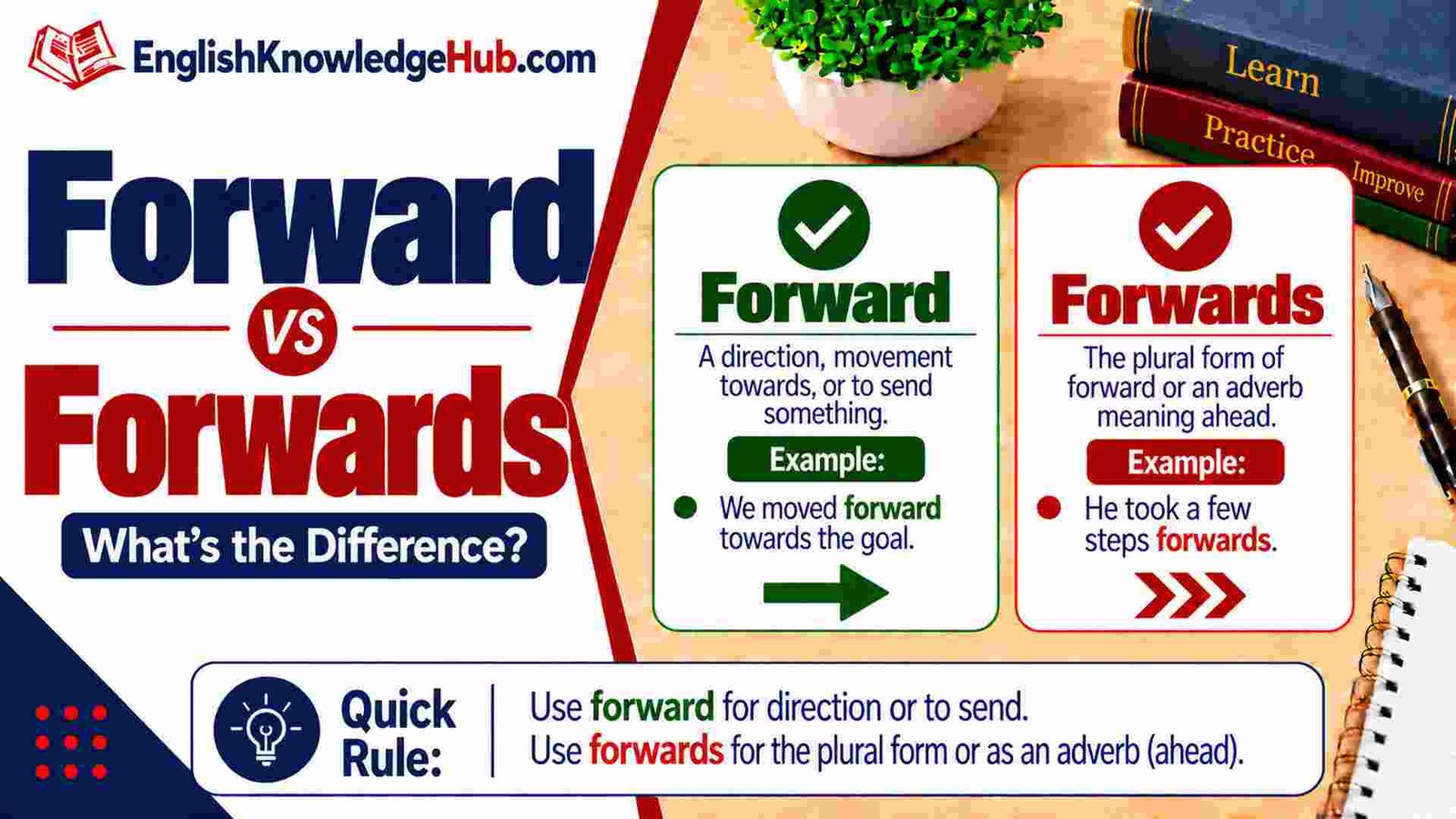
Forward Vs Forwards: Forward and forwards can both be correct when they mean movement toward the front. Forward is more widely used and can work as an adverb, adjective, verb, and noun. Forwards is mainly used as an adverb, especially in British English. If you are unsure, forward is usually the safer choice.
The difference looks small because only one letter changes. However, that final s affects how the word can be used in a sentence.
The easiest way to choose correctly is to look at the job the word is doing.
Forward Vs Forwards: The Simple Rule
Use forward when you need a word that can describe direction, a noun, or an action such as sending something.
Use forwards mainly when you are talking about movement toward the front.
For example:
Please step forward.
Please step forwards.
Both sentences can be correct because the word describes direction.
Now compare:
We noticed a forward movement.
This sentence needs forward, not forwards, because the word describes the noun movement.
A useful memory rule is:
Direction can use either form. Before a noun, use forward.
What Does Forward Mean?
Forward often means toward the front, ahead, or toward progress.
For example:
The car moved forward slowly.
Mia leaned forward to read the sign.
Our team is ready to move forward with the plan.
In these sentences, the word describes movement or progress.
However, forward can do more than that.
Forward as an Adverb
As an adverb, it tells us the direction of an action.
The child walked forward carefully.
Please move forward so others can enter.
The project is moving forward again.
In all three examples, forward tells us where the action goes.
Forward as an Adjective
Forward can also describe a noun.
The train made a forward movement.
We sat in the forward section of the bus.
The company needs better forward planning.
Here, forward describes movement, section, and planning.
You should not normally use forwards in these sentences.
Forward as a Verb
As a verb, forward can mean to send something to another person.
Please forward the message to Sarah.
I will forward the invoice this afternoon.
Can you forward this email to the manager?
This meaning is very common in workplace English.
Forward as a Noun
In some sports, a forward is an attacking player.
The coach moved Alex into a forward position.
The team signed a new forward last week.
The plural is forwards:
Both forwards played well.
Here, forwards is a plural noun, not the directional adverb.
What Does Forwards Mean?
Forwards is mainly an adverb meaning toward the front.
For example:
Leo moved forwards to see the stage.
The chair rolled forwards slightly.
She bent forwards to pick up the book.
In these examples, the word tells us the direction of movement.
The meaning is usually the same as forward.
Compare:
The boy stepped forward.
The boy stepped forwards.
Both sentences describe the same basic action.
The difference is mostly about style and regional preference.
Forward Vs Forwards at a Glance
| Use | Forward | Forwards |
|---|---|---|
| Movement toward the front | Correct | Correct |
| Adverb in American English | Very common | Less common |
| Adverb in British English | Common | Common |
| Before a noun | Correct | Incorrect in normal use |
| Verb meaning “send” | Correct | Only as a normal verb form |
| Sports noun | Correct | Can be the plural form |
| Safe choice for learners | Yes | Only in suitable adverb use |
This table shows why forward is more flexible.
British and American English
Forward Vs Forwards: One important difference is regional usage.
British English often uses forwards as an adverb.
For example:
Move forwards a little.
American English more often uses:
Move forward a little.
The meaning is the same.
British speakers also use forward, so this is not a strict rule.
Think of it as a preference rather than a right-or-wrong difference.
The same kind of pattern appears in words such as:
- backward and backwards
- toward and towards
For international writing, forward is often the easiest choice because it sounds natural to a wide range of readers.
When Both Forms Are Correct
Both forms can usually work when they describe direction.
For example:
Emma stepped forward when her name was called.
Emma stepped forwards when her name was called.
Both are correct.
Another example:
The dog moved forward when the gate opened.
The dog moved forwards when the gate opened.
Again, the meaning stays the same.
A useful test is to ask:
Does the word answer “In what direction?”
If yes, both forms may work.
When Only Forward Works
You should use forward when the word directly describes a noun.
Incorrect:
The machine made a forwards movement.
Correct:
The machine made a forward movement.
Explanation:
Forward describes the noun movement, so it is acting as an adjective.
Another example:
Incorrect:
We need a forwards plan for next year.
Correct:
We need a forward plan for next year.
Explanation:
The word describes plan, so forward is the correct form.
One more:
Incorrect:
They checked the forwards section of the building.
Correct:
They checked the forward section of the building.
Explanation:
Forward describes the location of the section.
Forward Vs Forwards: Daily Conversation Examples
Here are some natural everyday examples:
“Move forward a little so I can close the door.”
Zara stepped forwards to greet her friend.
The child leaned forward to see the screen.
“Come forwards so everyone can hear you.”
The bicycle rolled forward when the brake was released.
All of these describe direction.
Workplace Examples
Forward appears often in business English because it has several uses.
We are ready to move forward with the new project.
Please forward the report to the finance team.
The company created a forward plan for the next six months.
The meeting helped us move forward with the decision.
In the second example, forward is a verb meaning send.
In the third, it is an adjective describing plan.
Academic Examples
Academic writing also commonly uses forward.
The study represents an important step forward in medical research.
The object showed a small forward movement.
Researchers moved forward with the second stage of the experiment.
The paper presents a forward-looking approach to energy use.
These examples show that the word can describe progress as well as physical direction.
Formal Writing Examples
In formal English, you may see sentences such as:
The committee agreed to move forward with the proposal.
Please forward all required documents before Friday.
The report offers a clear way forward.
The organization has prepared a forward strategy.
Using forward in these situations sounds natural and professional.
Be Careful With “Look Forward To”
A very common expression is:
look forward to
For example:
I look forward to hearing from you.
We look forward to meeting the new team.
Sara is looking forward to her holiday.
In standard writing, look forward to is the normal form.
Also remember that after to, we often use a noun or an -ing form.
Correct:
I look forward to your reply.
Correct:
I look forward to seeing you.
Incorrect:
I look forward to see you.
The problem in the last sentence is the verb form after to.
Forward Vs Forwards: Common Mistakes
Using Forwards Before a Noun
Incorrect:
The car made a forwards move.
Correct:
The car made a forward move.
Explanation:
The word describes the noun move, so use forward.
Thinking Forwards Is Always Wrong
Incorrect idea:
Forwards is not correct English.
Correct idea:
Forwards is a valid adverb in suitable contexts.
Explanation:
It is especially common in British English when describing direction.
Adding S Everywhere in British English
Incorrect:
We need better forwards planning.
Correct:
We need better forward planning.
Explanation:
Even in British English, forwards does not normally replace the adjective forward.
Confusing Direction With the Verb Forward
Compare:
Ella moved forwards.
Here, forwards describes direction.
Now look at:
Ella forwards customer emails to the manager.
Here, forwards is a verb.
It has an s because the subject is Ella.
A Simple Three-Step Test
Use this quick test when you are unsure.
First, ask whether you are describing direction.
If yes:
walk forward
walk forwards
Both may be correct.
Second, ask whether the word directly describes a noun.
If yes:
forward movement
forward section
forward planning
Use forward.
Third, ask whether the meaning is send.
If yes:
forward the email
forward the message
forward the document
Use the verb forward.
This simple method works in most situations.
Is Forward More Formal Than Forwards?
Not necessarily.
The main difference is grammar and regional preference, not formality.
Forwards is correct when it is used as an adverb.
However, forward is more flexible and works in more types of sentences.
That is why it often appears more frequently in formal, academic, business, and international writing.
Frequently Asked Questions
Is forwards a correct word?
Yes. Forwards is a correct adverb meaning toward the front.
Should I say move forward or move forwards?
Both are correct when you mean movement toward the front. Move forward is especially common in American English, while move forwards is common in British English.
Is forward correct in British English?
Yes. British English uses both forward and forwards.
Can forwards be used before a noun?
Usually no. Use forward movement, forward planning, and forward position.
Is it looking forward or looking forwards?
The standard expression is looking forward to.
Example:
I am looking forward to the weekend.
What is the difference between forward and forwards?
Both can describe direction. However, forward has more grammatical uses, while forwards is mainly an adverb.
Which one is better for formal writing?
Forward is usually the safer choice because it is widely used and works in more situations.
Can forwards be a verb?
Yes, but only as the normal third-person form of the verb forward.
Example:
She forwards the reports every Monday.
Forward Vs Forwards: Final Answer
Both forms can be correct when talking about movement toward the front.
You can say:
Step forward.
or:
Step forwards.
The meaning is almost the same.
However, forward is more flexible. It can work as an adverb, adjective, verb, and noun. Forwards is mainly used as an adverb and is especially common in British English.
Remember this simple rule:
For direction, forward or forwards may work.
Before a noun, use forward.
When you mean send, use forward as a verb.
Once you check the job the word is doing in the sentence, the choice becomes much easier.
For more simple grammar lessons, clear explanations, and practical English examples, visit EnglishKnowledgeHub.com.
