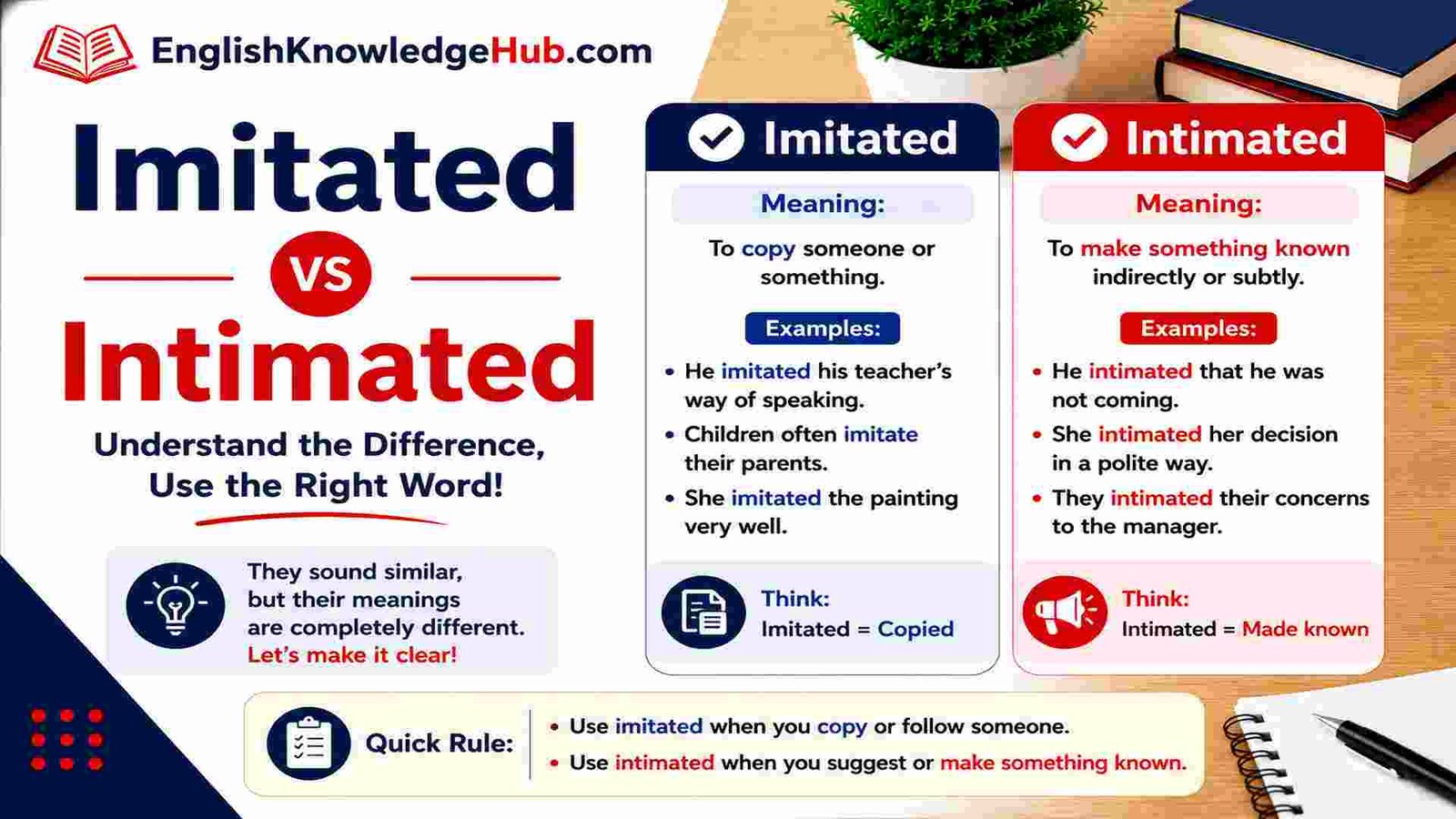
Imitated and intimated are different verbs with different meanings. Imitated means copied, mimicked, or followed as a model. Intimated means hinted, suggested, or communicated something indirectly. If someone copies a voice, style, or action, use imitated. If someone hints at an idea without saying it directly, use intimated.
In this article, you’ll learn how Imitated vs Intimated differ in meaning, pronunciation, sentence structure, tone, and common usage, plus how intimate changes meaning when it works as an adjective instead of a verb. Merriam-Webster defines imitate as copying or following a model, while the verb intimate can mean to communicate indirectly or hint.
One Word Copies, the Other Hints
The simplest distinction is this: imitated = copied, while intimated = hinted.
“The student imitated the teacher’s accent” means the student copied the way the teacher spoke. “The teacher intimated that the exam might be moved” means the teacher suggested that possibility without making a direct announcement.
Mixing these words up does more than create a spelling error. It changes the action in the sentence completely.
What “Imitated” Means
Imitated is the past tense and past participle of imitate. It can mean copying someone’s voice, behavior, movement, style, technique, or appearance. It can also describe one thing resembling another.
“The child imitated her brother’s laugh.” “The designer imitated the curved shape of a seashell.” “The software imitated the look of an older operating system.”
Imitation can be serious, playful, flattering, educational, or deceptive. Context tells you whether the copying is positive or negative.
Imitate vs Copy vs Mimic
These verbs overlap, but they do not always feel identical. Copy is the broadest and can mean reproducing something closely. Imitate often means following a person, style, or model. Mimic often suggests close copying of a voice, gesture, sound, or mannerism, sometimes for humor.
“She copied the notes” means she reproduced the written content. “She imitated the artist’s style” means she followed the artistic model. “She mimicked his laugh” suggests a recognizable imitation of the sound.
What “Intimated” Means
Intimated is the past tense and past participle of the verb intimate. As a verb, intimate can mean to communicate something delicately, indirectly, or by suggestion.
“The director intimated that changes were coming” means the director hinted at the changes rather than announcing them clearly. “She intimated that she might resign” means she suggested the possibility.
This use is more formal than everyday verbs such as hinted or suggested. In casual conversation, those simpler words often sound more natural.
Why “Intimate” Can Be Confusing
Most learners first meet intimate as an adjective meaning close, private, or personal: “an intimate friendship,” “an intimate conversation,” or “intimate knowledge.” That adjective is pronounced differently from the verb.
As an adjective, the final syllable sounds like “mit.” As a verb, intimate ends more like “mate.” So pronunciation can help you identify which word family you are dealing with.
Adjective: intimate friends.
Verb: She intimated that she would leave.
The Sentence Structure Gives You a Strong Clue
Imitated usually takes a direct object. You imitate a person, voice, action, style, sound, or design.
“He imitated the coach.” “She imitated the bird’s call.” “The building imitated classical architecture.”
Intimated often introduces an idea, especially with a that-clause: “He intimated that the plan might fail.” It can also take a noun phrase in formal writing, but the that-clause pattern is a useful learner clue.
Intimated vs Implied vs Hinted
These words are close because all can express indirect meaning. Hinted is common and conversational. Implied often means a message was communicated without direct wording. Intimated is more formal and can suggest a delicate or careful indirect communication.
“She hinted that she wanted to leave” sounds everyday. “She implied that the numbers were unreliable” is neutral and common in analytical writing. “She intimated that senior staff were concerned” sounds more formal.
If you want a deeper explanation of indirect meaning, our Imply vs Infer guide explains the difference between sending an unstated message and drawing a conclusion from one.
Pronunciation Helps Separate the Words
Imitated comes from imitate, pronounced roughly “IM-uh-tate.” Intimated comes from the verb intimate, pronounced roughly “IN-tuh-mate” or “IN-tə-mate,” depending on accent.
The spellings are close, but the extra n in intimated belongs to a completely different verb. Saying the words aloud can help prevent a fast typing mistake.
Common Mistakes and Why They Change Meaning
Incorrect: The child intimated his father’s voice.
Correct: The child imitated his father’s voice.
The child copied the voice, so imitated is correct.
Incorrect: The manager imitated that layoffs were possible.
Correct: The manager intimated that layoffs were possible.
The manager hinted at an idea rather than copying something.
Awkward: She intimated the actor’s accent.
Better: She imitated the actor’s accent.
Overly formal: He intimated that he was hungry.
More natural in everyday speech: He hinted that he was hungry.
The original sentence is grammatical, but tone matters. Intimated can sound unnecessarily formal in simple conversation.
Real-Life Examples
At home: “The toddler imitated the way her mother waved.” At work: “The director intimated that the deadline could move.” In school: “The student imitated the structure of the sample essay without copying its wording.” In formal writing: “The report intimated that further investigation might be necessary.”
Notice how imitated normally points to a model being copied, while intimated points to an idea being communicated indirectly.
Imitation vs Intimation
The related nouns can help you remember the distinction. Imitation is the act or result of copying. Intimation is a hint, indication, or indirect communication.
“His imitation of the singer made everyone laugh.” “The email gave the first intimation that the policy might change.”
Learning the noun pair makes the verb pair easier to keep apart.
A Quick Comparison
| Word | Meaning | Common pattern |
|---|---|---|
| imitated | copied or mimicked | imitated + person/voice/style/action |
| intimated | hinted or suggested indirectly | intimated + that-clause |
| imitation | copying or a copy | an imitation of… |
| intimation | hint or indirect indication | an intimation that… |
Frequently Asked Questions
What is the difference between imitated and intimated?
Imitated means copied. Intimated means hinted or suggested indirectly.
Is intimated a real word?
Yes. It is the past form of the verb intimate, meaning to hint or communicate indirectly.
Can intimate be a verb?
Yes. As a verb, it means to hint or communicate delicately and indirectly.
Is intimated formal?
Usually yes. Hinted or suggested often sounds more natural in everyday speech.
What is another word for imitated?
Depending on context: copied, mimicked, reproduced, echoed, or emulated.
What is another word for intimated?
Hinted, suggested, implied, indicated, or signaled.
Final Takeaway
For Imitated vs Intimated, remember one simple contrast: imitated = copied, intimated = hinted. The sentence structure often gives you the answer too. A person usually imitates someone or something, while a person often intimates that something may be true. Keep the two verb families separate and the spelling becomes much easier.
For more practical vocabulary and grammar comparisons, explore EnglishKnowledgeHub.com.
