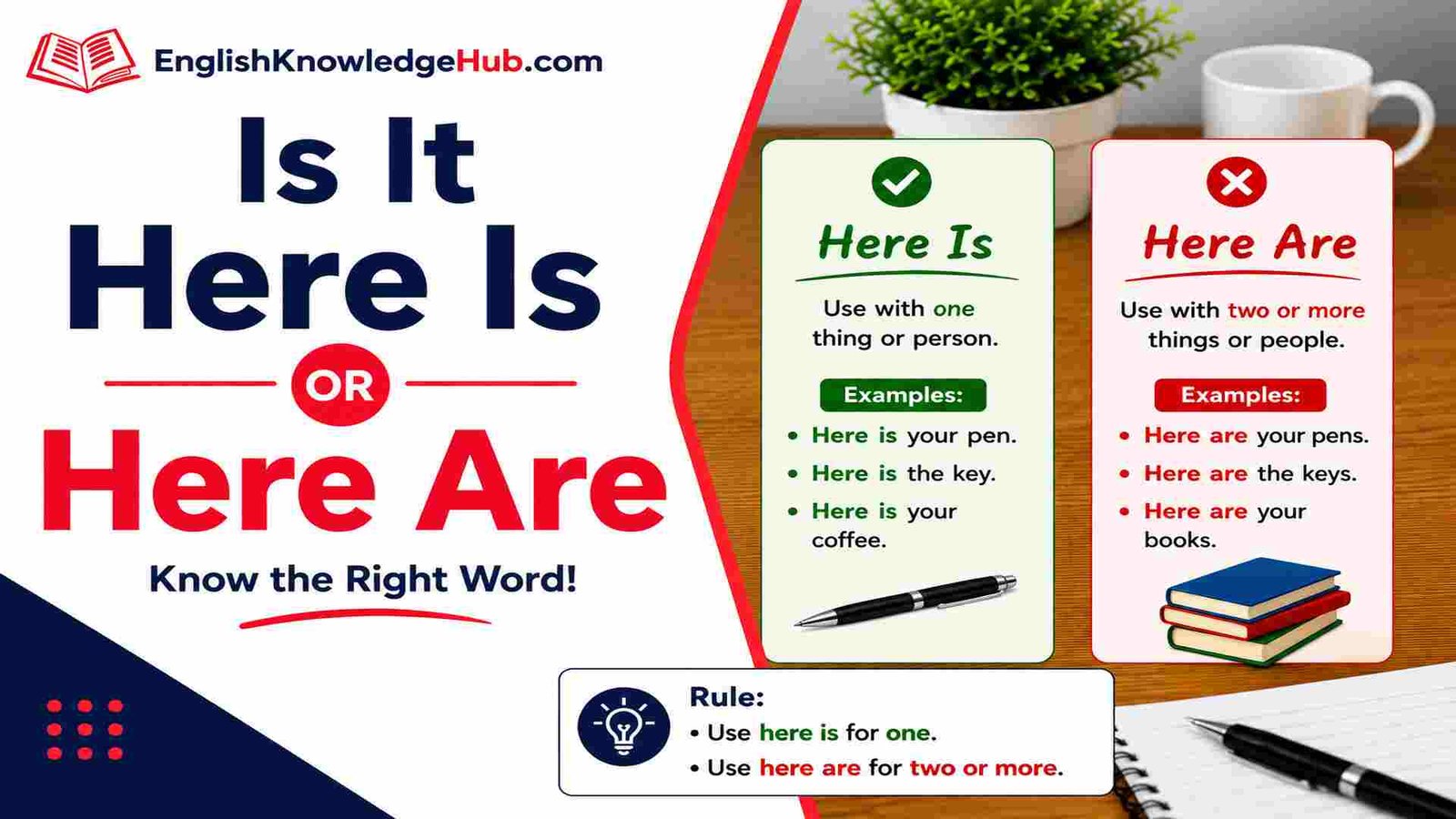
Use “here is” with a singular noun or one item, and “here are” with a plural noun or several items. Write “Here is the file” and “Here are the files.” In casual speech, you may hear “here’s” before a plural noun, but in careful writing, matching is with singular and are with plural is the safest rule.
In this article, you’ll learn Is It Here Is or Here Are through subject–verb agreement, contractions such as here’s, pronouns, lists, and natural spoken versus formal examples. Cambridge explains that here can introduce someone or something, with common patterns such as “Here’s the book” and “Here they are.”
Is It Here Is or Here Are? Quick Answer
The easiest rule is simple:
One person or thing = here is
More than one person or thing = here are
Look at these examples:
| Subject | Correct Form | Example |
|---|---|---|
| One bag | Here is | Here is your bag. |
| Three bags | Here are | Here are your bags. |
| One teacher | Here is | Here is our teacher. |
| Several teachers | Here are | Here are our teachers. |
| Information | Here is | Here is the information. |
| Four ideas | Here are | Here are four ideas. |
The word here does not decide whether you need is or are. The subject does.
Why Does the Verb Change?
To understand Is It Here Is or Here Are, you need to look at subject verb agreement.
A singular subject normally takes is:
The package is here.
A plural subject normally takes are:
The packages are here.
Now place here at the beginning:
Here is the package.
Here are the packages.
The word order changes, but the subject is still the same.
In:
Here are the packages.
the real subject is the packages.
Because packages is plural, we use are.
This is the most important grammar point to remember.
When Should You Use “Here Is”?
Use here is when you introduce one person, one object, one idea, or an uncountable noun.
With One Object
Examples:
- Here is your lunch.
- Here is the blue folder.
- Here is your bus ticket.
- Here is my old camera.
- Here is the key to the front door.
Each sentence introduces one thing.
You can check the sentence by moving here to the end:
The key is here.
Because the key is is correct, here is the key is also correct.
With One Person
Use here is when you introduce or point to one person.
- Here is our new teacher.
- Here is your next customer.
- Here is Ahmed from the sales team.
- Here is the student who found your book.
Every subject is singular.
One teacher is.
One customer is.
One student is.
So here is works correctly.
With One Idea, Answer, or Reason
The subject does not have to be a physical object.
You can say:
- Here is the main reason.
- Here is my answer.
- Here is another idea.
- Here is the best solution.
- Here is the point I wanted to explain.
Words such as reason, answer, idea, solution, and point are singular in these examples.
When Should You Use “Here Are”?
Use here are when you introduce more than one countable person or thing.
For example:
- Here are your shoes.
- Here are the final questions.
- Here are my classmates.
- Here are five useful examples.
- Here are the forms you need.
- Here are the photos from our trip.
All of the subjects are plural.
Try changing the word order:
The photos are here.
Now move here to the beginning:
Here are the photos.
The verb stays plural because photos is still a plural subject.
A Simple Trick to Check Your Sentence
Learners asking Is It Here Is or Here Are can use one very easy test.
Move the word here to the end of the sentence.
Suppose you are unsure about:
Here is/are the instructions.
Change it to:
The instructions are here.
You know that instructions are is correct.
So write:
Here are the instructions.
Now try:
Here is/are the message.
Change the order:
The message is here.
Therefore:
Here is the message.
This quick trick helps you see the real subject.
What Happens With Uncountable Nouns?
Some nouns are not normally counted as separate items in English.
Common examples include:
- information
- advice
- furniture
- equipment
- homework
- water
- traffic
These nouns normally take a singular verb.
So we say:
- Here is the information you requested.
- Here is some advice for your interview.
- Here is the equipment for the lesson.
- Here is your homework for tonight.
- Here is the furniture for the new room.
Common Error
Incorrect:
Here are the information you wanted.
Correct:
Here is the information you wanted.
Explanation:
Information is an uncountable noun, so we normally use a singular verb with it.
However, you can write:
Here are three pieces of information.
Why?
Because the subject is now three pieces, which is plural.
The same rule works with advice:
Here is some advice.
But:
Here are two pieces of advice.
Here Is and Here Are With Numbers
Numbers can make the choice easier.
When you have more than one countable item, use here are.
Examples:
- Here are two possible answers.
- Here are four new words.
- Here are six chairs.
- Here are three reasons to check again.
- Here are five questions for the class.
Use here is when there is only one item:
- Here is one possible answer.
- Here is one example.
- Here is one reason to stay.
- Here is a single question for you.
Look at the number of things being introduced.
Is “Here’s” the Same as “Here Is”?
Yes.
Here’s is the contraction of here is.
For example:
Here is your coat.
can become:
Here’s your coat.
Both forms have the same basic meaning.
Other examples include:
- Here’s your tea.
- Here’s my phone number.
- Here’s the problem.
- Here’s another idea.
- Here’s the document you wanted.
These sentences work because the subject after here’s is singular.
Why Do People Say “Here’s Your Keys”?
This is an important point when learning Is It Here Is or Here Are because real conversation does not always follow careful written grammar.
You may hear people say:
Here’s your keys.
Here’s the photos.
Here’s the documents.
Such forms can occur in informal conversation because here’s is quick and natural to say.
However, careful standard English normally uses here are with plural subjects.
Informal speech:
Here’s your keys.
Standard writing:
Here are your keys.
For schoolwork, articles, reports, business emails, and other careful writing, use here are with a plural subject.
Should You Use “Here’re”?
Here’re can represent here are, but it is uncommon in normal writing.
For example:
Uncommon:
Here’re the files you requested.
A clearer version is:
Better:
Here are the files you requested.
Writing the two words separately is easier to read and looks more natural.
Is It “Here Is What” or “Here Are What”?
The normal expression is:
Here is what…
For example:
- Here is what I learned.
- Here is what the teacher explained.
- Here is what you should remember.
- Here is what happened after class.
- Here is what we can try next.
You would normally say:
Here is what you need to know.
Do not write:
Here are what you need to know.
If you want to use a plural noun, change the sentence:
Here are the things you need to know.
Now things is plural, so are is correct.
What If Two Things Are Joined by “And”?
Two separate people or things joined with and usually form a plural subject.
For example:
- Here are Ali and Hamza.
- Here are your spoon and fork.
- Here are your passport and ticket.
- Here are the introduction and conclusion.
There is more than one person or item, so are is normally the correct verb.
Compare:
Here is your passport.
One item.
Here are your passport and ticket.
Two items.
Daily Conversation Examples
You may use these expressions when giving, showing, or pointing to something.
Singular Examples
- Here is your glass of water.
- Here is the umbrella you forgot.
- Here is your seat.
- Here is the remote control.
- Here is my new bicycle.
Plural Examples
- Here are your socks.
- Here are the snacks.
- Here are the batteries.
- Here are our neighbors.
- Here are the plates for dinner.
Notice that the number of the subject controls the verb.
Workplace Examples
The same grammar rule works in professional English.
- Here is the revised contract.
- Here is tomorrow’s schedule.
- Here is my suggestion for the project.
- Here are the updated figures.
- Here are the files from the design team.
- Here are our plans for next month.
Compare:
Here is the report.
Report is singular.
Here are the reports.
Reports is plural.
Academic Examples
Students and teachers often use these expressions in lessons, assignments, and presentations.
Examples:
- Here is the meaning of the word.
- Here is the formula we used.
- Here is one example from the story.
- Here are the main causes of the event.
- Here are three points for your answer.
- Here are the sources used in my project.
The same subject verb agreement rule applies in academic English.
Formal Writing Examples
In formal writing, correct agreement helps your sentences look polished.
Examples:
- Here is the evidence requested by the committee.
- Here is the final document for your review.
- Here are the findings from the study.
- Here are the documents needed for registration.
- Here are the proposed changes to the plan.
Sometimes you can rewrite the sentence to make it sound more formal.
Instead of:
Here are the findings from our study.
you could write:
Our study produced the following findings.
Both can be grammatically correct.
Common Mistakes With Here Is and Here Are
Understanding these mistakes makes the answer to Is It Here Is or Here Are much easier to remember.
Mistake 1: Using “Here Is” With a Plural Subject
Incorrect:
Here is the books for your class.
Correct:
Here are the books for your class.
Explanation:
Books is plural, so it needs are.
Mistake 2: Using “Here Are” With One Thing
Incorrect:
Here are your new phone.
Correct:
Here is your new phone.
Explanation:
Phone is singular, so it needs is.
Mistake 3: Treating “Here” as the Subject
Incorrect thinking:
The sentence begins with here, so here decides which verb I need.
Correct thinking:
Look at the person or thing being introduced.
For example:
Here are my questions.
The subject is my questions, and questions is plural.
Mistake 4: Using “Are” With an Uncountable Noun
Incorrect:
Here are some advice for your test.
Correct:
Here is some advice for your test.
Explanation:
Advice is an uncountable noun and normally takes a singular verb.
You can instead write:
Here are three pieces of advice for your test.
Mistake 5: Using “Here’s” With Every Subject
Informal:
Here’s the reports you wanted.
Better in careful writing:
Here are the reports you wanted.
Explanation:
You may hear here’s before plural nouns in casual speech, but here are follows standard agreement with a plural subject.
British vs American English
There is no important British and American English difference in this basic rule.
In both standard British and American English:
- Use here is with a singular subject.
- Use here are with a plural subject.
Informal speakers in different places may sometimes use here’s before plural nouns, but careful writing still normally follows subject verb agreement.
Quick Comparison
| Situation | Use | Example |
|---|---|---|
| One object | Here is | Here is your pencil. |
| One person | Here is | Here is the teacher. |
| One idea | Here is | Here is my suggestion. |
| Uncountable noun | Here is | Here is some advice. |
| Several objects | Here are | Here are your pencils. |
| Several people | Here are | Here are the teachers. |
| Several ideas | Here are | Here are my suggestions. |
Remember:
Singular = is
Plural = are
Small Practice Test
Choose is or are.
- Here ___ the photo you wanted.
- Here ___ the students from Class Four.
- Here ___ some information about the event.
- Here ___ three ways to solve the problem.
- Here ___ your new school bag.
- Here ___ the results from the test.
Answers
- is
- are
- is
- are
- is
- are
If you understand why each answer works, you understand the main grammar rule.
Frequently Asked Questions
Is It Here Is or Here Are in correct English?
Both forms are correct. Use here is with a singular subject and here are with a plural subject.
Is it correct to say “here is”?
Yes. Use it with one person, one thing, or an uncountable noun, such as Here is your bag.
Is “here are” grammatically correct?
Yes. Use here are with plural subjects, such as Here are your bags.
Is it “here is the details” or “here are the details”?
Use here are the details because details is plural.
Is it “here is some examples” or “here are some examples”?
Use here are some examples because examples is plural.
Is it “here is the information” or “here are the information”?
Use here is the information because information is an uncountable noun.
Is “here’s your keys” correct?
You may hear it in informal conversation, but here are your keys is the better choice in careful standard English.
How can I remember which form to use?
Move here to the end. If you say the book is here, use here is the book. If you say the books are here, use here are the books.
Final Thoughts
When deciding Is It Here Is or Here Are, look at the subject instead of the word here. Use here is when the subject is singular or uncountable. Use here are when the subject is plural.
Remember these two examples:
Here is the answer.
Here are the answers.
If you are still unsure, move here to the end. The answer is here sounds correct, while the answers are here needs the plural verb are.
For more simple grammar lessons, word comparisons, and clear English explanations, visit EnglishKnowledgeHub.com.
