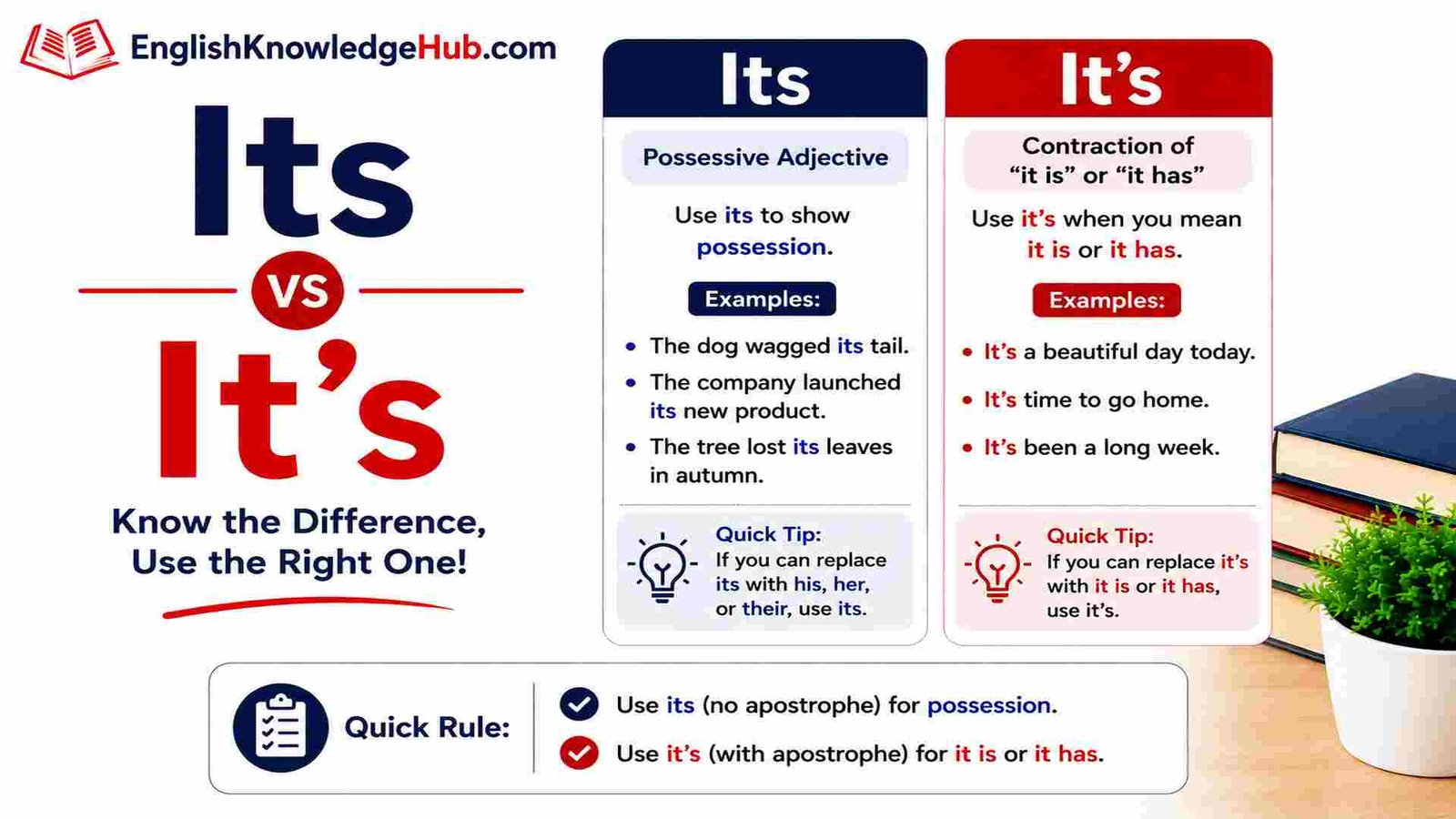
Its vs It’s: Its shows that something belongs to or is connected with a thing, animal, place, or group. It’s is the short form of it is or it has. If you can replace the word with it is or it has, use it’s. If you are showing belonging, use its.
That is the main rule behind Its vs It’s.
The two forms sound exactly the same when we say them aloud. The difference only appears in writing, which is why even good writers sometimes mix them up.
Look at these two sentences:
- The puppy lifted its paw.
- It’s waiting by the door.
In the first sentence, the paw belongs to the puppy.
In the second sentence, it’s means it is.
Once you understand what the apostrophe is doing, the difference becomes much easier.
Its vs It’s: The Quick Rule
Remember these two meanings:
Its = belonging to it
It’s = it is or it has
For example:
- The chair has lost its cushion.
- It’s near the window.
Now test the second sentence:
- It is near the window.
It still makes sense, so it’s is correct.
Now look at this sentence:
- The chair has lost its cushion.
Would this work?
- The chair has lost it is cushion.
No.
That tells you that its is the correct choice.
Its vs It’s in a Simple Table
| Word | What it means | Example |
|---|---|---|
| its | belonging to it | The plant needs its water. |
| it’s | it is | It’s very hot outside. |
| it’s | it has | It’s been an exhausting day. |
The apostrophe is not there to show ownership. In it’s, the apostrophe tells you that letters have been left out.
When Should You Use “Its”?
Use its when something belongs to, comes from, or is connected with the thing you are talking about.
For example:
- The bird returned to its nest.
- The phone fell out of its case.
- The school changed its lunch menu.
- The tree is losing its leaves.
- The company moved its main office.
- The car needs its front tire checked.
In each sentence, its connects one thing to another.
The nest belongs to the bird.
The case belongs to the phone.
The menu belongs to the school.
The leaves are part of the tree.
Think of “Its” Like “His” or “Her”
Here is a useful way to remember it.
We write:
- his coat
- her bag
- their house
- our room
- its cover
We do not write hi’s to mean something belongs to him.
We also do not write it’s when we only want to show that something belongs to “it.”
That makes its easier to remember.
Why Doesn’t “Its” Have an Apostrophe?
This question causes a lot of confusion.
We often use an apostrophe when a noun shows possession.
For example:
- Daniel’s bicycle
- the girl’s hat
- the dog’s bowl
So you may think that something belonging to “it” should also use an apostrophe.
But possessive words such as these work differently:
- his
- hers
- yours
- ours
- theirs
- its
None of these needs an apostrophe to show possession.
That is why we write:
- The dog wagged its tail.
Not:
- The dog wagged it’s tail.
The apostrophe in it’s has another job. It shows that the expression has been shortened.
When Should You Use “It’s”?
Use it’s when you mean it is.
For example:
- It’s raining again.
- It’s almost dinner time.
- It’s too heavy for me.
- It’s a good place to study.
- It’s colder than I expected.
You can open each one into two words.
It’s raining again.
becomes:
It is raining again.
That proves that the apostrophe belongs there.
“It’s” Can Also Mean “It Has”
Many learners know that it’s can mean it is, but they forget that it can also mean it has.
For example:
- It’s been a busy morning.
This means:
- It has been a busy morning.
Here are a few more examples:
- It’s become much quieter.
- It’s stopped making noise.
- It’s been open since Monday.
- It’s grown quickly this year.
In these sentences, has is helping another verb such as been, become, stopped, or grown.
There is an important limit.
You normally cannot use it’s when has means that something owns or contains something.
For example:
Incorrect:
It’s four bedrooms.
Correct:
It has four bedrooms.
Explanation:
Here, has means that the house contains four bedrooms. It is not acting as a helping verb, so we keep it has in full.
A Five-Second Test for Choosing the Right Word
When you are unsure about Its vs It’s, stop and replace the word with:
it is
or:
it has
If one of those choices works, write it’s.
If neither one works and the sentence shows belonging, write its.
Try this example:
- The museum changed ___ opening hours.
Test it:
- The museum changed it is opening hours.
That sounds wrong.
So the correct sentence is:
- The museum changed its opening hours.
Now try:
- ___ getting dark.
Replace it:
- It is getting dark.
That works.
So write:
- It’s getting dark.
This test is simple, but it catches most mistakes.
Common Mistakes and How to Fix Them
Mistake 1: Using “It’s” for Something That Belongs to It
Incorrect:
The rabbit moved it’s ears.
Correct:
The rabbit moved its ears.
Explanation:
The ears belong to the rabbit. We are not saying it is ears, so no apostrophe is needed.
Mistake 2: Forgetting the Apostrophe in “It Is”
Incorrect:
Its very quiet in here.
Correct:
It’s very quiet in here.
Explanation:
The sentence means it is very quiet, so it’s is the correct form.
Mistake 3: Adding an Apostrophe Because You See Ownership
Incorrect:
The computer needs it’s power cable.
Correct:
The computer needs its power cable.
Explanation:
The cable is connected with the computer. Its shows this relationship.
Mistake 4: Writing “Its” When You Mean “It Has”
Incorrect:
Its been a great week.
Correct:
It’s been a great week.
Explanation:
The full form is it has been a great week, so we need an apostrophe.
Mistake 5: Writing “Its’”
Incorrect:
The shop changed its’ sign.
Correct:
The shop changed its sign.
Explanation:
Its’ is not the correct standard form. To show possession, simply write its.
Everyday Examples
These examples show how the two forms appear in normal conversation.
- It’s almost eight o’clock.
- The cat left its toy under the table.
- It’s much warmer today.
- The bottle has lost its cap.
- It’s been a nice weekend.
- The bus changed its route.
- It’s difficult to hear you from here.
- My tablet needs its charger.
Notice that the meaning decides the spelling.
The sound does not help because both forms sound the same.
Examples From Work
You may also see these words in emails, reports, and office messages.
- The company updated its website.
- It’s ready for the manager to review.
- The team changed its meeting time.
- It’s been a strong month for sales.
- The software improved its search feature.
- It’s important to check the figures again.
Using the correct form is especially helpful in professional writing because small grammar mistakes can make a message look less careful.
Examples From School and Academic Writing
Students also use both forms in essays and assignments.
- The study explains its main goal.
- It’s useful to compare the two answers.
- The planet follows its path around the star.
- It’s been studied for many years.
- The report gives its results in the final section.
- It’s clear that the two groups are different.
A good proofreading habit is to search your work for every its and it’s before you submit it.
Then use the replacement test on each one.
What About Formal Writing?
The grammar rule does not change in formal English.
You still use:
its for belonging
and:
it’s for it is or it has
However, very formal writing sometimes avoids contractions.
For example:
Less formal:
- It’s necessary to review the plan.
More formal:
- It is necessary to review the plan.
Both are correct.
The second one simply sounds more formal.
There is no similar choice with its. If you need the possessive form, its remains its.
Is There a British and American English Difference?
No major difference exists for this rule.
British English and American English both use:
- its to show possession
- it’s for it is
- it’s for it has
So you do not need to learn two different rules.
An Easy Memory Trick
Here is a simple way to picture the apostrophe.
Think of it’s as a tiny suitcase carrying missing letters.
When:
it is
becomes:
it’s
the letter i from is disappears.
When:
it has
becomes:
it’s
the letters ha disappear.
The apostrophe shows where letters have been removed.
But its is not a shortened form.
Nothing is missing.
It simply shows belonging.
That gives you an easy memory rule:
Missing letters? Use it’s.
Showing belonging? Use its.
FAQs
Is “its” a correct English word?
Yes. Its is the possessive form used when something belongs to or is connected with a thing, animal, place, organization, or idea.
Example:
- The library changed its closing time.
Is “it’s” always short for “it is”?
No. It’s can mean it is or it has.
For example:
- It’s cold. = It is cold.
- It’s been cold all week. = It has been cold all week.
Which is correct, “its name” or “it’s name”?
Its name is correct when you are talking about the name belonging to something.
Example:
- The restaurant changed its name.
Writing it’s name would mean it is name, which does not make sense.
Can “it’s” show possession?
No. It’s does not show possession.
Use its when something belongs to “it.”
Example:
- The machine needs its cover.
Is “its’” ever correct?
No. Its’ is not a standard English form.
Use either its or it’s, depending on the meaning.
How can I remember Its vs It’s?
Replace the word with it is or it has. If the sentence still makes sense, use it’s. If you are showing belonging, use its.
Should I use “it’s” in formal writing?
You can, but some formal writing prefers the full form it is or it has. The choice depends on the style and level of formality.
Final Thoughts
The difference between Its vs It’s comes down to one simple question: are you showing belonging, or are you shortening two words?
Use its when something belongs to or is connected with something.
Use it’s when you mean it is or it has.
Whenever you feel unsure, replace the word with it is or it has. If the sentence still sounds right, you need the apostrophe. If it does not, and you are showing possession, use its.
For more clear grammar lessons, word comparisons, and easy English explanations, visit EnglishKnowledgeHub.com.
