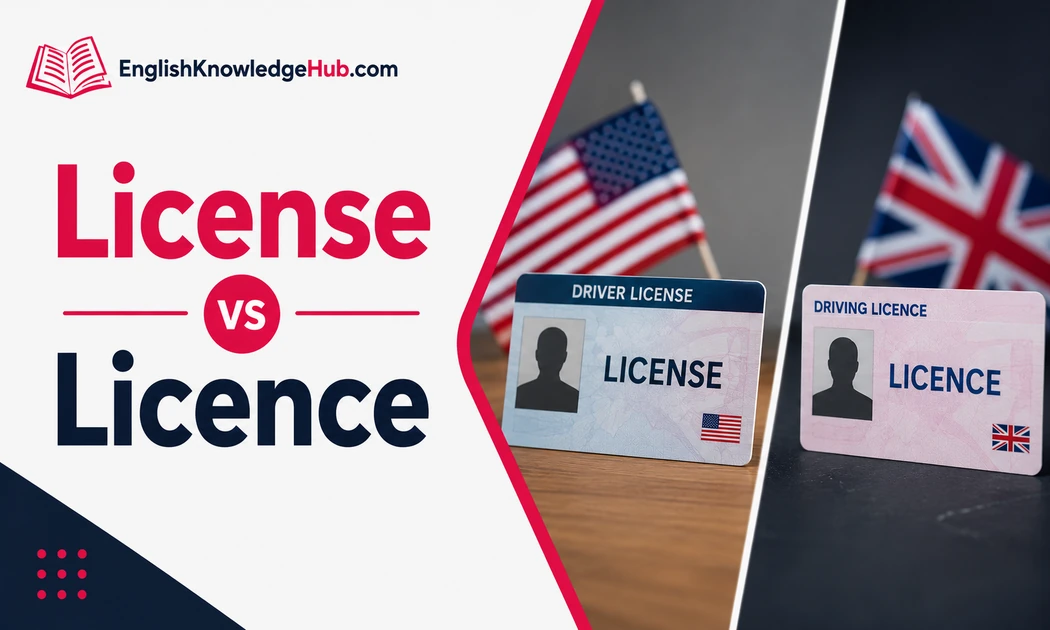
License vs Licence can both be correct, but the right spelling depends on the type of English you use and whether the word acts as a noun or a verb.
In American English, use license for both the noun and the verb. In British English, use licence as a noun and license as a verb. Cambridge, Merriam-Webster, and UK government style guidance all reflect this difference.
So, are you writing about a driving permit, software permission, or the act of giving official approval? This guide explains the correct spelling, meaning, pronunciation, origin, usage, common phrases, and mistakes in simple terms.
Quick Answer: License or Licence?
Here is the easiest way to remember the difference:
| English style | Noun | Verb |
|---|---|---|
| American English | license | license |
| British English | licence | license |
| Australian English | licence | license |
Australian Government writing guidance also treats licence as the noun and license as the verb.
Simple examples
American English:
- I renewed my driver’s license.
- The state will license the new business.
British English:
- I renewed my driving licence.
- The council will license the new business.
That small change from c to s is the main point behind License vs Licence.
What Does Licence Mean?
Licence is mainly the British spelling of the noun.
It means official permission to do, use, own, sell, or operate something. It can also mean the document that proves you have that permission. Cambridge defines licence as the UK noun, while American English uses license.
For example:
- a driving licence
- a fishing licence
- a television licence
- a business licence
- a software licence
You can think of a licence as the permission you have.
Example
Maya received her driving licence last week.
Here, licence names a thing, so it works as a noun.
What Does License Mean?
License has two important uses.
In American English, it works as both a noun and a verb. In British English, it is normally the verb form.
As a verb, to license means to officially allow someone or something to do an activity.
For example:
- The government can license a company.
- The board licensed her to practise professionally.
- The owner agreed to license the software to another firm.
- The city may license restaurants to sell alcohol.
Think of license as the action of giving permission.
License vs Licence in American English
The License vs Licence question becomes very simple in American English.
Use license with an s whether the word is a noun or a verb. Merriam-Webster lists license as the standard American form and also recognizes licence as a variant, while Cambridge identifies licence specifically as the UK noun form.
As a noun
- She has a driver’s license.
- I need a fishing license.
- The company bought a software license.
As a verb
- The state will license the clinic.
- The agency licensed three new operators.
- The studio may license the character for use in a game.
If your audience is mainly in the United States, license is usually the safest choice.
License vs Licence in British English
British English makes a clear distinction.
Use:
- licence for the noun
- license for the verb
UK government writing guidance gives the same rule. For example, a person may hold a licence, while an authority may license that person to carry out an activity.
Compare these sentences
Noun:
You need a valid licence to operate the vehicle.
Verb:
The authority can license qualified drivers.
Noun:
The restaurant has an alcohol licence.
Verb:
The council licensed the restaurant to sell alcohol.
Once you identify whether the word names a thing or describes an action, the British spelling becomes much easier.
A Simple Trick to Remember Licence and License
Not sure which spelling to choose in British English?
Think about advice and advise.
- advice is a noun
- advise is a verb
The same c for noun, s for verb idea can help you remember:
- licence = noun
- license = verb
The pronunciation does not change in the same way as advice and advise, but the spelling trick is still useful.
Another easy question is:
Do I have it, or am I giving it?
If you have a licence, it is a noun.
If an authority licenses you, it is a verb.
Do License and Licence Have Different Meanings?
Usually, no.
The difference is mainly about spelling, grammar, and regional English, not a completely different meaning.
Both forms connect to the idea of permission or authority. The important question is how the word functions in your sentence and which English style you follow.
This is why someone in London may write:
I have a driving licence.
Someone in the United States may write:
I have a driver’s license.
Both sentences are correct in their own language varieties.
Licence and License Pronunciation
Here is some good news: licence and license are pronounced the same in normal English.
Cambridge gives the pronunciation of licence as approximately LYE-suhns, and the American noun license has the same basic sound.
So, the difference matters mainly in writing.
You do not need to change the way you say the word when switching between British and American spelling.
Common Real-World Uses
Understanding License vs Licence becomes easier when you see the words in familiar phrases.
| American English | British English |
|---|---|
| driver’s license | driving licence |
| business license | business licence |
| software license | software licence |
| fishing license | fishing licence |
| marriage license | marriage licence |
| professional license | professional licence |
Cambridge specifically distinguishes the US phrase driver’s license from the UK driving licence.
But what happens when it becomes a verb?
The spelling normally uses s:
- The company licensed the software.
- She is a licensed professional.
- The authority is licensing new operators.
This is true even in British English because these forms come from the verb license. UK government material commonly uses forms such as licensed and licensing.
What Is a Software License or Software Licence?
You may see both spellings when installing apps, games, or computer programs.
In American English, write:
software license
In British English, write:
software licence
The meaning remains the same. It refers to permission or legal terms that control how software may be installed, copied, shared, or used.
When describing the action, both styles can use license:
The developer licenses its software to businesses.
Driving License or Driving Licence?
This is one of the most common areas of confusion.
In the UK, the normal term is driving licence. GOV.UK and Cambridge use this spelling.
In American English, the common term is driver’s license. Cambridge identifies this expression as the US form.
So:
UK:
She passed her test and received her driving licence.
US:
She passed her test and received her driver’s license.
If you are filling out an official form, always copy the spelling used by the authority that issued the document.
Artistic Licence or Artistic License?
Both forms can also describe freedom to change facts, rules, or details for a creative purpose.
In British English, write:
artistic licence
poetic licence
In American English, write:
artistic license
poetic license
The word is a noun in these phrases, so British English uses licence. Collins lists this wider noun meaning as freedom of action or an intentional departure from normal rules for an effect.
For example:
The film used artistic licence when telling the historical story.
This does not mean someone received an official document. It means the creator took some freedom with the facts or normal rules.
Origin and Word History
The history of these spellings helps explain why both forms exist.
Licence entered English in the late 1300s through Old French licence. That word came from Latin licentia, connected with freedom, permission, and something being allowed.
English used several spellings during the Middle English period. Over time, British usage developed a stronger distinction between licence as the noun and license as the verb. American English moved toward using license for both jobs.
So, the two spellings are not simply a modern typo. They reflect different spelling traditions that developed over many years.
Common Mistakes to Avoid
1. Using licence as a British verb
Incorrect in standard British usage:
The council will licence the shop.
Preferred:
The council will license the shop.
Remember, the action uses license.
2. Using licence in normal American writing
Avoid:
I renewed my driver’s licence.
For an American audience, write:
I renewed my driver’s license.
3. Mixing styles in one article
You might write business licence in one paragraph and business license in another.
Both forms may exist in English, but switching between regional styles can make your writing look inconsistent.
Choose American or British English and stay with it.
4. Assuming every word ending in licence needs a c
Look at the grammar first.
British noun:
The driver has a licence.
Verb:
The authority licensed the driver.
Adjective:
She is a licensed driver.
5. Thinking the pronunciation changes
The spelling changes, but the normal pronunciation stays essentially the same.
Licence, Licensed, and Licensing
Here is a simple word-family guide:
| Word | Main role | Example |
|---|---|---|
| licence | British noun | She has a licence. |
| license | verb | They license drivers. |
| license | American noun | He has a license. |
| licensed | adjective or verb form | She is a licensed pilot. |
| licensing | noun or verb form | Licensing rules have changed. |
| licensee | noun | The licensee received permission. |
| licensor | noun | The licensor owns the rights. |
The forms licensed and licensing come from the verb license, which is why the s spelling appears even in British usage.
Which Spelling Should You Use?
Ask yourself two questions.
Are you writing in American English?
Use license.
Examples:
- driver’s license
- business license
- software license
- license a company
Are you writing in British English?
First identify the part of speech.
Use licence when it is a noun:
I need a licence.
Use license when it is a verb:
They will license the company.
This simple check solves most License vs Licence spelling problems.
Final Thoughts
The main difference between License vs Licence comes down to region and grammar. American English normally uses license for both the noun and verb. British English uses licence for the noun and license for the verb.
When in doubt, ask whether you are talking about permission you have or the action of giving permission. That small check can help you choose the right spelling every time.
Want to make confusing English words easier to understand? Explore more clear spelling, grammar, and word comparison guides at EnglishKnowledgeHub.com.
