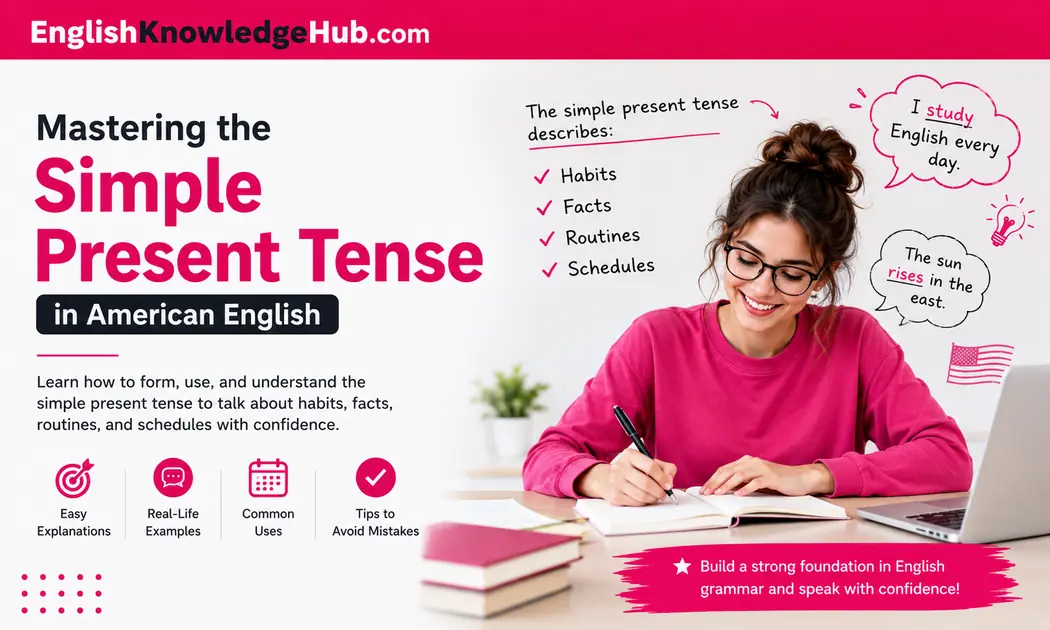
Mastering the Simple Present Tense in American English becomes much easier when you understand a few basic rules. We use the simple present for habits, routines, general facts, states, and fixed schedules.
For example, I walk to work every day describes a routine, while She lives in Chicago describes a current fact.
In this guide, you will learn when to use the simple present, how verbs change with he, she, and it, how to make questions and negative sentences, and how to avoid common mistakes. You will also find clear examples and exercises to practice what you learn.
What Is the Simple Present Tense?
The simple present is a verb tense used for regular actions, general facts, states, and some scheduled future events.
Cambridge Grammar explains that the present simple uses the base form of a verb, with -s normally added for the third person singular, such as he, she, and it.
Here is the basic pattern:
| Subject | Verb | Example |
|---|---|---|
| I, you, we, they | work | They work here. |
| he, she, it | works | She works here. |
The same rule applies when the subject is a person’s name or one thing.
David works downtown.
David takes the same verb form as he.
One useful point to know is that these main grammar rules are not unique to American English. British English uses the simple present in much the same way. This guide focuses on natural American English wording and examples.
When Do We Use the Simple Present?
The easiest way to understand this tense is to look at what the sentence means.
Habits and Routines
Use the simple present for something that happens regularly.
I check my email every morning.
She goes to the gym on Fridays.
Words such as always, usually, often, sometimes, rarely, and never often appear with routines.
However, you do not need one of these words in every sentence.
He plays basketball.
This can still describe something he does regularly.
Facts and General Truths
Use this tense for facts and things that are generally true.
Water freezes at 32°F.
Plants need water.
It can also describe a fact about someone’s life:
My sister lives in Boston.
The situation does not have to last forever. It is simply presented as a current fact.
States, Feelings, and Thoughts
Some verbs describe a state, thought, feeling, need, or preference rather than an action in progress.
Common examples include:
know, believe, understand, like, love, want, need, prefer, own
For example:
I know the answer.
She wants some coffee.
They own a small business.
This matters because not everything happening now needs an -ing form.
You normally say:
I understand now.
Not:
I am understanding now.
Fixed Schedules
The simple present can describe a future event when its time is already set by a schedule.
The flight leaves at 8:30 tomorrow morning.
The class starts at 10 a.m.
The events are in the future, but the schedule is fixed.
This use is common for flights, trains, classes, store hours, movies, and other planned schedules.
How to Form the Simple Present
For I, you, we, and they, use the base form of the verb.
I work.
They work.
With he, she, and it, usually add -s.
He works.
She reads.
It looks good.
This rule also applies to a singular name or thing:
Emma drives to work.
The store closes at nine.
When to Add -es
Some verbs take -es instead of only -s.
This commonly happens with verbs ending in -ch, -sh, -ss, -x, and -z.
| Base Verb | He, She, It |
| watch | watches |
| wash | washes |
| miss | misses |
| fix | fixes |
| buzz | buzzes |
Two common forms worth remembering are:
go → goes
do → does
Verbs Ending in Y
When a consonant comes before y, change the y to i and add -es:
study → studies
try → tries
carry → carries
When a vowel comes before y, keep the y and add -s:
play → plays
enjoy → enjoys
For example:
She studies English and plays tennis.
That one sentence shows both spelling patterns.
The Verb “Be” Works Differently
The verb be does not follow the usual pattern.
| Subject | Form |
| I | am |
| you, we, they | are |
| he, she, it | is |
For example:
I am tired.
She is busy.
They are ready.
You also form questions and negatives differently with be.
She is not busy.
Is she busy?
You do not use do or does here.
How Do Have and Do Change?
The verb have becomes has with he, she, and it:
I have a car.
She has a car.
The verb do becomes does:
They do their homework after dinner.
He does his homework after dinner.
These forms matter again when you start making questions and negative sentences.
How to Make Negative Sentences
For most verbs, use do not or does not.
The pattern is:
I/you/we/they + do not + base verb
he/she/it + does not + base verb
In everyday American English, the shorter forms don’t and doesn’t are very common.
I don’t drink coffee.
She doesn’t drive to work.
The important rule is that the main verb stays in its base form after doesn’t.
Compare:
She works here.
She doesn’t work here.
Not:
She doesn’t works here.
The -s is already carried by does, so it is not added to the main verb.
How to Ask Simple Present Questions
Most questions use do or does.
Use do with I, you, we, and they:
Do you live here?
Use does with he, she, and it:
Does he work here?
The main verb stays in its base form:
Does she like coffee?
Not:
Does she likes coffee?
For questions beginning with words such as where, when, what, or why, use this pattern:
Question word + do/does + subject + base verb
For example:
Where do you work?
When does she leave?
Why Do We Say “Who Works Here?”
There is an important exception that many basic grammar guides do not explain clearly.
Look at this question:
Who works here?
We do not normally say:
Who does work here?
In Who works here?, the word who is the subject. It asks which person performs the action, so does is not needed.
Now compare:
Who does Sarah work with?
Here, Sarah is the subject. Who asks about another person, so does is needed.
This difference becomes useful when you start asking more natural questions in English.
Simple Present vs. Present Continuous
A common problem when mastering the simple present tense in American English is knowing when to use the simple present instead of the present continuous.
The simple present usually describes something regular, general, or seen as a fact.
I work from home.
This describes my normal work situation.
The present continuous often describes something happening now or a temporary situation.
I am working from home today.
This tells us what is happening today and may not be my normal routine.
Another simple comparison is:
She reads before bed.
This is a habit.
She is reading now.
This is happening at this moment.
A useful question to ask yourself is:
Is this regular or generally true?
The simple present is probably right.
Is this happening around now or only for a temporary period?
The present continuous may be better.
Remember that state verbs such as know, want, believe, and understand often stay in the simple present even when the state is true right now.
Where Do Frequency Words Go?
Words such as always, usually, often, sometimes, rarely, and never tell us how often something happens.
With most verbs, they usually come before the main verb:
I usually eat breakfast at home.
She often walks to work.
They never arrive late.
With the verb be, they normally come after it:
She is always busy.
They are usually ready by eight.
Compare:
He often works late.
He is often tired.
This small word order difference can make your English sound more natural.
Can the Simple Present Talk About the Future?
Yes.
Fixed schedules are one example:
The train leaves at 7:30 tomorrow.
There is also another future use that is easy to miss.
After words such as when, before, after, as soon as, and if, English often uses the simple present even when the action will happen later.
For example:
I’ll call you when I get home.
Getting home is in the future, but we use get, not will get.
Another example:
We’ll eat after she arrives.
Not:
We’ll eat after she will arrive.
Cambridge Grammar notes this use of the present simple in future time clauses after words such as when, before, as soon as, and if.
This rule is useful because sentences like these appear often in everyday American English.
Common Simple Present Mistakes
Most errors come from a small number of grammar rules. Fixing these patterns is more useful than memorizing many separate sentences.
| Incorrect | Correct | Reason |
| He work here. | He works here. | Use the third-person form with he. |
| She don’t drive. | She doesn’t drive. | Use doesn’t with she. |
| Does he works here? | Does he work here? | Use the base verb after does. |
| She doesn’t likes it. | She doesn’t like it. | Use the base verb after doesn’t. |
| I am know the answer. | I know the answer. | Know normally describes a state. |
| Are you work here? | Do you work here? | Use do with a normal main verb. |
When checking your own sentence, first look at the subject. If it is he, she, it, or one person or thing, check whether the verb needs to change.
Then look for does or doesn’t. If one is present, the main verb should normally be in its base form.
Simple Present Tense Examples
These examples show the main uses without adding extra rules:
| Sentence | Use |
| I take the bus to work. | Routine |
| She lives in New York. | Current fact |
| We prefer tea. | Preference |
| The store opens at nine. | Fixed schedule |
| Does he work here? | Question |
| They don’t eat meat. | Negative |
| I’ll text you when I arrive. | Future time clause |
A good way to practice is to take one sentence and change its form.
Start with:
She works here.
Make it negative:
She doesn’t work here.
Now make it a question:
Does she work here?
This helps you see how the parts of the tense work together.
Simple Present Tense Exercises
Practice is an important part of mastering the simple present tense in American English. Complete each sentence with the correct form of the verb.
- She ___ (work) at a hospital.
- They ___ (live) near the school.
- My brother ___ (study) every evening.
- He ___ not ___ (drink) coffee.
- ___ she ___ (drive) to work?
- The train ___ (leave) at 7:30 tomorrow.
- I ___ (know) the answer.
- We will call you when we ___ (arrive).
- Who ___ (work) in this office?
- Sarah usually ___ (watch) TV after dinner.
Answers
- works
- live
- studies
- does not drink or doesn’t drink
- Does, drive
- leaves
- know
- arrive
- works
- watches
Quick Simple Present Grammar Guide
Use this table when you need a quick reminder:
| Sentence Type | I, You, We, They | He, She, It |
| Positive | They work. | She works. |
| Negative | They don’t work. | She doesn’t work. |
| Question | Do they work? | Does she work? |
The verb be follows its own pattern:
| Subject | Positive | Negative | Question |
| I | I am. | I am not. | Am I? |
| he, she, it | She is. | She isn’t. | Is she? |
| you, we, they | They are. | They aren’t. | Are they? |
This gives you the main forms in one place without having to remember a separate example for every subject.
Final Thoughts on Mastering the Simple Present Tense in American English
Mastering the simple present tense in American English becomes easier when you connect each grammar form to its meaning. Use this tense for regular actions, facts, states, and fixed schedules, and pay close attention to the verb when the subject is he, she, or it.
Practice changing a simple sentence into positive, negative, and question forms. Patterns such as she works, she doesn’t work, and does she work? will become easier to use as you practice them.
For more simple grammar, spelling, and English usage guides, visit EnglishKnowledgeHub.com and learn English with clear rules and useful examples.
