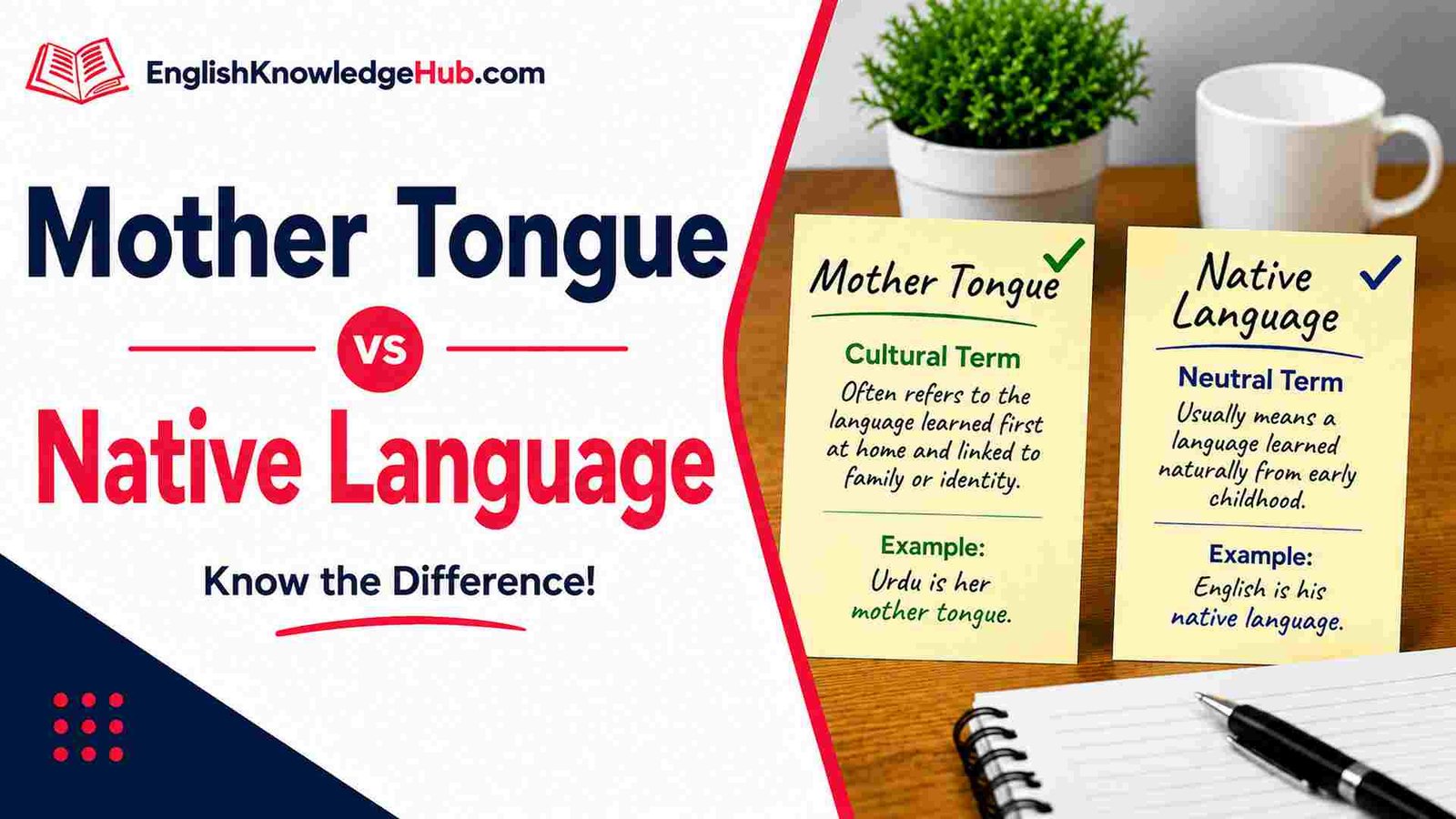
Mother tongue and native language usually refer to the language a person learned naturally in early childhood, and in everyday English they often overlap. Mother tongue can feel more personal or cultural, while native language is common in education, forms, and language-learning contexts. For multilingual people, one simple label may not always describe their experience perfectly.
In this article, you’ll learn Mother Tongue vs Native Language through first-language learning, bilingual and multilingual situations, cultural identity, formal usage, and related terms such as first language and native speaker. Cambridge defines mother tongue as the first language learned as a baby rather than one learned later at school or as an adult.
Mother Tongue vs Native Language: Quick Comparison
| Term | Usual Meaning | Main Focus |
|---|---|---|
| Mother tongue | A language learned naturally as a child | Family, home, community, or culture |
| Native language | A language learned naturally from childhood | Early language background |
| First language | A language learned first or during childhood | A neutral learning or language term |
| Dominant language | The language a person uses most or knows best now | Present-day use and language strength |
In Short
Mother tongue, native language, and first language often refer to the same language. The main difference is usually the focus. Mother tongue can show family or cultural connection, native language focuses on early language learning, and dominant language describes the language a person uses or handles most strongly today.
What Does Mother Tongue Mean?
A mother tongue is usually a language that is part of a person’s earliest language experience.
A person often learns it by hearing and using it with family members, caregivers, or people in the community.
For example:
Aisha grew up speaking Pashto at home, so Pashto is her mother tongue.
The term can also show a connection with family, heritage, or culture.
For example:
I use English at work, but Bengali is still my mother tongue.
This does not mean Bengali is the language the person uses most today. It simply shows their early language background.
Does Mother Tongue Mean a Language Learned From Your Mother?
No.
The phrase mother tongue should not be taken literally.
A person may learn the language from:
- a father
- grandparents
- brothers or sisters
- caregivers
- neighbors
- the wider community
and still call it their mother tongue.
For example:
Ravi learned Marathi mainly from his father and grandparents, but Marathi is still his mother tongue.
What Does Native Language Mean?
A native language also describes a person’s early language background.
It usually refers to a language a person learned naturally, not a language they studied later in school or as an adult.
For example:
Elena grew up speaking Italian, so Italian is her native language.
Now imagine someone who grew up speaking Dutch but later spent many years living in England.
English may become the language they use most, but Dutch can still be their native language.
This shows an important point:
Native language and strongest language are not always the same.
Are Mother Tongue and Native Language the Same?
In many everyday situations, yes.
The two terms are often used in the same way.
A person may say:
Arabic is my mother tongue.
Arabic is my native language.
Arabic is my first language.
All three sentences can describe the same language background.
The difference becomes useful when you want to focus on a certain part of that background.
Where the Difference Appears
Mother Tongue Can Focus on Family or Heritage
Mother tongue may give more attention to:
- home life
- family background
- culture
- heritage
- community
Example:
Sara works in English, but Urdu is still her mother tongue.
Native Language Can Focus on Early Learning
Native language often works well when you want to compare a language learned early with one learned later.
Example:
Korean is Min-jun’s native language, while French is a language he learned at university.
These are common patterns, not strict rules.
Native Language Is Not the Same as Dominant Language
This is one of the most essential differences to understand.
Your native language tells us about your early language background.
Your dominant language usually tells us which language you use most or handle best now.
For example, Mariam spoke Dari when she was young. Later, she moved to an English-speaking country and studied and worked in English.
As an adult:
- Dari may be her mother tongue.
- Dari may be her native language.
- Dari may be her first language.
- English may be her dominant language.
This wording explains both her past and her present language use clearly.
Mother Tongue, First Language, and Native Language
These three terms often have very similar meanings.
Mother Tongue
Often used when family, home, heritage, or culture is important.
Tamil is her mother tongue.
First Language
A simple and neutral term often used in education.
His first language is Vietnamese.
Teachers and language experts may also use L1 to mean first language.
Native Language
Often used when talking about a person’s early natural language background.
Arabic is one of her native languages.
In many situations, all three terms can describe the same language.
Can You Have Two Native Languages?
Yes.
A child can grow up learning two languages at the same time.
For example, one parent may speak Spanish and the other may speak German. The child may use both languages naturally from a young age.
It would be correct to say:
Spanish and German are both his native languages.
You could also say:
He grew up with two mother tongues.
A bilingual person does not always need to choose only one native language.
Can Your Native Language Change?
Your language skills can change over time.
A person may become stronger in another language because of:
- education
- work
- moving to another country
- relationships
- social life
- daily use
However, it is usually clearer to say that the dominant language changed.
For example:
Less precise:
English became my native language after I moved abroad.
More precise:
English became my dominant language after I moved abroad.
The second sentence explains the change more clearly.
What Is a Home Language?
A home language is a language spoken in the home.
It may also be a person’s mother tongue or native language, but not always.
For example:
The family speaks Punjabi at home, while the children also use English at school and in daily life.
Here, Punjabi is clearly the home language.
The term is useful because it tells us where the language is used without guessing which language is strongest.
Mother Tongue Does Not Equal Nationality
Nationality does not decide a person’s mother tongue.
Two people from the same country may grow up speaking different languages.
Incorrect:
She is Canadian, so English must be her mother tongue.
Correct:
She is Canadian, but French is her mother tongue.
Explanation:
Nationality tells us about a person’s country. It does not always tell us which language they learned first.
Official Language and Native Language Are Different
An official language is a language used officially by a government or institution.
A native language is connected with a person’s own language background.
These are not the same thing.
A country may have one official language while many people speak other languages at home.
Native Language vs Native Speaker
A native language is a language that is part of a person’s early language development.
A native speaker is a person who grew up learning and using that language naturally.
For example:
English is her native language, so she is a native English speaker.
Some people grow up with two languages and may be native speakers of both.
How These Terms Work in Daily Conversation
Daily Conversation
“What’s your mother tongue?”
“Gujarati, but I use English most of the day.”
“Is French your native language?”
“Yes. I grew up speaking it.”
Workplace English
Sofia’s native language is Portuguese, but she leads most meetings in English.
Danish is his first language, but English is his main work language.
Academic English
Participants completed the survey in their first language.
The researchers compared native speakers with advanced second-language learners.
Formal Writing
Please state your first language and any other languages you speak professionally.
The interpreter translated the statement into the speaker’s native language.
Common Mistakes
Mistake 1: Calling Every Fluent Language Native
Incorrect:
I learned English at university, and now I speak it fluently, so English is my native language.
Correct:
I learned English at university, and now I speak it fluently.
Explanation:
Fluent tells us how well a person uses a language. Native usually tells us about early language background.
Mistake 2: Treating Work Language as Native Language
Incorrect:
Daniel uses English every day at work, so English is his native language.
Correct:
Daniel uses English every day at work, but Polish is his native language.
Explanation:
Using a language often does not automatically make it native.
Mistake 3: Taking Mother Tongue Literally
Incorrect:
Arabic cannot be her mother tongue because she learned it mainly from her grandfather.
Correct:
Arabic can still be her mother tongue because it was part of her early language background.
Explanation:
The term does not mean that the language must come from a person’s mother.
Mistake 4: Thinking Bilingual People Have Only One Native Language
Incorrect:
You must choose which language is your real native language.
Correct:
Spanish and English are both her native languages.
Explanation:
A person can grow up learning more than one language naturally.
Mistake 5: Confusing Official and Native Language
Incorrect:
German is an official language where he lives, so it must be his native language.
Correct:
German is an official language where he lives, but Italian is his native language.
Explanation:
Official language describes a country or institution. Native language describes a person’s own language background.
Which Term Should You Use?
Use mother tongue when you want to focus on family, heritage, culture, or early home language.
Bengali is my mother tongue.
Use native language when you want to describe someone’s early language background.
Korean is her native language.
Use first language when you want a simple and neutral term.
Urdu is his first language.
Use dominant language when you mean the language a person uses or handles most strongly now.
Spanish was her first language, but English is now her dominant language.
Is Mother Tongue Formal or Informal?
Mother tongue is a standard English term.
It is used in education, dictionaries, language policy, and formal writing.
However, first language may sound more neutral in academic or professional writing.
For example:
Participants whose first language was not English completed an extra task.
Both terms can be correct. The better choice depends on the situation.
British vs American English
There is no strong British and American difference here.
Both mother tongue and native language are understood in British and American English.
It would be wrong to say:
British English = mother tongue
American English = native language
Choose the term based on meaning, not country.
A Simple Way to Remember
Ask yourself two questions:
Which language did the person learn naturally during childhood?
That may be their mother tongue, native language, or first language.
Which language do they use most strongly today?
That may be their dominant language.
This simple difference solves most of the confusion.
FAQs About Mother Tongue vs Native Language
Is mother tongue the same as native language?
Yes, in many cases. Both often describe a language learned naturally during childhood.
What is the difference between mother tongue and first language?
They often mean the same thing. First language is usually a more neutral term.
Can I have two native languages?
Yes. If you grew up learning two languages naturally, both can be your native languages.
Can English be my native language if my parents speak another language?
Yes. If English was part of your early natural language development, it can be one of your native languages.
Can a second language become your native language?
Usually, it is clearer to say that it became your dominant language.
Does mother tongue mean the language of your mother?
No. The language may come from family members, caregivers, or the wider community.
Is fluent English the same as native English?
No. Fluent describes ability, while native usually describes language background.
What should I write as my mother tongue on a form?
Usually, write the language you first grew up speaking. If the form gives special instructions, follow them.
Final Thoughts
Mother tongue and native language usually describe the same broad idea, and in many everyday situations, they can be used in the same way.
The main difference is the focus. Mother tongue can show family, culture, or heritage, while native language usually focuses on early language background. First language is a simple neutral term, while dominant language describes the language a person uses or handles most strongly now.
The main thing to remember is this: how you learned a language and how often you use it today are not always the same thing.
For more simple guides about English meanings, grammar, usage, and commonly confused words, visit EnglishKnowledgeHub.com.