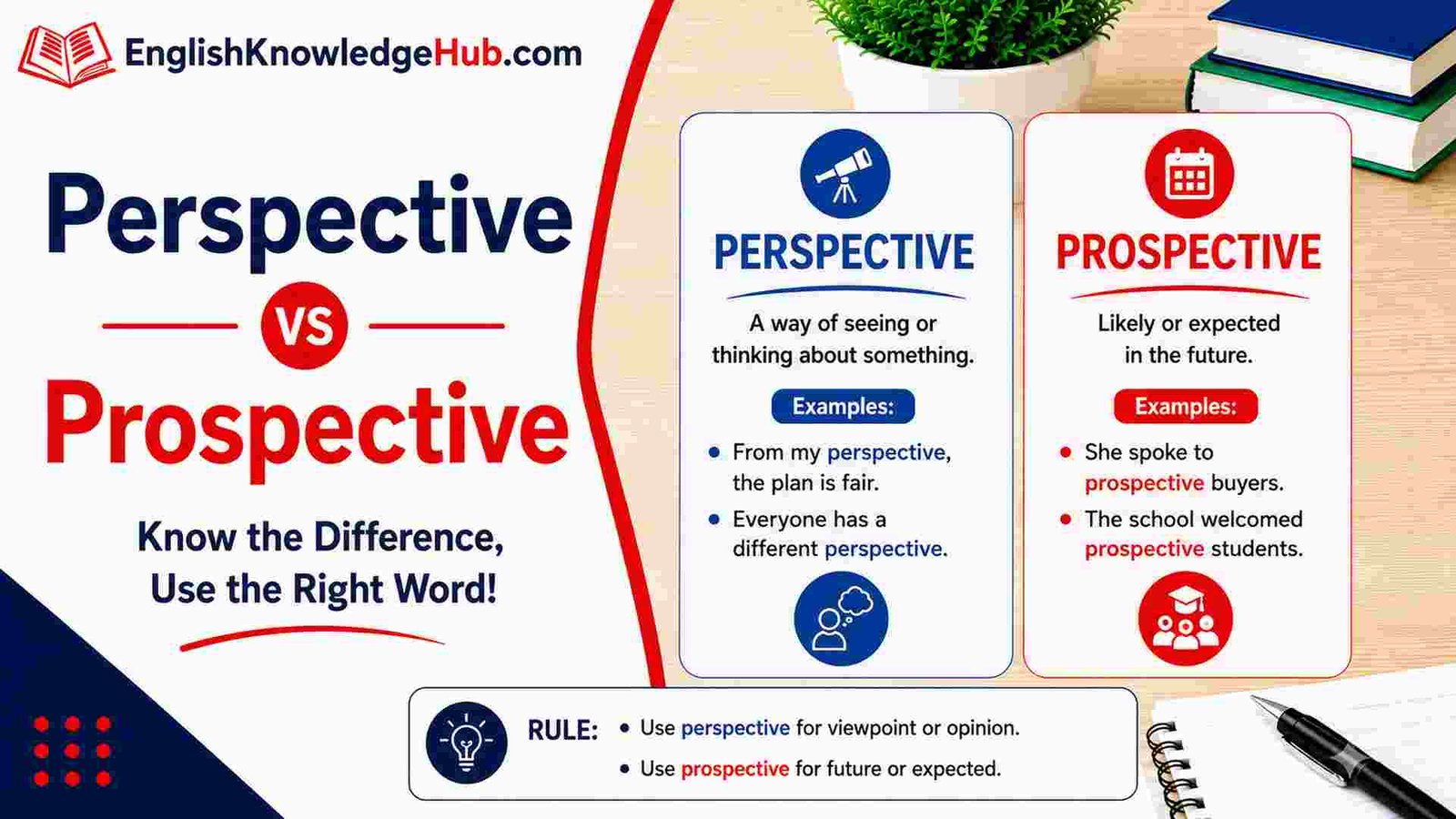
Perspective and prospective are both correct words, but they describe different ideas. Perspective is usually a noun meaning a point of view, way of seeing something, sense of proportion, or the visual technique that creates depth. Prospective is an adjective meaning expected, future, or likely to become. A buyer has a perspective; a prospective buyer is someone who may buy.
In this article, you’ll learn how Perspective or Prospective differ in meaning, grammar, pronunciation, common phrases, academic and workplace use, and confusing combinations such as prospective student, future perspective, and from my perspective. Merriam-Webster defines perspective as a point of view or way of seeing things and prospective as relating to the future or likely to become something.
The Fastest Difference: Viewpoint vs Future Possibility
If you mean viewpoint, outlook, or way of seeing, choose perspective. If you mean future, expected, or possible, choose prospective.
“From a customer’s perspective, the form is too long” talks about a viewpoint. “A prospective customer asked about pricing” describes someone who may become a customer.
This one contrast solves most real-life mistakes.
What “Perspective” Means as a Point of View
The most common modern use of perspective is a mental viewpoint: the way a person understands or interprets a situation.
“Try to see the issue from her perspective.” “The documentary offers a different perspective on the event.” “From a financial perspective, the plan is risky.”
The phrase from my perspective is close to “in my view” or “from my point of view.” It does not mean anything about the future.
“Keep It in Perspective” Has a Special Meaning
Another common use is about relative importance. If someone says “Keep the problem in perspective,” they mean do not let one issue seem larger or more important than it really is when compared with everything else.
Similarly, “The new information put the setback into perspective” means it helped someone understand the setback in a more balanced way.
This meaning is about proportion and judgment, not visual art or future events.
Perspective in Art and Design
Perspective also names the technique of representing depth and distance on a flat surface. In perspective drawing, lines and object sizes are arranged so a two-dimensional image appears three-dimensional.
A designer may use one-point or two-point perspective. A photographer can talk about perspective when discussing how distance and camera position affect the scene.
This visual sense connects naturally with illusion because perspective can create an impression of depth. If those two words are part of your vocabulary study, our Allusion vs Illusion guide explains the separate meaning of illusion.
What “Prospective” Means
Prospective is an adjective. It describes something connected with the future or someone/something likely to become a particular thing.
“Prospective students attended the campus tour.” These people may become students. “The company contacted prospective clients.” They are possible future clients. “We discussed the prospective benefits of the change.” The benefits are expected or anticipated rather than already certain.
Because prospective is usually an adjective, it commonly appears directly before a noun.
Common “Prospective + Noun” Combinations
You will often see prospective buyer, prospective student, prospective employee, prospective employer, prospective client, prospective tenant, prospective parent, and prospective candidate.
The meaning is generally “someone who may become this” or “something being considered for the future.”
“A prospective employer” is an organization you may work for. “A prospective employee” is a person the organization may hire. The adjective works from either side of the potential future relationship.
Prospective vs Potential
Potential and prospective can overlap when describing a possible future person or outcome, but they are not identical in every sentence.
“Prospective customer” strongly suggests someone being considered as a future customer. “Potential customer” can be broader, describing anyone who could possibly become one.
In many business contexts, both sound natural. Prospective can feel slightly more formal and more connected to an expected future role.
Prospective vs Retrospective
Prospective looks forward. Retrospective looks backward.
This distinction is especially important in research. A prospective study follows participants forward from a starting point. A retrospective study looks back at existing information or past events.
The same contrast appears outside research: a retrospective review examines the past, while a prospective plan considers what may happen next.
“Future Perspective” and “Prospective” Are Not Interchangeable
A future perspective means a viewpoint focused on the future. Prospective means future-related or likely to happen/become.
“From a future perspective, the investment may look wise” talks about how something might be viewed later. “The prospective return on the investment is uncertain” talks about an expected future return.
The word perspective does not become prospective simply because the topic is the future.
Pronunciation and Spelling
The words are easy to confuse because only a few letters change. Perspective contains per-spec-, while prospective contains pro-spec-.
A useful spelling link is prospective → prospect. A prospect is something expected or a possible future person/opportunity. Perspective, by contrast, connects to how you see or view something.
Common Mistakes and Better Choices
Incorrect: From my prospective, the deadline is too short.
Correct: From my perspective, the deadline is too short.
The writer is expressing a viewpoint.
Incorrect: We invited perspective students to the open day.
Correct: We invited prospective students to the open day.
The students may enroll in the future.
Incorrect: The artist used prospective to create depth.
Correct: The artist used perspective to create depth.
The sentence refers to the visual technique.
How the Difference Appears at Work and School
At work: “From the manager’s perspective, the change saves time.” “The sales team contacted twenty prospective clients.”
At university: “The essay compares two historical perspectives.” “Prospective students must submit the application by March.”
In research: “The authors discuss the issue from a public-health perspective.” “The team designed a prospective study that will follow participants for five years.”
The part of speech and time direction make the correct word easy to identify.
A Quick Replacement Test
| If you can replace it with… | Use | Example |
|---|---|---|
| viewpoint / outlook | perspective | From my perspective… |
| sense of proportion | perspective | Keep the problem in perspective. |
| visual depth technique | perspective | The drawing uses perspective. |
| future / expected | prospective | prospective benefits |
| possible future person | prospective | prospective buyer |
Frequently Asked Questions
What is the difference between perspective and prospective?
Perspective usually means viewpoint or visual depth. Prospective means future-related or likely to become.
Is it prospective student or perspective student?
Prospective student is correct for someone who may become a student.
Is it “from my perspective” or “from my prospective”?
From my perspective is correct because you are talking about a viewpoint.
Can perspective be an adjective?
Yes, though its noun uses are much more familiar. Dictionaries also record adjective uses related to visual perspective.
What is the opposite of prospective in research?
Retrospective is the common contrast.
Can prospective mean potential?
Often, especially for future customers, students, employees, or outcomes, though the words are not identical in every context.
Final Takeaway
For Perspective or Prospective, focus on the core idea. Perspective is about how something is seen, understood, or represented in depth. Prospective is about what may happen or what someone/something may become in the future. If you can replace the word with viewpoint, choose perspective; if you can replace it with future or potential, choose prospective.
For more clear and practical English word comparisons, explore EnglishKnowledgeHub.com.
