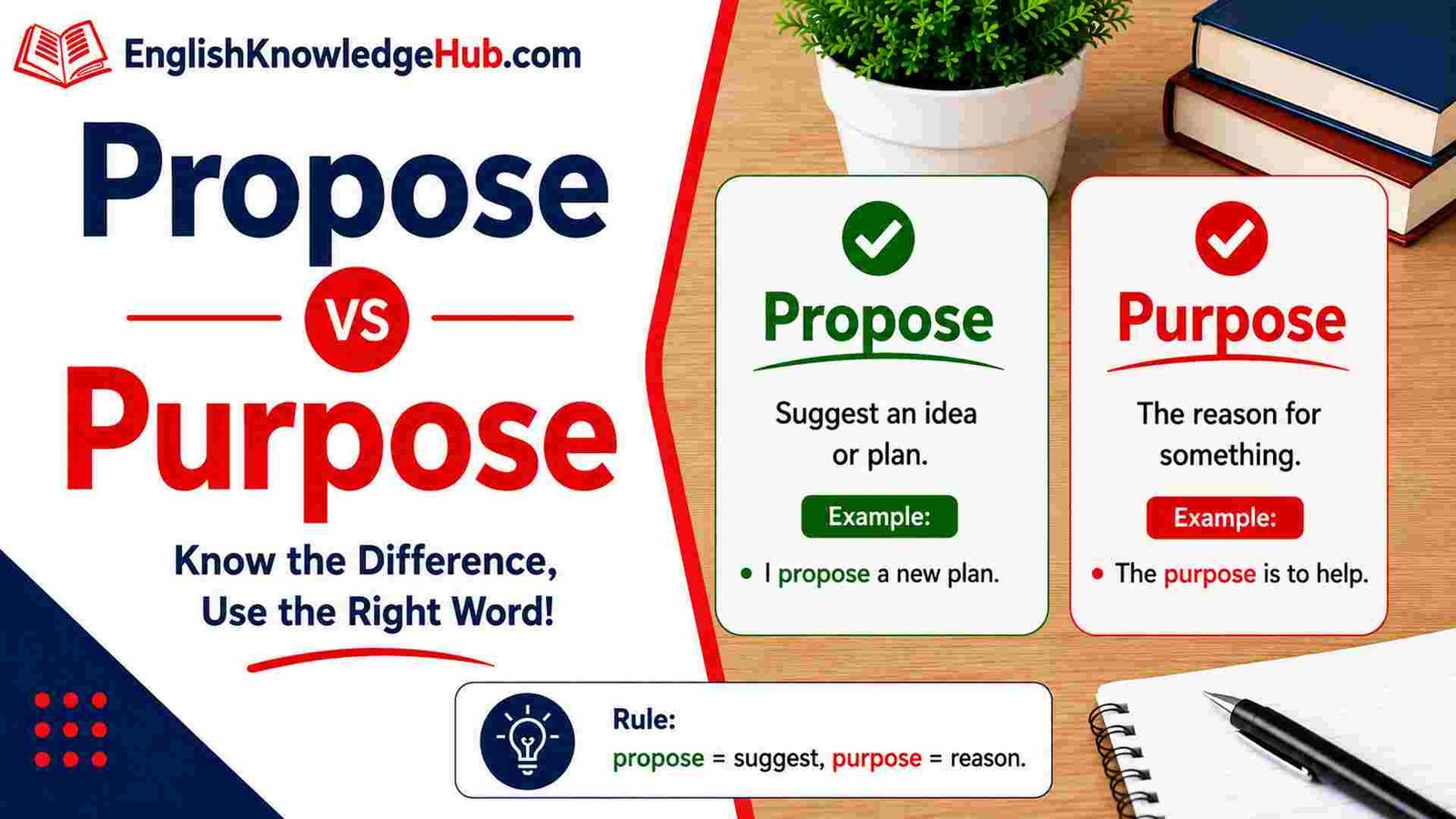
Propose and purpose are different words with different jobs. Propose is mainly a verb meaning to suggest, put forward, intend, nominate, or make an offer of marriage. Purpose is usually a noun meaning the reason, aim, or intended result of something. If you suggest a plan, you propose it. If you explain why the plan exists, you describe its purpose.
In this article, you’ll learn how Propose or Purpose differ in meaning, grammar, pronunciation, sentence patterns, and related forms such as proposal, proposed, purposeful, and purposely. Merriam-Webster lists propose as a verb for putting forward a plan, intention, or offer, while purpose is most commonly a noun for a reason, aim, or goal and also has a less common verb use.
The Quick Meaning Test
Ask what the sentence is doing. If someone is suggesting or putting something forward, choose propose. If the sentence is talking about why something exists or what it is meant to achieve, choose purpose.
“We propose a new schedule” means we suggest the schedule. “The purpose of the new schedule is to reduce delays” explains the reason for it.
That simple contrast solves most learner mistakes.
What “Propose” Means
Propose is a verb. One of its most common meanings is to suggest an idea, plan, action, or solution for other people to consider.
“The committee proposed a new rule.” “She proposed moving the meeting to Friday.” “The researchers proposed another explanation for the result.” In each case, an idea is being put forward.
The word can also describe intention: “They propose to expand the service next year.” This use is more formal than simply saying “They plan to expand.”
Propose Can Also Mean Offer Marriage
In everyday conversation, propose often means ask someone to marry you. “He proposed during their trip” means he made a marriage proposal.
You can say “He proposed to her,” but you normally do not say “He proposed her” when you mean marriage. The preposition to matters in this use.
The noun is proposal, which can mean either a suggested plan or an offer of marriage. Context tells you which meaning is intended.
Propose Can Mean Nominate or Put Someone Forward
In meetings, organizations, and formal procedures, propose can mean recommend a person for a position, membership, or role.
“The board proposed Elena for membership.” “He was proposed as the next chair.” This use is less common in casual conversation but appears regularly in formal and organizational English.
What “Purpose” Means
Purpose is usually a noun. It answers questions such as “Why does this exist?”, “What is it meant to do?”, or “What goal are we trying to reach?”
“The purpose of the meeting is to review the budget.” “This tool serves a different purpose.” “She worked with a clear sense of purpose.”
The word can refer to a practical function, a personal goal, or a broader sense of meaning and determination.
“On Purpose” Has a Special Meaning
The phrase on purpose means intentionally rather than accidentally.
“I did not break the glass on purpose.” “He left the note there on purpose.” This use is very common and does not mean “for the purpose of.”
That distinction matters because learners sometimes confuse on purpose with phrases about goals. “She spoke loudly on purpose” means she deliberately chose to speak loudly.
Can “Purpose” Be a Verb?
Yes, although this use is much less common in modern everyday English. Merriam-Webster records purpose as a verb meaning to intend or resolve.
You may encounter older or formal sentences such as “He purposed to return.” Most modern writers would choose “He intended to return” or “He planned to return.”
So it is inaccurate to say that purpose can never be a verb. The practical advice is simply that its noun use is far more common today.
Propose vs Suggest
Suggest and propose overlap, but propose often sounds more deliberate or formal when a plan, solution, or official action is being put forward.
“I suggest taking a break” sounds natural and conversational. “I propose that the committee postpone the vote” sounds more formal and procedural.
Both verbs can introduce an -ing form: “She proposed changing the policy.” You can also say “She proposed that the policy be changed,” especially in formal English.
Purpose vs Goal, Aim, and Function
These nouns are related, but their emphasis differs. A goal is usually something you want to achieve. An aim is a desired result or intention. A function is the job something performs. Purpose can cover both the reason something exists and the result it is intended to achieve.
For example, the function of a filter may be to remove particles, while its broader purpose in a system is to protect equipment. In ordinary writing, the words often overlap, so choose the one that best matches the emphasis.
Pronunciation Helps Separate Them
Propose ends with a voiced z sound: roughly “pruh-POHZ.” Purpose ends with an s sound: roughly “PUR-pus.”
The words are similar enough to be confused in quick speech, but their stress and final sounds differ. Saying the sentence aloud can sometimes reveal which word you intended.
Common Sentence Patterns
| Pattern | Example |
|---|---|
| propose + noun | They proposed a new policy. |
| propose + -ing | She proposed changing the deadline. |
| propose that + clause | I propose that we review the figures again. |
| propose to + person | He proposed to his partner. |
| the purpose of + noun | The purpose of the test is to measure progress. |
| for the purpose of + -ing | The room is used for the purpose of training staff. |
| on purpose | She deleted the file on purpose. |
Common Mistakes and Why They Happen
Incorrect: I purpose a new plan for the team.
Correct: I propose a new plan for the team.
The sentence is putting forward a suggestion, so propose is the natural verb.
Incorrect: What is the propose of this meeting?
Correct: What is the purpose of this meeting?
The question asks for the meeting’s reason or aim, so the noun purpose is required.
Incorrect: He purpose to her at dinner.
Correct: He proposed to her at dinner.
The marriage meaning uses the verb propose.
If noun-versus-verb confusion is a recurring problem, our Advice vs Advise guide uses the same part-of-speech approach to make the choice clearer.
How the Words Sound in Real Contexts
At work: “The manager proposed a shorter approval process. The purpose of the change is to reduce waiting time.”
In academic writing: “The researchers proposed a new interpretation. The purpose of the follow-up experiment was to test that interpretation.”
In everyday life: “He plans to propose next month.” “The purpose of the trip is to celebrate their anniversary.”
Seeing both words in the same context makes their roles easy to separate.
A Fast Proofreading Test
Try replacing the word. If suggest or put forward fits, use propose. If reason, aim, goal, or intended function fits, use purpose.
Do not rely only on spelling similarity. The grammar job is the stronger clue.
Frequently Asked Questions
What is the difference between propose and purpose?
Propose is mainly a verb meaning suggest or put forward. Purpose is mainly a noun meaning reason, aim, or intended result.
Can purpose be a verb?
Yes, but that use is uncommon in modern everyday English. It can mean intend or resolve.
What is the noun form of propose?
Proposal.
Is it “propose a plan” or “purpose a plan”?
Use propose a plan.
What does “on purpose” mean?
It means intentionally or deliberately.
Do you propose someone or propose to someone?
For marriage, use propose to someone. In formal nomination contexts, you can propose someone for a role or membership.
Final Takeaway
For Propose or Purpose, remember the job of the word. Propose usually performs an action: suggesting, intending, nominating, or offering marriage. Purpose usually names a reason, aim, or intended function. Although purpose can technically be a verb, that use is uncommon today, so the noun-versus-verb contrast remains the most useful everyday rule.
For more practical English word-choice lessons, explore EnglishKnowledgeHub.com.
