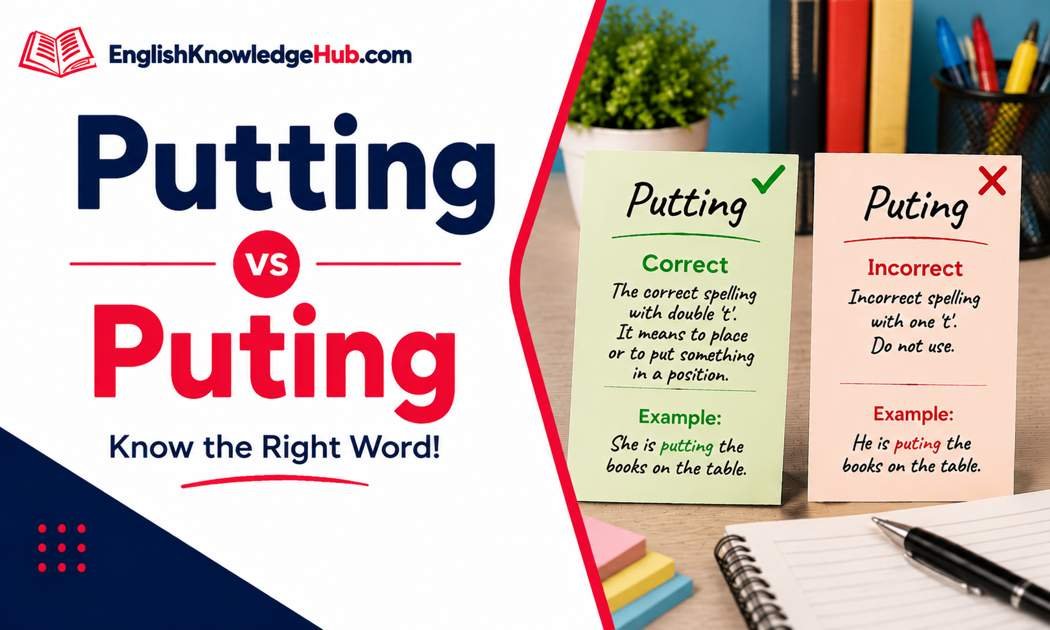
Putting is the correct spelling; puting is not standard English. The verb put ends with one short vowel followed by one consonant, so the final t doubles before -ing: put + ing = putting. The same doubling pattern appears in words such as sitting and running.
In this article, you’ll learn why putting vs puting follows the consonant-doubling rule, how put changes with different endings, which similar words follow the same pattern, and the mistakes learners make most often. Cambridge Grammar explains when final consonants double before suffixes such as -ing.
The rule is simple: use putting in conversations, academic writing, emails, and professional documents. In this article, you will learn why Putting vs Puting is a common spelling confusion, discover the reason behind the double t, see practical examples, and understand how to use the correct form in real English.
Putting vs Puting: The Quick Difference
| Word | Correct? | Explanation |
|---|---|---|
| Putting | ✅ Correct | The -ing form of the verb put |
| Puting | ❌ Incorrect | A spelling mistake in standard English |
The difference is only one letter, but that extra t is important.
Examples:
- She is putting the groceries away.
- The company is putting a new plan into action.
- He is putting his thoughts into writing.
The spelling puting should not be used in formal, academic, or everyday English.
Why Do We Spell It “Putting” Instead of “Puting”?
The reason comes from English spelling patterns.
When a short verb ends with:
one vowel + one consonant
the final consonant is often doubled before adding -ing.
Examples:
- sit → sitting
- run → running
- stop → stopping
- plan → planning
The verb put follows the same pattern:
put + ing = putting
The second t keeps the spelling consistent with the pronunciation and structure of the word.
A useful way to remember it is:
A small verb may need a small spelling change when it becomes an action happening now.
What Does Putting Mean?
Putting is the present participle form of put. It can describe an action happening at the moment or an activity connected with placing, arranging, or expressing something.
The meaning depends on the situation.
Putting something somewhere
This is the most common use.
Examples:
- I am putting my laptop on the desk.
- She is putting the clean clothes in the cupboard.
- They are putting the chairs outside for the event.
Here, putting means moving something into a particular place.
Putting ideas into words
English also uses putting when talking about communication.
Examples:
- The speaker is putting his ideas into simple language.
- She is putting her concerns into an email.
- The student is putting her answer into a complete sentence.
In these examples, the person is not moving a physical object. They are organizing thoughts.
Putting effort into something
The word also appears in common expressions.
Examples:
- He is putting extra effort into his training.
- The team is putting more attention into customer service.
- She is putting time into improving her writing.
How to Use Putting Correctly
The word putting commonly appears in continuous tenses.
Present continuous
Structure:
Subject + am/is/are + putting
Examples:
- I am putting the documents in order.
- The teacher is putting examples on the board.
- They are putting together a research proposal.
Past continuous
Structure:
Subject + was/were + putting
Examples:
- She was putting the books away when the phone rang.
- We were putting the equipment back after the event.
Future continuous
Structure:
Subject + will be + putting
Examples:
- The team will be putting the final changes into the report tomorrow.
Common Mistakes With Putting
Mistake 1: Adding “-ing” without changing the spelling
Incorrect:
I am puting the files in the folder.
Correct:
I am putting the files in the folder.
Explanation:
The final t in put must be doubled before adding -ing.
Mistake 2: Thinking “puting” is an alternative spelling
Incorrect:
The manager is puting a new system in place.
Correct:
The manager is putting a new system in place.
Explanation:
Unlike some words that have regional spelling differences, puting is not a British or American variation. It is simply incorrect.
Mistake 3: Confusing putting with the past tense of put
Incorrect:
Yesterday, I was putting the book on the table.
(Incorrect if you mean a completed past action.)
Correct:
Yesterday, I put the book on the table.
Explanation:
The past tense of put is also put. Putting shows an ongoing action, not a completed past event.
Putting in Different Types of English
Everyday Conversation
- I am putting my shoes near the door.
- Are you putting the milk back in the fridge?
- She is putting her phone away.
Workplace English
- The company is putting new safety rules into practice.
- The manager is putting the information into a final report.
- Our department is putting more focus on employee training.
Academic English
- Researchers are putting their observations into a written analysis.
- The student is putting each argument into a separate section.
- The professor is putting difficult theories into practical examples.
Formal Writing
- The organization is putting new policies into effect.
- The committee is putting forward several recommendations.
- The report is putting greater emphasis on long-term planning.
Putting vs Putt ing: A Different Meaning
Some learners also notice the word putting in golf.
There are two different verbs:
Put + ing → putting
Meaning: placing something somewhere
Example:
- She is putting the keys on the table.
Putt + ing → putting
Meaning: hitting a golf ball gently
Example:
- He is practicing putting before the golf match.
The spelling looks the same, but the meaning comes from the original verb.
Is “Puting” Ever Correct?
No, not when you mean the -ing form of put.
It is not:
- an informal spelling
- a modern spelling change
- a British English version
- an American English version
It is considered a spelling error.
Correct:
- putting information into a report
- putting books on a shelf
- putting effort into a project
Incorrect:
- puting information into a report
- puting books on a shelf
- puting effort into a project
British English and American English Difference
There is no difference between British and American spelling.
Both use:
✅ putting
Examples:
British English:
- She is putting the files in the cabinet.
American English:
- She is putting the files in the cabinet.
The spelling rule remains the same.
Similar Words That Follow the Same Pattern
Learning similar examples can make the rule easier to remember.
| Verb | Correct -ing Form |
|---|---|
| cut | cutting |
| hit | hitting |
| sit | sitting |
| set | setting |
| put | putting |
These verbs keep their original short vowel sound by doubling the final consonant.
Frequently Asked Questions About Putting vs Puting
Is putting or puting correct?
Putting is correct. Puting is a spelling mistake.
Why does putting have two t’s?
Because the verb put doubles its final consonant before adding -ing.
What is the meaning of putting?
Putting can mean placing something somewhere, expressing an idea, applying effort, or performing a golf action.
Is putting a verb?
Yes. It is the present participle form of the verb put.
Example:
- She is putting the files away.
Is puting accepted in dictionaries?
No. Standard English dictionaries list putting, not puting, as the correct form.
Is putting formal or informal?
Putting is used in all types of English, including conversations, business writing, and academic writing.
What is the past tense of put?
The past tense is also put.
Examples:
- Present: I put the pen here.
- Past: I put the pen here yesterday.
Final Reminder
When choosing between putting vs puting, remember the extra t:
✅ putting
❌ puting
The correct spelling follows a common English pattern where short verbs double their final consonant before adding -ing. Learning this small detail will help you avoid a frequent writing mistake.
For more practical grammar explanations, spelling lessons, and English improvement resources, visit EnglishKnowledgeHub.com and continue building stronger English skills.
