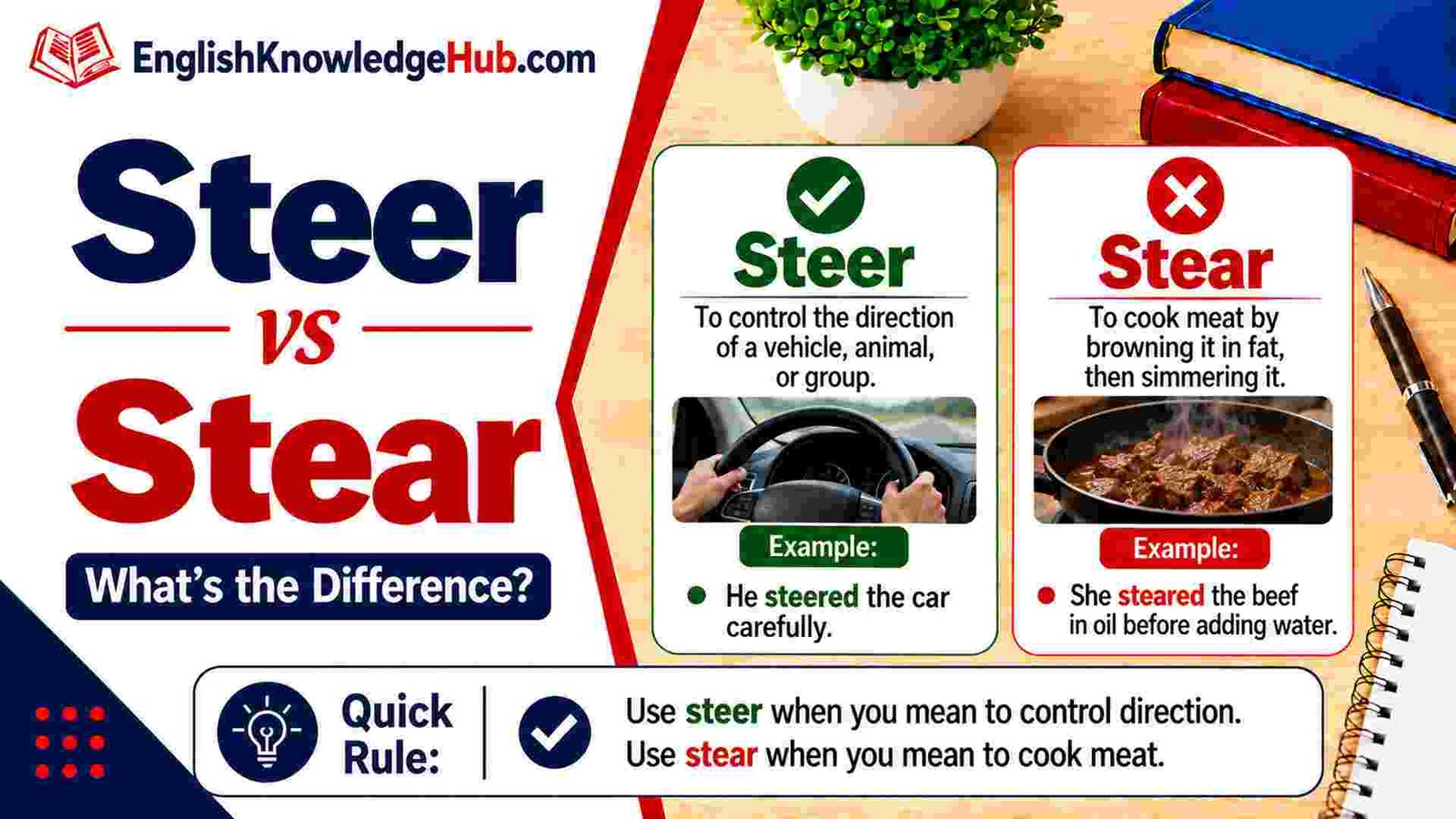
Steer is the correct spelling in modern English when you mean to guide, direct, or control something. Stear is not a standard modern alternative, although it appears as an obsolete historical spelling. This guide explains Steer vs Stear, the verb and noun meanings of steer, its word forms, common phrases, and easy ways to avoid the spelling mistake.
Steer vs Stear: The Answer in One Look
If you are writing about driving a car, guiding a boat, directing a conversation, influencing a decision, or moving something in a certain direction, use steer.
| Form | Modern status | Use it? |
|---|---|---|
| steer | Standard English word | Yes |
| stear | Obsolete historical spelling / modern misspelling in normal use | No, not in present-day standard writing |
Merriam-Webster lists steer as a verb meaning to control or direct a course and also as a noun for a male bovine animal. Cambridge likewise uses steer for controlling the direction of a vehicle and for guiding people, discussions, or activities. See the entries at Merriam-Webster and Cambridge Dictionary.
Why Does “Stear” Look Possible?
The confusion in Steer vs Stear usually comes from sound. English has many words where the long or near-long vowel sound is written with ea, such as hear, near, and fear. A learner may hear steer and guess that the middle should be ea.
But the standard spelling uses two e’s:
s-t-e-e-r
The same kind of “looks believable” spelling problem appears in words such as Forest vs Forrest, where an extra or changed letter can make a familiar word look almost right.
What Does “Steer” Mean as a Verb?
The easiest way to understand steer is to think of guiding a direction. That direction can be physical or figurative.
1. Steer a car, boat, bicycle, or other vehicle
This is the most familiar use. Steer means to control where a vehicle goes.
- Please steer the car slowly through the narrow gate.
- Leah learned to steer the small boat before learning to dock it.
- He steered the bicycle away from the broken glass.
You do not need to be holding a traditional steering wheel. The verb can describe controlling the direction of many kinds of vehicles.
2. Steer someone in a direction
You can also guide a person physically or help direct their choices.
- The receptionist steered us toward the quieter waiting area.
- Her teacher steered her toward books that matched her reading level.
- I tried to steer him away from making a rushed decision.
In these sentences, the person is being guided rather than mechanically controlled.
3. Steer a conversation or discussion
Steer works naturally when someone changes or controls the direction of a discussion.
- The chairperson steered the meeting back to the budget issue.
- She gently steered the conversation away from personal questions.
- The interviewer steered the discussion toward practical examples.
This is a useful workplace and academic use because conversations can have a “direction” even though they do not physically move.
4. Steer a company, project, or situation
In business and formal writing, steer can mean guide something through a difficult process or toward a desired result.
- The new manager helped steer the team through a difficult transition.
- The committee is trying to steer the project toward a simpler design.
- Good planning helped steer the organization away from unnecessary costs.
Common Patterns With “Steer”
Learning a few common patterns makes the word much easier to use naturally.
| Pattern | Meaning | Example |
|---|---|---|
| steer toward | Guide in the direction of | She steered the cart toward the exit. |
| steer away from | Guide away or discourage | His mentor steered him away from a risky deal. |
| steer through | Guide successfully through a place or difficulty | He steered the boat through the narrow channel. |
| steer back to | Return something to a topic or direction | Let’s steer the discussion back to the main question. |
| steer clear of | Avoid | I steer clear of that road during rush hour. |
What Does “Steer Clear” Mean?
Steer clear of is a common expression meaning avoid someone or something.
- Steer clear of the wet paint.
- She steers clear of office gossip.
- Drivers should steer clear of the flooded road.
The phrase comes from the idea of directing your course away from danger or trouble. In modern English, you can use it for both physical and nonphysical things.
“Steer” Is Also a Noun
One reason Steer vs Stear deserves more than a one-line spelling answer is that steer has noun meanings too.
A steer: a male bovine animal
In farming and animal vocabulary, a steer is a male bovine that has been castrated, commonly one raised for beef. This noun has nothing to do with steering a car, even though the spelling is identical.
- The farmer moved the steer into a separate pen.
- Several steers were grazing near the fence.
The plural is steers.
“A steer” meaning advice
In British informal English, a steer can also mean a useful piece of advice or information.
- Can you give me a steer on which form I should complete?
- Her colleague gave her a useful steer before the interview.
This meaning is less common for many international learners, so context matters.
Steer, Steered, Steering, and Steers
The verb follows a regular spelling pattern.
| Form | Use | Example |
|---|---|---|
| steer | Base form | I can steer the boat. |
| steers | Third-person present | She steers carefully. |
| steered | Past tense / past participle | He steered around the obstacle. |
| steering | -ing form | They are steering toward the harbor. |
Notice that steering keeps the double e. Do not write stearing when you mean guiding or controlling direction.
If spelling changes around endings often cause trouble, our Tweek vs Tweak guide shows another case where the vowel pattern can trick the eye.
Steer vs Steering Wheel: What Is the Grammar Difference?
Steer is usually a verb in driving sentences. Steering can be the -ing form of that verb, and it also appears as part of nouns such as steering wheel and steering system.
- Verb: I steer the car with both hands on the wheel.
- -ing form: She is steering around the parked truck.
- Noun phrase: The steering wheel felt loose.
So the object in your hands is the steering wheel, while the action is to steer.
Is “Stear” Ever a Real Word?
For normal modern English, do not use stear as an alternative spelling of steer. Historical sources record stear as an obsolete form of steer, so you may encounter it in very old texts or historical quotations.
That historical record does not make it suitable for current essays, emails, reports, captions, or professional writing.
If you mean guide, direct, control, or the cattle noun, write steer.
Does “Stear” in Stearic Acid Change the Answer?
You may notice the letters stear inside scientific terms such as stearic acid, stearate, or stearyl. Those are separate chemistry terms with their own word history.
They do not make stear a modern spelling of the verb steer.
Correct: Steer the vehicle to the left.
Incorrect: Stear the vehicle to the left.
How to Pronounce “Steer”
Steer is one syllable. Cambridge gives pronunciations approximately /stɪə(r)/ in British English and /stɪr/ in American English.
The spelling stays the same in both varieties:
- British English: steer
- American English: steer
- Canadian English: steer
- Australian English: steer
There is no British-versus-American spelling choice between steer and stear.
Common Mistakes and Better Corrections
Mistake 1: Spelling the verb as “stear”
Incorrect:
Please stear the cart around the boxes.
Correct:
Please steer the cart around the boxes.
Explanation:
The modern verb is spelled with ee.
Mistake 2: Writing “stearing”
Incorrect:
She is stearing the boat toward the dock.
Correct:
She is steering the boat toward the dock.
Explanation:
The -ing form keeps the spelling steer and adds -ing: steering.
Mistake 3: Confusing “steer” with “stir”
Incorrect:
Stir the car toward the right lane.
Correct:
Steer the car toward the right lane.
Explanation:
Stir usually means mix or move something around, often a liquid or food. Steer means guide direction.
Mistake 4: Using “steer” where “drive” is more natural
Less natural:
I steered to work this morning.
Better:
I drove to work this morning.
Explanation:
Steer focuses on controlling direction. Drive describes the whole act of operating and traveling in a vehicle.
Real-Life Examples in Different Settings
Everyday conversation
- Can you steer while I check the map?
- Try to steer clear of the construction area.
- She steered the stroller around the puddle.
Workplace English
- The manager steered the meeting toward practical solutions.
- We need someone who can steer the project through the final stage.
- His questions helped steer the team away from a costly mistake.
Academic writing
- The instructor steered the discussion toward evidence from the text.
- The findings may steer future research toward smaller sample groups.
- The policy could steer investment toward renewable energy.
Formal writing
- The committee sought to steer resources toward the areas of greatest need.
- The captain steered the vessel away from shallow water.
- The program is designed to steer applicants toward suitable support services.
A Simple Memory Trick
For Steer vs Stear, connect the spelling with another word from the same everyday idea:
steer → steering → steering wheel
If you remember that steering has ee, it becomes easier to remember that the base verb is steer.
You can also use this tiny rule:
If you guide the direction, choose EE: steer.
Frequently Asked Questions
Which is correct, steer or stear?
Steer is the correct modern spelling. Use it for guiding or controlling direction and for the cattle noun.
Is “stear” a word?
It appears historically as an obsolete form of steer, but it is not the standard modern spelling you should use in normal writing.
Is it “steer the car” or “stear the car”?
Write steer the car. The verb for controlling a vehicle’s direction is steer.
Is it “steering” or “stearing”?
Steering is correct when it comes from the verb steer. Example: “She is steering the boat.”
What is the past tense of steer?
The past tense is steered. Example: “He steered the car around the fallen branch.”
What does “steer clear” mean?
It means to avoid someone or something. Example: “Steer clear of that icy path.”
Can “steer” mean a cow?
Yes. As a noun, a steer is a castrated male bovine, commonly raised for beef.
Can “steer” mean advice?
Yes, especially in informal British English. “Give me a steer” means give me useful advice or guidance.
Final Takeaway
The practical answer to Steer vs Stear is straightforward: use steer in modern English. It can mean control a vehicle, guide a person, direct a conversation, influence a situation, or name a male bovine. Historical stear does not function as a current alternative spelling.
For more clear explanations that answer the full question instead of stopping at a one-line definition, explore EnglishKnowledgeHub.com.
