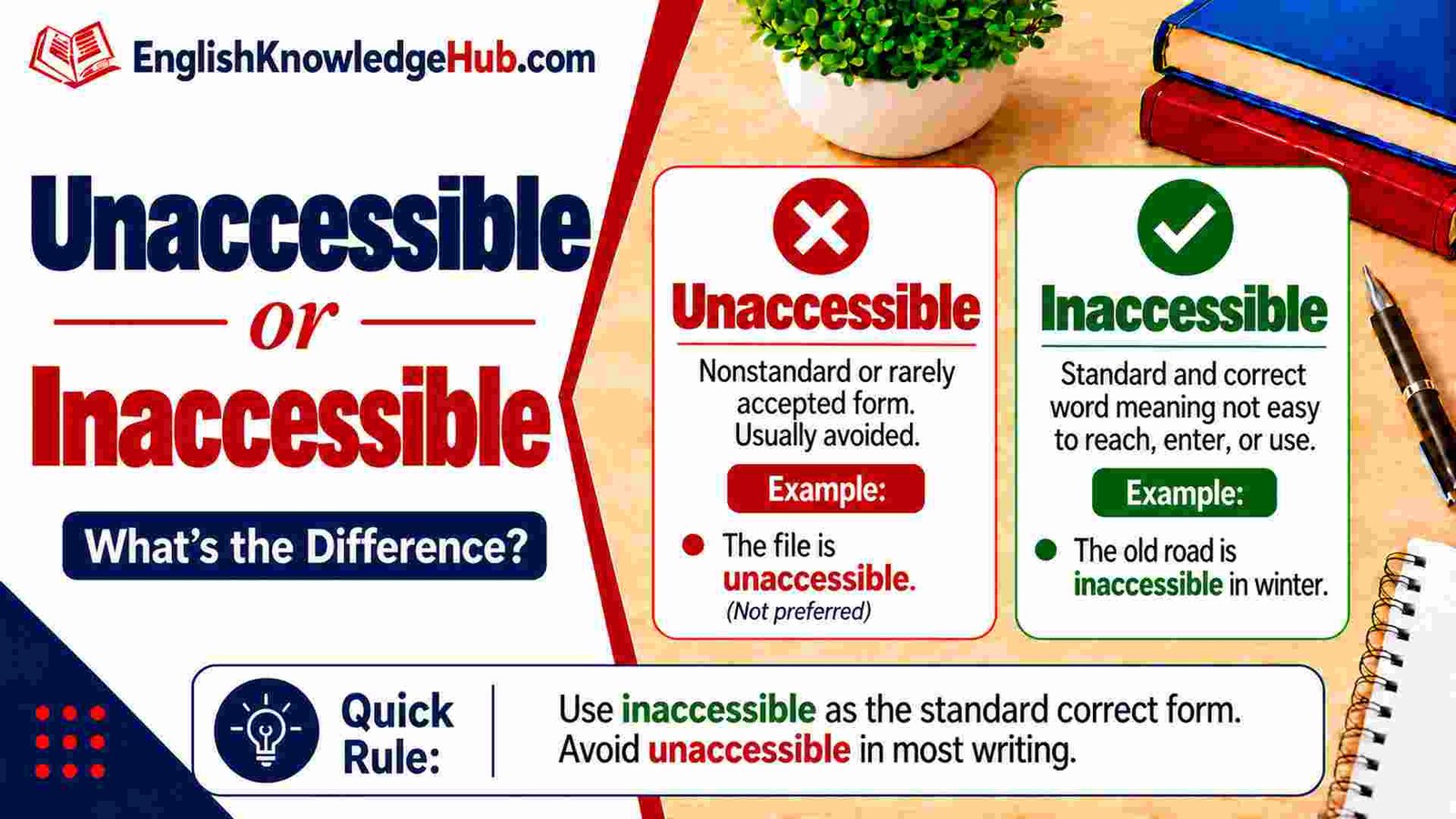
When choosing between Unaccessible or Inaccessible, use “inaccessible.” It is the normal and correct word in modern English. It means something is hard or impossible to reach, use, enter, get, or understand. “Unaccessible” has been used before, but it is very rare today. This guide shows you how to use the correct word.
The Easy Answer
The correct word is:
inaccessible
The word accessible means easy or possible to reach or use.
The word inaccessible means hard or impossible to reach or use.
Look at these examples:
- The park is accessible by car.
- The park is inaccessible after heavy snow.
In the first sentence, people can reach the park.
In the second sentence, people cannot reach it easily.
So the easy word pair is:
accessible = you can reach or use it
inaccessible = you cannot reach or use it easily
Why Do We Say “Inaccessible”?
This can feel strange at first.
Many English words use un- to show the opposite.
For example:
- happy → unhappy
- fair → unfair
- clear → unclear
- safe → unsafe
Because of this, some people think the opposite of accessible should be unaccessible.
But English does not always work that way.
Some words use in- instead.
For example:
- active → inactive
- correct → incorrect
- complete → incomplete
- accessible → inaccessible
So we say:
accessible → inaccessible
It is best to learn these two words together.
Is “Unaccessible” a Word?
Yes, the word has appeared in older English.
But it is not the usual word today.
Most people now use inaccessible.
So if you are writing:
- homework
- an exam
- an email
- a school paper
- a report
- a website
- a work message
use inaccessible.
If you are asking Unaccessible or Inaccessible, the best choice is almost always inaccessible.
What Does “Inaccessible” Mean?
The word can have a few simple meanings.
The main idea is the same:
Something is hard or impossible to get to, use, or understand.
1. A Place Is Hard to Reach
You can use inaccessible for a place.
Examples:
- The road is inaccessible after the flood.
- The cave is inaccessible in winter.
- The old tower is inaccessible from this side.
- The village became inaccessible after the storm.
In all these examples, people cannot reach the place easily.
2. A File or Website Is Hard to Use
You can also use the word for computers and the internet.
Examples:
- My file is inaccessible without the password.
- The website was inaccessible this morning.
- The folder is inaccessible to new workers.
- The old account became inaccessible after the system change.
Here, the problem is not a road or door.
The problem is that you cannot open or use something.
3. Something Is Hard to Understand
The word can also talk about ideas, books, lessons, or writing.
Examples:
- The book is inaccessible to young readers.
- The lesson was inaccessible to beginners.
- His speech used words that were too hard.
- The guide became inaccessible because it used too many hard terms.
Here, inaccessible means hard to understand.
4. A Person Can Be Hard to Reach
Sometimes, a person can also be called inaccessible.
Example:
- The manager was inaccessible during the meeting.
- The doctor was hard to contact and seemed inaccessible.
Still, other words may be better in some cases.
You can say:
- unavailable if the person is busy
- unreachable if you cannot contact the person
- unapproachable if the person is hard to talk to
Unaccessible or Inaccessible: Quick Comparison
| Word | Simple Meaning | Example |
|---|---|---|
| accessible | Easy to reach or use | The library is accessible by bus. |
| inaccessible | Hard or impossible to reach or use | The road is inaccessible after snow. |
| unaccessible | Rare form | Avoid it in normal writing. |
The main rule is simple:
Use inaccessible.
Daily Life Examples
Here are some easy examples.
- The beach is inaccessible at night.
- This room is inaccessible without a key.
- The road is inaccessible because of the rain.
- The top floor is inaccessible while the lift is broken.
- My old photos are inaccessible on this phone.
These are all natural uses.
Workplace Examples
You may also see inaccessible at work.
- The file is inaccessible to new staff.
- The office is inaccessible during repairs.
- The website became inaccessible after the update.
- The records are inaccessible without permission.
- The meeting room is inaccessible from this hall.
These sentences are common in business and office English.
School and Study Examples
You can use the word in school too.
- The book is inaccessible to young students.
- The lesson is too hard and feels inaccessible.
- The article is inaccessible to beginners.
- The teacher made the topic easier and more accessible.
- The old notes were inaccessible online.
The word can talk about both physical access and understanding.
Formal Writing Examples
Here are some simple formal examples.
- The building is inaccessible during construction.
- The data is inaccessible without approval.
- Some services are inaccessible to people in remote areas.
- The report is inaccessible to readers who do not know the topic.
- The upper road remains inaccessible because of damage.
You do not need a hard sentence to use this word well.
Simple writing is often better.
Unaccessible or Inaccessible: Common Mistakes
Mistake 1: Using “Unaccessible”
Incorrect:
The road is unaccessible today.
Correct:
The road is inaccessible today.
Explanation:
Modern English uses inaccessible as the normal form.
Mistake 2: Using “Inaccessible” When You Mean “Unavailable”
Less suitable:
The teacher is inaccessible today because she is not at school.
Better:
The teacher is unavailable today because she is not at school.
Explanation:
Unavailable means someone or something is not free or ready to use.
Mistake 3: Using “Inaccessible” When You Mean “Unreachable”
Less natural:
Ali did not answer his phone, so he was inaccessible.
Better:
Ali did not answer his phone, so he was unreachable.
Explanation:
Use unreachable when you cannot contact a person.
Mistake 4: Thinking It Only Talks About Places
Wrong idea:
Inaccessible is only for roads and buildings.
Correct idea:
It can also talk about files, websites, books, ideas, services, and people.
“Inaccessible To” Is a Common Pattern
A very common form is:
inaccessible to + person or group
Examples:
- The room is inaccessible to visitors.
- The file is inaccessible to students.
- The lesson may be inaccessible to young children.
- The service is inaccessible to people without internet access.
This pattern is easy to remember.
You can also say:
inaccessible by
- The village is inaccessible by car.
- The road is inaccessible by bus.
You can also say:
inaccessible without
- The file is inaccessible without a password.
- The room is inaccessible without a key.
Inaccessible, Unavailable, and Unreachable
These words are close, but they are not the same.
Inaccessible
Use this when something is hard or impossible to access.
Example:
- The website is inaccessible without a login.
Unavailable
Use this when something is not ready or not free to use.
Example:
- The doctor is unavailable today.
Unreachable
Use this when you cannot reach a person or place.
Example:
- Sara was unreachable by phone.
A simple trick is:
access problem = inaccessible
not free or ready = unavailable
cannot reach or contact = unreachable
British and American English
Both British and American English use inaccessible.
There is no important difference here.
So you can use the same spelling in:
- British English
- American English
- Canadian English
- Australian English
The correct modern form stays the same.
Word Family
You can learn these words together.
access
The way or chance to reach or use something.
accessible
Easy or possible to reach or use.
inaccessible
Hard or impossible to reach or use.
accessibility
How easy something is to reach or use.
inaccessibility
The state of being hard or impossible to reach or use.
Examples:
- The school improved accessibility.
- The broken road caused inaccessibility.
- The hall is accessible by lift.
- The room is inaccessible today.
Learning word families can make new words easier to remember.
An Easy Way to Check Your Sentence
Ask yourself:
Can I replace this word with “hard to reach or use”?
If yes, inaccessible may be the right word.
Example:
“The road is hard to reach or use after the flood.”
This becomes:
“The road is inaccessible after the flood.”
Another example:
“The file is hard to open without a password.”
This becomes:
“The file is inaccessible without a password.”
You can also use it for ideas:
“The book is hard for children to understand.”
This can become:
“The book is inaccessible to children.”
Unaccessible or Inaccessible: Frequently Asked Questions
Is “unaccessible” correct?
It has been used before, but it is very rare now. Use inaccessible in modern English.
Unaccessible or Inaccessible, which one should I use?
Use inaccessible. It is the normal and standard word.
What is the opposite of accessible?
The opposite is inaccessible.
What does inaccessible mean?
It means hard or impossible to reach, enter, use, get, or understand.
Can a website be inaccessible?
Yes. A website can be inaccessible if people cannot open or use it.
Can a book be inaccessible?
Yes. A book can be inaccessible if it is too hard to understand.
Can a building be inaccessible?
Yes. A building can be inaccessible if people cannot enter or use it easily.
Is inaccessible used in both US and UK English?
Yes. It is normal in both American and British English.
Final Answer
When you are unsure about Unaccessible or Inaccessible, choose inaccessible.
It is the standard word in modern English.
Remember:
accessible = easy to reach or use
inaccessible = hard or impossible to reach or use
Unaccessible may appear in very old or rare writing, but you should avoid it in normal English.
For more simple grammar lessons and easy word guides, visit EnglishKnowledgeHub.com.
