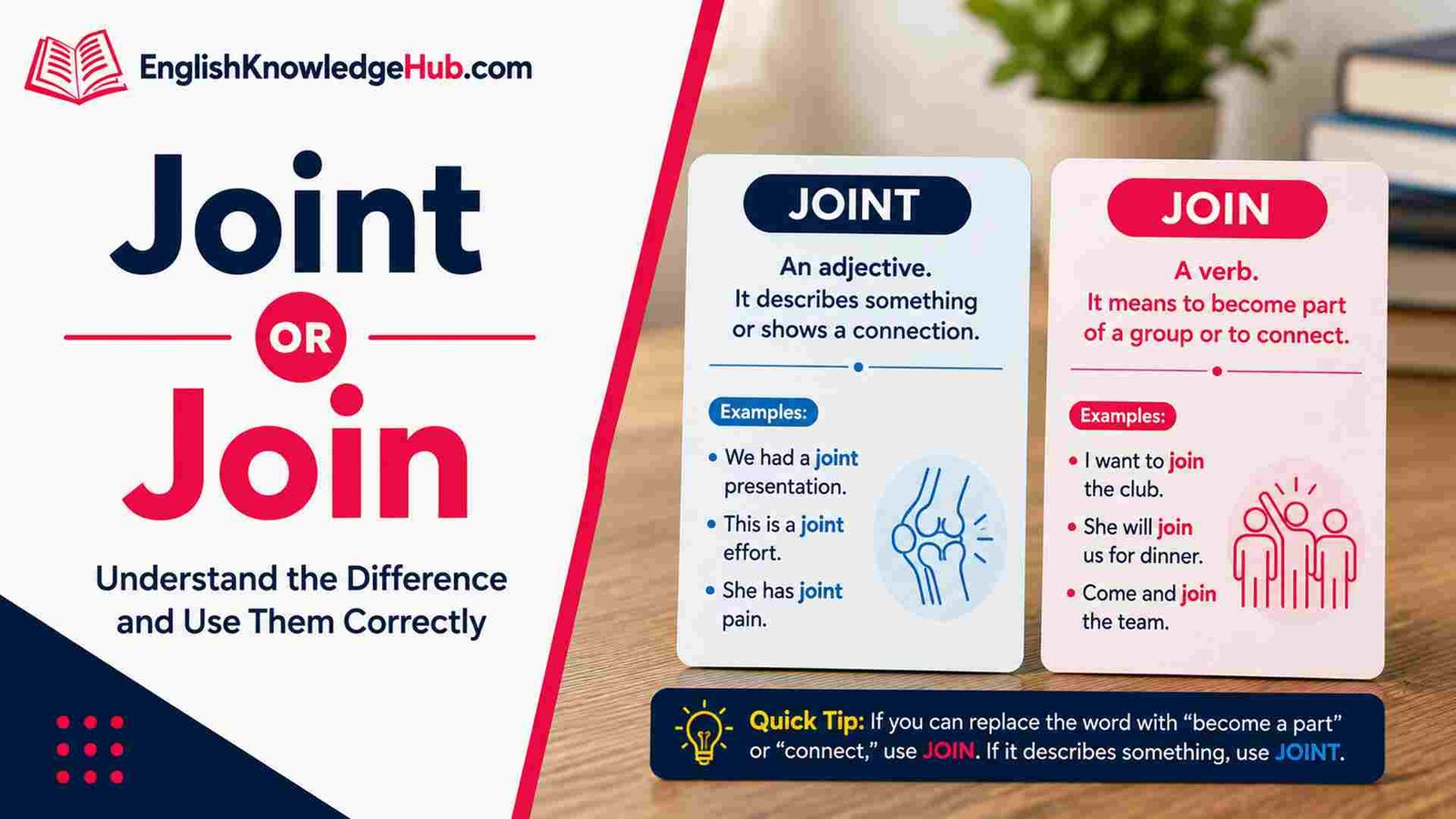
Joint and join are related words, but they have different jobs in a sentence. Join usually works as a verb and means to connect, become part of something, or do something with others. Joint can work as a noun or adjective and usually means a connection, a body part where bones meet, or something shared by two or more people.
In this guide, you will learn the difference between joint or join, their meanings, grammar rules, common uses, and easy examples. You will also learn simple tricks that can help you choose the right word every time.
Joint or Join at a Glance
Here is the easiest way to understand the difference:
| Word | Main Word Type | Simple Meaning | Example |
|---|---|---|---|
| Join | Verb | To connect or become part of something | I will join the club. |
| Joint | Noun | A place where two things meet | My knee joint hurts after running. |
| Joint | Adjective | Shared by two or more people | They have a joint bank account. |
The main rule is simple:
Use “join” when someone or something performs an action. Use “joint” when you mean a connection, a body part, or something shared.
Cambridge Dictionary defines join as connecting things, becoming a member of a group, or taking part with other people.
Oxford also explains that joint can describe something involving two or more people together.
What Does Join Mean?
Join most often works as a verb.
It can mean:
- To become part of a group.
- To connect two or more things.
- To take part in an activity.
- To meet or come together.
Join Meaning 1: Become Part of a Group
Use join when someone becomes a member of a club, team, company, group, or organization.
Examples:
- I want to join the football team.
- She joined our company last year.
- Can I join your group?
- He plans to join the gym.
- Maya joined the school music club.
In all these examples, someone becomes part of a group.
Join Meaning 2: Connect Things
Join can also mean to connect two or more things.
Examples:
- Use glue to join the two pieces.
- This road joins the highway.
- The bridge joins the two sides of the river.
- We need to join these wires carefully.
- The carpenter joined the wooden boards together.
Cambridge gives this connection meaning as one of the main uses of join.
Join Meaning 3: Take Part With Someone
You can use join when you take part in an activity with another person or group.
Examples:
- Would you like to join us for dinner?
- Please join me for coffee.
- She joined us for the meeting.
- Can you join the game?
- They invited me to join them for lunch.
The phrase join someone for something means to take part in an activity with that person or group.
Join Meaning 4: Meet at a Point
Roads, rivers, paths, or lines can also join.
Examples:
- The two roads join near the station.
- These rivers join outside the city.
- The paths join at the top of the hill.
- The two lines join in the center.
Here, join means that two things meet.
What Does Joint Mean?
Joint has several meanings. It most often works as a noun or adjective.
As a noun, it can mean a place where two things meet.
As an adjective, it can mean shared by two or more people.
Joint as a Body Part
A joint is a place in the body where two bones meet.
Common body joints include:
| Joint | Where It Is |
|---|---|
| Knee joint | Between the upper and lower leg |
| Elbow joint | Where the upper and lower arm meet |
| Hip joint | Where the leg meets the body |
| Shoulder joint | Where the arm meets the shoulder |
| Ankle joint | Where the foot meets the lower leg |
| Finger joint | Where finger bones meet |
Examples:
- My knee joint feels stiff.
- The doctor checked his shoulder joint.
- Exercise can help keep your joints moving.
- She injured an ankle joint while playing tennis.
Cambridge defines a body joint as a place where two bones meet.
Joint as a Connection
A joint can also mean the place where two objects or parts connect.
Examples:
- Water is leaking from the pipe joint.
- Check the joint between the two pieces of wood.
- The metal joint needs repair.
- The worker covered the joint with sealant.
Notice the difference:
Join describes the action.
Joint names the place where the connection exists.
For example:
- We will join the two pipes.
- Check the joint between the two pipes.
That small difference is important.
Joint Meaning Shared by Two or More People
As an adjective, joint means shared, owned, created, or done by two or more people or groups.
Examples:
- They opened a joint bank account.
- It was a joint decision.
- The schools started a joint project.
- They made a joint statement.
- The house has joint owners.
- Both companies made a joint effort.
Oxford gives examples such as a joint account, joint effort, and joint owners to show this meaning.
Joint or Join: The Main Difference
The difference between joint or join becomes much easier when you look at the job each word performs.
| Situation | Correct Word | Example |
|---|---|---|
| Become part of a club | Join | I want to join the club. |
| Connect two objects | Join | Join the two pieces together. |
| Take part with people | Join | Please join us. |
| Body connection | Joint | The knee is a joint. |
| Connection between parts | Joint | The pipe joint is broken. |
| Shared by two people | Joint | They have a joint account. |
| Shared activity | Joint | It was a joint project. |
Ask yourself one simple question:
Am I describing an action or naming something?
If it is an action, join will often be correct.
If you mean a connection, body part, or shared thing, joint will often be correct.
Join vs Joint in Grammar
Grammar can help you choose the right word.
Join Is Usually a Verb
A verb shows an action.
Examples:
- I join the class every Monday.
- She joined the team yesterday.
- They will join us tomorrow.
- He is joining the company next month.
Common forms of join include:
| Form | Example |
|---|---|
| Join | I want to join. |
| Joins | She joins us every week. |
| Joined | He joined yesterday. |
| Joining | They are joining the event. |
Joint Can Be a Noun
A noun names a person, place, thing, or idea.
Examples:
- My elbow joint hurts.
- The pipe joint is loose.
- This wooden joint is strong.
The plural form is joints.
Example:
- Stretching helps move your joints.
Joint Can Be an Adjective
An adjective describes a noun.
Examples:
- a joint account
- a joint project
- a joint decision
- a joint statement
- a joint effort
In these examples, joint tells us that two or more people share or do something together.
Is It “Join Account” or “Joint Account”?
The correct phrase is joint account.
A joint account is an account shared by two or more people.
Correct:
- We opened a joint account.
Incorrect:
- We opened a join account.
Why?
Because the word describes the account. You need the adjective joint, not the verb join.
Is It “Join Venture” or “Joint Venture”?
The correct phrase is joint venture.
A joint venture is a business activity or project that two or more people or companies work on together.
Correct:
- The companies started a joint venture.
Incorrect:
- The companies started a join venture.
Here, joint means shared.
Is It “Join Effort” or “Joint Effort”?
Use joint effort.
A joint effort means two or more people work together toward the same goal.
Example:
- Cleaning the park was a joint effort.
Do not write:
- Cleaning the park was a join effort.
Is It “Join Family” or “Joint Family”?
Use joint family when talking about a family system where several related family members live together or share family duties and resources.
Example:
- He grew up in a joint family.
Here, joint means connected or shared.
Is It “Join Pain” or “Joint Pain”?
The correct phrase is joint pain.
Example:
- She spoke to her doctor about joint pain.
Joint refers to the place where bones meet.
“Join pain” is incorrect in this meaning.
Is It “Join Us” or “Joint Us”?
The correct phrase is join us.
Example:
- Would you like to join us for dinner?
“Joint us” is incorrect because you need a verb that describes the action of taking part.
Is It “Join the Team” or “Joint the Team”?
Use join the team.
Correct:
- Jack wants to join the team.
Incorrect:
- Jack wants to joint the team.
The sentence describes the action of becoming part of the team, so use join.
Common Phrases With Join
Learning common phrases can make the word easier to remember.
| Phrase | Meaning | Example |
|---|---|---|
| Join a club | Become a member | I want to join a club. |
| Join a team | Become part of a team | She will join the team. |
| Join us | Come or take part with us | Please join us. |
| Join together | Connect | We can join together the pieces. |
| Join forces | Work together | The groups joined forces. |
| Join in | Take part | Come and join in the game. |
| Join a company | Start working there | He joined the company in May. |
| Join a meeting | Take part in a meeting | I will join the meeting soon. |
Common Phrases With Joint
Here are some common uses of joint:
| Phrase | Meaning |
|---|---|
| Joint account | Account shared by two or more people |
| Joint effort | Work done together |
| Joint project | Project shared by people or groups |
| Joint decision | Decision made together |
| Joint owner | Person who shares ownership |
| Joint statement | Statement made by two or more parties |
| Joint pain | Pain in a body joint |
| Knee joint | Place where leg bones meet |
| Joint operation | Activity carried out together |
These phrases show why joint often appears before a noun.
Join and Joint in the Same Sentence
Want to see both words together? These examples make the difference very clear.
- We will join the pipes and then check the joint.
- Sarah will join her parents in managing their joint account.
- The two companies decided to join forces on a joint project.
- He plans to join the fitness class to improve movement in his knee joints.
- The schools will join together for a joint event.
Notice the pattern.
Join shows what someone or something does.
Joint describes or names something.
Common Mistakes With Joint and Join
These words look similar, so mistakes happen easily.
Here are some common errors:
| Incorrect | Correct | Why? |
|---|---|---|
| Can I joint your group? | Can I join your group? | You need an action word. |
| We have a join account. | We have a joint account. | The account is shared. |
| My knee join hurts. | My knee joint hurts. | A body connection is a joint. |
| Please joint us for dinner. | Please join us for dinner. | Join means take part. |
| It was a join project. | It was a joint project. | The project was shared. |
| Join pain can affect walking. | Joint pain can affect walking. | Joint refers to the body part. |
Easy Trick to Remember Joint or Join
Here is a quick memory trick:
JOIN = DO
Think of join as an action.
You can:
- join a team
- join a meeting
- join your friends
- join two pieces
If someone does something, think join.
JOINT = THING OR SHARED
Think of joint as a thing or description.
It can describe:
- a knee joint
- a pipe joint
- a joint account
- a joint project
- a joint decision
If you can place shared before the noun and the meaning stays similar, joint may be the word you need.
For example:
joint project = shared project
joint account = shared account
Can Join Be a Noun?
Yes. Join can sometimes work as a noun and mean the place where two things meet or connect.
For example:
- You can hardly see the join between the two pieces.
Cambridge lists this noun use of join as a place where two things meet or are fastened together.
However, learners will see join much more often as a verb.
In everyday English, learning join = action first is the easiest approach.
Can Joint Be a Verb?
In normal everyday English, you should not use joint when you simply mean “become part of” or “take part.”
For example:
Correct:
- I want to join the group.
Incorrect:
- I want to joint the group.
For most learners, the safest rule is to use join for the action of connecting or becoming part of something.
Join, Joined, and Joint: What Is the Difference?
These three forms can also cause confusion.
Join
Join is the base form of the verb.
Example:
- I want to join the class.
Joined
Joined is the past form of join.
Example:
- I joined the class yesterday.
It can also appear after helping verbs.
Example:
- The two parts are joined together.
Joint
Joint is a different word.
Example:
- They opened a joint account.
Compare:
- They joined the club.
- They have a joint membership plan.
The first sentence talks about an action. The second describes something shared.
Join or Joined?
Use join when talking about the present, future, or after words such as “to,” “will,” “can,” and “should.”
Examples:
- I want to join.
- I will join tomorrow.
- Can she join us?
Use joined when talking about something that happened in the past.
Examples:
- I joined yesterday.
- She joined the club last month.
Jointly and Join
You may also see the word jointly.
Jointly means together or in a shared way.
Example:
- The event was jointly organized by two schools.
Oxford defines jointly as doing something in a way that involves two or more people or groups together.
Compare:
- The schools joined together to organize the event.
- The schools jointly organized the event.
- It was a joint event.
All three sentences express a similar idea, but the words have different grammar roles.
Quick Test: Joint or Join?
Choose the correct word.
- Can you ___ us for lunch?
- They opened a ___ bank account.
- My shoulder ___ feels sore.
- I want to ___ the school club.
- The companies announced a ___ project.
- We need to ___ these two pieces.
- The pipe ___ is leaking.
- They made a ___ decision.
Answers
- join
- joint
- joint
- join
- joint
- join
- joint
- joint
If you got most of them right, you already understand the main difference.
Frequently Asked Questions
What is the difference between joint and join?
Join usually means to connect, become a member, or take part in something. Joint usually means a place where two things meet, a body part where bones meet, or something shared by two or more people.
Is it join or joint account?
The correct phrase is joint account because the account belongs to or is shared by two or more people.
Is it join or joint family?
The standard phrase is joint family. Here, joint describes a family structure in which several related family members live together or share duties and resources.
Is it join or joint pain?
Use joint pain. A joint is the place where two bones meet.
Should I say “join us” or “joint us”?
Use join us. Join is the verb you need when asking someone to take part.
Is joint the past tense of join?
No. The past tense of join is joined.
Correct:
- join
- joined
- joining
Joint is a separate word with its own meanings.
Can joint mean together?
Yes. As an adjective, joint can mean shared or done together.
For example:
- joint project
- joint decision
- joint account
- joint effort
What is an easy way to remember join and joint?
Remember this simple rule:
Join is usually an action. Joint is usually a thing or something shared.
Final Takeaway
Choosing between joint or join becomes easy once you remember their main jobs. Use join when you mean to connect, participate, or become part of something. Use joint for a body connection, a connection between objects, or something shared by two or more people.
When you feel unsure, ask yourself, “Do I need an action word?” If yes, join is probably right. If you mean a thing or something shared, joint will usually fit.
Want to make confusing English words easier to understand? Explore more simple word comparisons and grammar guides at EnglishKnowledgeHub.com.
