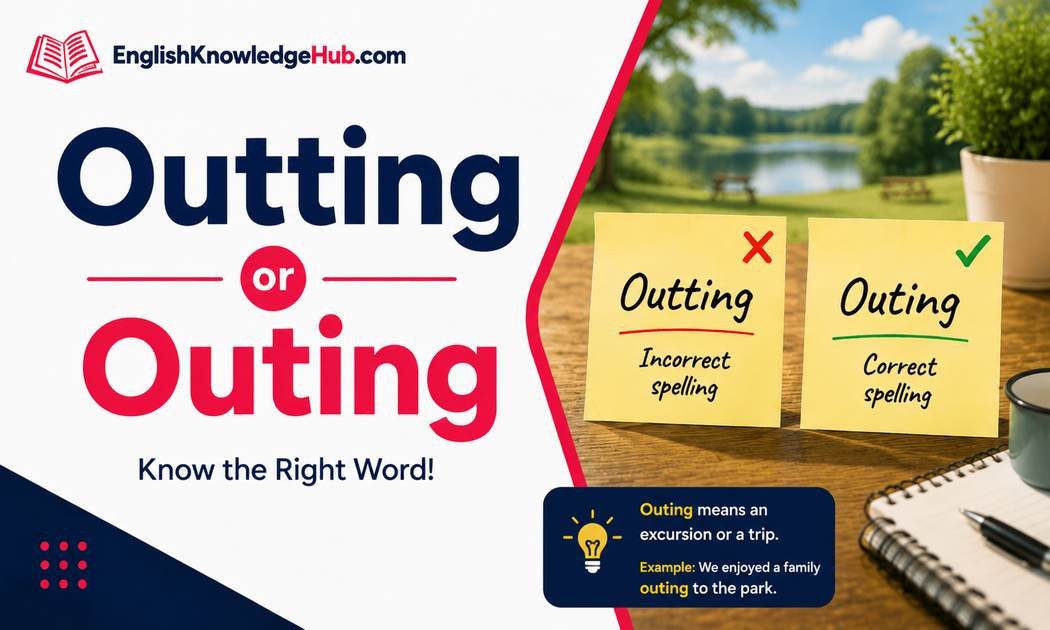
Outing is the standard spelling; outting is not. As a noun, outing can mean a short pleasure trip, an appearance or performance, and in another sensitive sense, the public disclosure of private identity information. The spelling keeps only one t.
In this article, you will learn why out + ing becomes outing, the main meanings of the word, its plural outings, and how to avoid confusing this noun with the verb form of out.
Why Outing Has One T
The word is not formed by doubling the final consonant. Write outing, as confirmed by Merriam-Webster. Its plural is outings.
A useful comparison is putting, which doubles the final consonant because put follows a different spelling pattern. Our Putting vs Puting guide explains that contrast.
What Outing Means in Real English
The most familiar meaning is a short trip for pleasure: “Our class planned an outing to the science museum.” In sports, an outing can mean a player’s appearance in a game or competition: “The pitcher looked sharper in his second outing.” It can also mean a public appearance in a role.
There is another meaning that needs careful handling. Outing can refer to publicly revealing a person’s private sexual orientation or gender identity without their consent. Because that meaning involves privacy and personal information, context matters greatly.
Common Mistakes
Incorrect: “We planned an outting for Saturday.”
Correct: “We planned an outing for Saturday.”
Incorrect: “The team had three good outtings.”
Correct: “The team had three good outings.”
Do not let the strong t sound tempt you into writing two t’s. The standard spelling stays outing.
Frequently Asked Questions
Is outting ever correct?
Not as the standard spelling of the noun outing. Use outing.
What is the plural of outing?
The plural is outings.
Does outing only mean a trip?
No. It can also refer to an appearance in sports or public life, and it has a separate privacy-related meaning involving disclosure of someone’s identity information.
Final Takeaway
For Outting or Outing, choose outing. Remember the spelling, then use context to decide which meaning is intended.
For more practical spelling help, visit EnglishKnowledgeHub.com.
