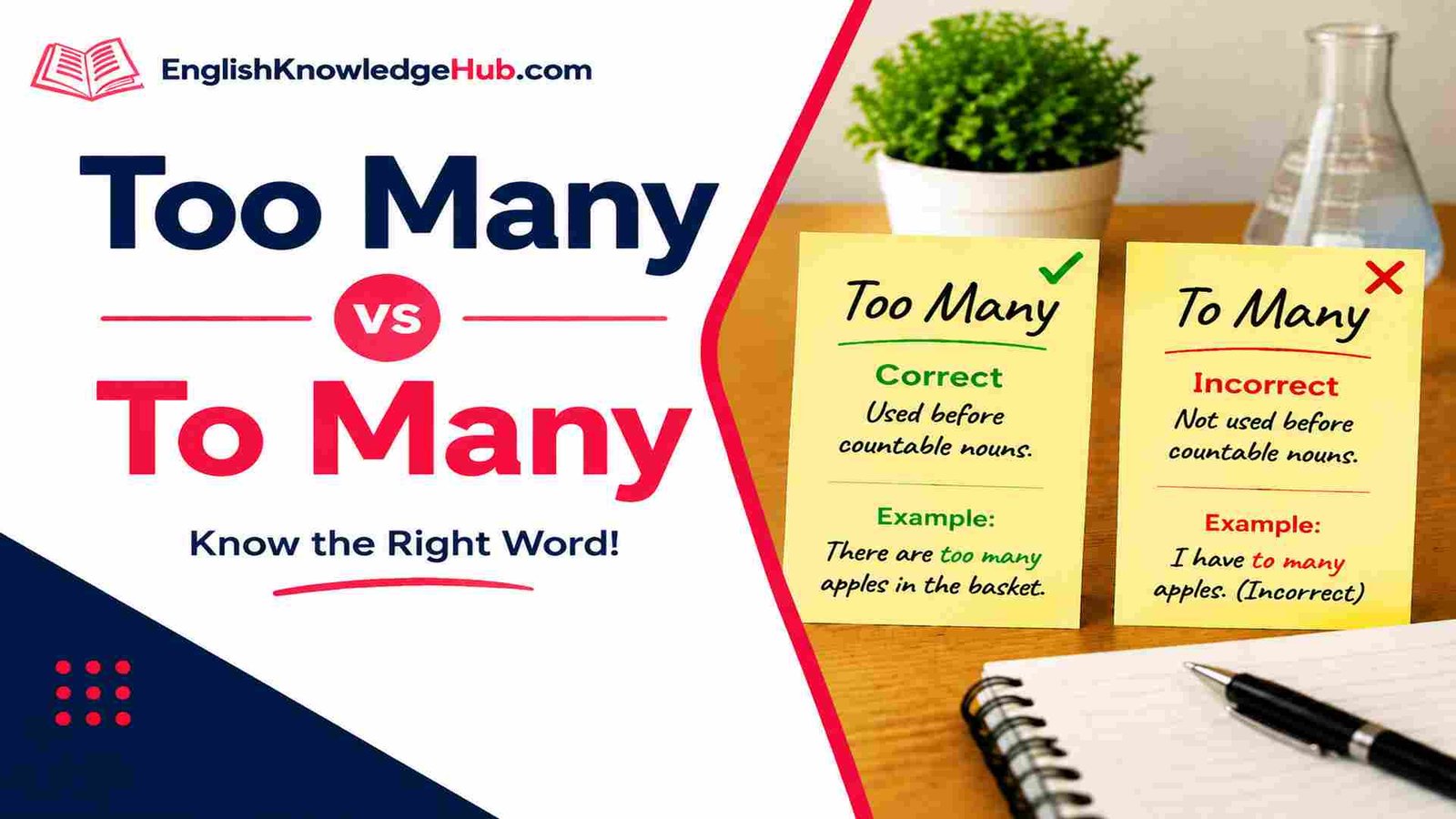
Use too many when you mean an excessive number of countable people or things. For example, “There are too many cars on this road.” The words to many can be correct only in a different structure where to is a preposition, as in “The rule matters to many students.” So when you mean “more than needed,” too many is the correct phrase.
In this article, you’ll learn the difference between too many vs to many, how too expresses excess, why many is used with countable nouns, when to many is genuinely possible, and common mistakes. Cambridge Dictionary defines too as more than is wanted, needed, or acceptable.
Many learners write “to many” because they hear the same pronunciation in conversation. This small spelling mistake can change the meaning of a sentence. In this article, you will learn the difference between too many and to many, understand the grammar rule behind the correct phrase, and see how native speakers use it naturally.
The Short Answer: Use “Too Many,” Not “To Many”
When you mean more than needed, more than expected, or more than acceptable, use:
too many + plural countable noun
Examples:
- I have too many assignments to finish tonight.
- There are too many people waiting outside.
- She purchased too many decorations for the small room.
The word too means “more than necessary.” The word many refers to a large number of countable things.
Together:
too many = an excessive number
What Does “Too Many” Mean?
The phrase too many does not simply mean “a lot.” It suggests that the amount has become a problem.
Compare these sentences:
Many visitors came to the museum.
This only tells us that a large number of visitors arrived.
Too many visitors came to the museum.
This suggests there were more visitors than the museum could comfortably manage.
The difference is the idea of excess.
A simple way to remember it:
- Many = a large number
- Too many = a larger number than is suitable
Why “To Many” Is Usually Incorrect
The word to has several common uses in English. It can show:
- movement toward something
- a person receiving something
- a connection between ideas
Examples:
- We drove to the airport.
- She sent the file to her colleague.
- This advice is helpful to many students.
In the last example, to is not connected to many as a phrase. It belongs to the sentence structure:
helpful to + group of people
The phrase to many does not mean “an excessive number.”
So:
Incorrect:
The company received to many complaints.
Correct:
The company received too many complaints.
Explanation:
The sentence means the number of complaints was higher than acceptable, so too many is required.
Too Many vs To Many: The Main Difference
| Phrase | Meaning | Example |
|---|---|---|
| Too many | More than needed or acceptable | There are too many errors in this document. |
| To many | Not a quantity phrase; usually a spelling mistake | This form is incorrect when meaning excess. |
How to Use “Too Many” Correctly
Use It With Countable Plural Nouns
“Too many” works with things you can count.
Examples:
- too many emails
- too many chairs
- too many meetings
- too many mistakes
- too many questions
Example sentences:
- The manager received too many requests during the morning shift.
- I saved too many files with similar names.
- The teacher answered too many questions after class.
Do Not Use “Too Many” With Uncountable Nouns
Some nouns cannot normally be counted individually. For these, use too much, not too many.
Incorrect:
There is too many traffic on this road.
Correct:
There is too much traffic on this road.
Explanation:
Traffic is not counted as separate items, so too much is the correct choice.
More examples:
Incorrect:
She gave me too many advice.
Correct:
She gave me too much advice.
Real-Life Examples of “Too Many”
Everyday Conversations
A: Why did you buy six jackets?
B: I know. I bought too many clothes during the sale.
A: Can we choose a movie quickly?
B: There are too many choices on this website.
Workplace English
- The project failed because the team had too many priorities at the same time.
- Our support department received too many customer messages after the update.
- The supervisor noticed that one employee had too many responsibilities.
Academic English
- The essay included too many unrelated examples, which made the argument unclear.
- Researchers should avoid asking too many questions in a short survey.
- The student used too many quotations instead of explaining ideas independently.
Formal Writing
- The report identified too many unnecessary procedures in the current system.
- The committee concluded that too many changes had been introduced without proper planning.
- The policy created too many restrictions for small organizations.
Common Mistakes With Too Many and To Many
Mistake 1: Confusing “too” and “to”
Incorrect:
I have to many meetings this week.
Correct:
I have too many meetings this week.
Explanation:
The writer means there are more meetings than manageable. The correct word is too.
Mistake 2: Thinking “too” only means “also”
The word too has two common meanings:
- also
Example:
- I want to come too.
- more than necessary
Example:
- This bag is too heavy.
In too many, the second meaning is used.
Mistake 3: Using “too many” for every large amount
Incorrect:
I have too many friends at university.
This may be grammatically correct, but the meaning suggests having many friends is a problem.
If you simply mean a large number:
Correct:
I have many friends at university.
If the number creates difficulty:
Correct:
I have too many friends asking for help with homework.
When Can “To Many” Be Correct?
Although to many is usually a mistake, the two words can appear together when to has its own function.
Examples:
- The announcement was surprising to many employees.
- This restaurant is popular to many tourists.
- The change was confusing to many users.
Here, “to many” does not describe quantity. It means something is experienced, understood, or related to a group of people.
A helpful question:
Am I saying “more than enough”?
- Yes → use too many
- No → check whether to connects another part of the sentence
Is There a Difference Between British and American English?
No. The rule is the same in both British and American English.
Speakers in both varieties use:
- too many problems
- too many people
- too many options
Writing to many instead of too many is considered a spelling error in standard English.
A Quick Memory Method
Remember this connection:
Too = extra
Examples:
- too expensive = extra expensive
- too difficult = more difficult than acceptable
- too many = more than acceptable
The extra o in too can remind you that the number is “extra.”
Frequently Asked Questions About Too Many vs To Many
Is “too many” one word?
No. It is written as two separate words: too many.
Is “to many” ever used in English?
Yes, but not as a quantity phrase. It can appear when to connects an idea to a group of people.
Example:
- The news was shocking to many residents.
Which is correct: too many people or to many people?
The correct phrase depends on meaning.
For an excessive number:
✅ Too many people arrived.
For a connection:
✅ The decision mattered to many people.
What is the difference between too many and many?
Many describes a large number.
Too many describes a number that is higher than acceptable.
Example:
- Many students joined the course.
- Too many students joined the course, so the teacher created another class.
Can “too many” be used alone?
Yes. The noun can be understood from context.
Example:
“I cannot carry these boxes. There are too many.”
The missing noun is understood as “boxes.”
Should I use “too many” in formal writing?
Yes. “Too many” is completely acceptable in academic, professional, and formal writing.
Why do people confuse too many and to many?
They sound identical when spoken. Since English has many words with the same pronunciation but different spellings, learners often confuse them.
Final Thought
The difference between too many and to many is small in spelling but important in meaning. When you describe an excessive number of countable things, use too many. When to connects an idea to someone or something, it keeps its normal meaning.
For more clear grammar lessons, practical examples, and English learning resources, visit EnglishKnowledgeHub.com and continue building stronger English skills with expert guidance.
