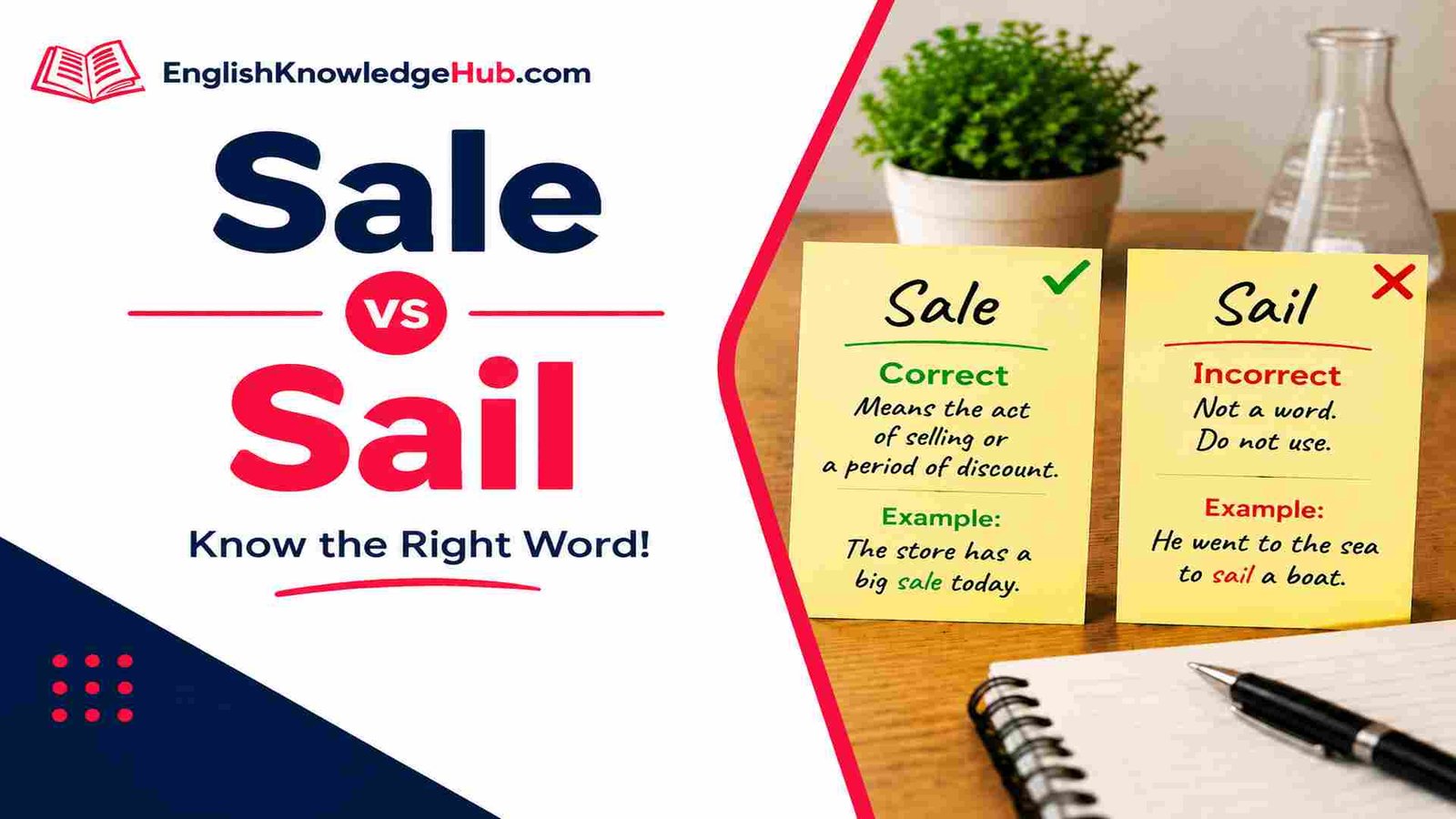
Sale and sail are homophones, but they have different meanings and spellings. A sale is the act of selling something or a period when goods are offered at reduced prices. A sail is the material on a boat that catches the wind, and sail can also be a verb meaning to travel by boat. Say “The shoes are on sale,” but “We sail at noon.”
In this article, you’ll learn the difference between sale vs sail, their noun and verb roles, common phrases, pronunciation, and easy context clues that prevent spelling mistakes. Merriam-Webster defines sale as the act of selling or a selling opportunity, which separates it clearly from sail.
Many learners confuse sale and sail because they sound identical when spoken. If someone says, “The store has a big sale” or “The boat will sail tomorrow,” the words may sound the same, but their meanings are completely different.
This type of confusion happens because English has many homophones—words that share pronunciation but have different spellings and meanings. The key is not the sound; the key is understanding the idea behind the sentence.
The Simple Difference Between Sale and Sail
The easiest way to separate these words is to connect them with two different worlds:
- Sale → money, shopping, business
- Sail → boats, oceans, movement
Compare these examples:
- The furniture is on sale this week.
(The price has been reduced.) - The fishermen will sail before sunrise.
(They will travel by boat.)
The pronunciation is the same, but the situation tells you which word is correct.
What Does Sale Mean?
Sale is a noun that describes the act of selling something or an occasion when goods are offered for purchase.
It is commonly used in two ways:
- A business transaction
- A discount event
Sale Meaning in Shopping
When customers see “sale” in a shop, it usually means products are available at lower prices.
Examples:
- I bought my backpack during the school supplies sale.
- The furniture store announced a weekend sale.
- These headphones are on sale until Friday.
The phrase “on sale” means something costs less than its usual price.
Example:
- The printer is normally $200, but it is on sale for $150.
Sale Meaning in Business
In professional contexts, sale often refers to an official exchange where ownership changes.
Examples:
- The company completed the sale of its old warehouse.
- The lawyer prepared documents for the sale of the property.
- The report includes details about last month’s product sales.
Here, “sale” does not mean a discount. It refers to a business deal.
What Does Sail Mean?
Sail is connected with boats and movement across water. It can work as both a verb and a noun.
Sail as a Verb
As a verb, sail means to travel by boat or move using a boat.
Examples:
- We plan to sail around the island during our holiday.
- The captain will sail the vessel through calm waters.
- The students watched the boat sail away from the harbor.
Sail as a Noun
As a noun, a sail is the large piece of fabric on a boat that catches wind and helps it move.
Examples:
- The torn sail needed immediate repair.
- The white sails looked beautiful against the blue sky.
- The crew raised the sail before leaving the shore.
Sale vs Sail: A Quick Comparison
| Word | Meaning | Common Use | Example |
|---|---|---|---|
| Sale | An act of selling or a discount event | Shopping and business | The store is having a sale. |
| Sail | To travel by boat or a boat part | Travel and ships | They will sail across the lake. |
A useful memory trick:
Sale has money. Sail has water.
If you can imagine a shop, a price tag, or a customer buying something, you probably need sale.
If you can imagine a boat, ocean, or journey, you probably need sail.
How to Use Sale and Sail in Real Situations
Everyday Conversations
Sale
Person A: “Where did you get that jacket?”
Person B: “I found it during a winter sale.”
The speaker is talking about shopping.
Sail
Person A: “What are your plans this weekend?”
Person B: “I’m going to sail with my cousins.”
The speaker is talking about a boat activity.
Workplace English
Sale
- The marketing team increased product sales after the new campaign.
- The manager reviewed the monthly sales figures.
Sail
- The research ship will sail from the port at dawn.
- The company owns a vessel that can sail long distances.
Academic and Formal Writing
Sale
- The study examines how online sales influence consumer behavior.
- The agreement confirms the sale of commercial equipment.
Sail
- Historical explorers used ships to sail across unknown seas.
- The researcher described the challenges of ocean sailing.
Common Mistakes With Sale and Sail
Mistake 1: Using sail for a discount
Incorrect:
The clothing store is having a summer sail.
Correct:
The clothing store is having a summer sale.
Explanation:
A store promotion involves buying and prices, so the correct word is sale.
Mistake 2: Using sale for traveling by boat
Incorrect:
They will sale across the Atlantic next year.
Correct:
They will sail across the Atlantic next year.
Explanation:
Traveling by boat requires the verb sail.
Mistake 3: Confusing “for sale”
Incorrect:
The house is for sail.
Correct:
The house is for sale.
Explanation:
“For sale” means something is available for purchase.
Mistake 4: Using sale as a verb
Incorrect:
The company will sale new products online.
Correct:
The company will sell new products online.
Explanation:
Sale is a noun. The verb form is sell.
Is There Any Difference Between British and American English?
No major difference exists between British and American English for sale and sail.
Both varieties:
- Pronounce the words the same way
- Use sale for selling and prices
- Use sail for boats and movement
The spelling difference is based on meaning, not regional English.
Why Do Sale and Sail Sound the Same?
English spelling does not always match pronunciation perfectly. Over time, different words can develop the same sound while keeping different spellings.
Examples of other homophones include:
- right / write
- sea / see
- flour / flower
- pair / pear
Like these words, sale and sail require context.
If someone says:
“I bought it during the ___.”
The missing word is probably sale because buying is involved.
If someone says:
“The boat will ___ tomorrow.”
The missing word is sail because movement on water is involved.
How to Remember Sale vs Sail Easily
Use this quick mental picture:
Sale = Store
Imagine:
A shop → a price tag → customers → discounts
That gives you sale.
Sail = Sea
Imagine:
A boat → waves → wind → a journey
That gives you sail.
The spelling difference becomes easier when you connect the word with its meaning.
Frequently Asked Questions About Sale vs Sail
Are sale and sail pronounced the same?
Yes. In standard English pronunciation, sale and sail sound the same.
Which is correct: sale or sail?
Both are correct words, but they are used in different situations.
- Use sale for selling or discounts.
- Use sail for boats and traveling on water.
Is sale a verb?
No. Sale is normally a noun.
Correct:
- The sale was successful.
Incorrect:
- They will sale their products.
The correct verb is sell.
Can sail be used without a boat?
Yes. Although it usually refers to boats, it can also describe smooth movement.
Example:
- The leaf sailed across the garden.
Here, it means the leaf moved gently through the air.
What is the difference between sale and sell?
Sale is a noun:
- The company announced a sale.
Sell is a verb:
- The company sells software.
What does “on sale” mean?
“On sale” usually means something is available at a reduced price.
Example:
- The camera is on sale this weekend.
Is “for sail” ever correct?
It is extremely uncommon and would only relate to an actual sail on a boat. When talking about something available to buy, the correct phrase is always for sale.
Final Thoughts
Although sale and sail sound exactly alike, their meanings belong to completely different situations. Sale is connected with money, shopping, and business. Sail belongs to boats, water, and journeys.
When choosing between these two words, do not focus only on pronunciation. Look at the meaning of the sentence. If money is involved, choose sale. If a boat is involved, choose sail.
For more practical English lessons, vocabulary explanations, and grammar guidance, visit EnglishKnowledgeHub.com and continue building your confidence with clear, expert language resources.
