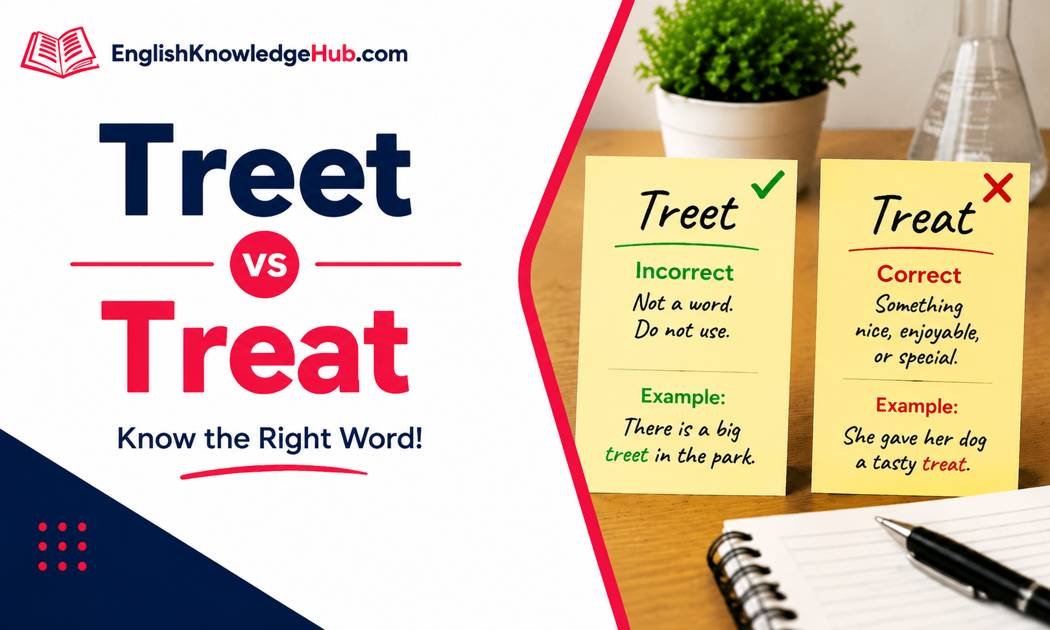
Treat is the standard English spelling; treet is not the normal spelling of this word. Treat can be a verb meaning to behave toward someone in a certain way, give medical care, deal with a subject, or provide something enjoyable. It can also be a noun for a special pleasure, food, or experience. For ordinary English, write treat.
In this article, you’ll learn why treet vs treat causes spelling confusion, the main noun and verb meanings of treat, pronunciation, common phrases, and examples that make the correct spelling easy to remember. Merriam-Webster’s entry for treat shows its standard spelling and major uses.
Many learners write treet because the pronunciation sounds like words such as street or sweet. This is a common spelling confusion, but English spelling is not always based only on sound. In this article, you will learn why treat is correct, how to use it properly, and how to avoid this mistake in your writing.
Treet vs Treat: The Key Difference
The difference between these two words is not about meaning. It is about correct spelling.
| Word | Correct Form? | Explanation |
|---|---|---|
| Treat | ✅ Yes | A real English word with several meanings |
| Treet | ❌ No | Not the standard spelling of the word “treat” |
Use treat when you mean a special pleasure, a reward, kindness toward someone, medical care, or handling a subject.
Examples:
- The handmade chocolates were a lovely treat.
- The doctor will treat the infection.
- The article treats the topic carefully.
What Does Treat Mean?
The word treat has different meanings depending on how it appears in a sentence. It can be a noun or a verb.
Treat as a Noun
When treat is a noun, it refers to something enjoyable, special, or given as a reward.
Examples:
- The children received a small treat after finishing their homework.
- The garden concert was a wonderful treat for the local community.
- Finding an old family photo was an unexpected treat.
Here, the word describes something that creates happiness or pleasure.
Treat as a Verb
As a verb, treat has several meanings.
To Give Someone Something Special
Example:
- My colleague treated me to coffee after I helped with the presentation.
Meaning:
My colleague paid for the coffee as a kind gesture.
Another example:
- Her parents treated her to a weekend trip after graduation.
To Behave Toward Someone in a Particular Way
Example:
- Successful teams treat every member with respect.
Meaning:
They act respectfully toward each person.
Other examples:
- The manager treats new employees fairly.
- We should treat animals with care.
To Deal With or Discuss Something
Example:
- The textbook treats grammar as a practical communication skill.
Meaning:
The textbook discusses or explains grammar.
This use is common in academic and formal writing.
To Provide Medical Care
Example:
- The nurse treated the patient’s injury before the doctor arrived.
Meaning:
The nurse provided medical attention.
Why Do People Spell Treat as Treet?
The mistake usually comes from listening rather than reading.
The pronunciation of treat is:
/triːt/
The ending sound is similar to:
- meet
- greet
- street
- sweet
A learner may think:
“If it sounds like street, maybe it should be spelled treet.”
But English does not work that way. Similar sounds can have different spellings.
Compare:
| Sound | Different Spellings |
|---|---|
| Long “ee” sound | treat |
| Long “ee” sound | green |
| Long “ee” sound | complete |
| Long “ee” sound | receive |
The pronunciation helps you say a word, but spelling must be learned through correct word forms.
How to Use Treat in Real Conversations
Everyday Examples
Example:
A: “Who ordered the dessert?”
B: “I did. It’s my treat.”
Meaning:
The speaker will pay for it.
More examples:
- The movie night was a real treat after a stressful week.
- I bought myself a small treat after completing my assignment.
- The fresh fruit basket was a thoughtful treat.
Treat in Workplace Communication
The word appears frequently in professional English.
Examples:
- The company treats customer satisfaction as a major goal.
- Managers should treat workplace concerns seriously.
- The team treated the problem as an opportunity to improve.
In these sentences, treat means “handle,” “consider,” or “respond to.”
Treat in Academic Writing
In academic contexts, treat often means “to examine” or “to discuss.”
Examples:
- The research paper treats language learning from a psychological perspective.
- The author treats social change as a complex issue.
- The study treated both groups equally during testing.
This meaning is more formal than the everyday meaning of a reward.
Common Mistakes With Treet vs Treat
Mistake 1: Writing Treet for a Special Gift
Incorrect:
My aunt sent me a birthday treet.
Correct:
My aunt sent me a birthday treat.
Explanation:
A gift, reward, or enjoyable experience is called a treat.
Mistake 2: Using Treet in “Trick or Treat”
Incorrect:
The children went door-to-door saying “Trick or Treet.”
Correct:
The children went door-to-door saying “Trick or Treat.”
Explanation:
The traditional Halloween expression uses treat.
Mistake 3: Writing Treet as a Verb
Incorrect:
Doctors treet illnesses in different ways.
Correct:
Doctors treat illnesses in different ways.
Explanation:
The verb meaning “to provide care” is spelled treat.
Is Treet Ever Used Correctly?
In normal English vocabulary, treet is not an accepted alternative spelling of treat.
However, you might see Treet used as:
- a company name
- a brand name
- a product name
- a username
These are special names, not examples of normal English spelling.
For everyday writing, choose:
✅ Treat
Treat vs Treet: British and American English
There is no difference between British English and American English.
Both use:
✅ treat
Examples:
British English:
- The surprise party was a real treat.
American English:
- The surprise party was a real treat.
The spelling remains unchanged.
A Simple Memory Trick for Treat
Remember:
A treat is something you enjoy or something you eat.
Examples:
- a sweet treat
- a holiday treat
- a special treat
The word contains “ea,” like:
- eat
- meal
- clean
This can help you remember:
Treat = correct
Treet = incorrect
Treet vs Treat: Quick Comparison
| Question | Answer |
|---|---|
| Which spelling is correct? | Treat |
| Is treet a standard English word? | No |
| Can treat be a noun? | Yes |
| Can treat be a verb? | Yes |
| Does British English use a different spelling? | No |
Frequently Asked Questions
Is treet a word?
No. Treet is not the standard spelling of the English word treat.
Should I write treat or treet?
Write treat. It is the only correct spelling for the common English word.
Why do treat and treet sound the same?
Because treat contains the long “ee” sound. English has many different spellings for the same pronunciation.
What is the meaning of treat?
Treat can mean a special pleasure, a reward, the way someone behaves toward another person, medical care, or the handling of a topic.
What is the past tense of treat?
The past tense is treated.
Example:
- The doctor treated the patient successfully.
Can treat be used in formal writing?
Yes. In formal writing, treat can mean “discuss,” “analyze,” or “handle.”
Example:
- The report treats environmental protection as a priority.
Is “trick or treet” correct?
No. The correct phrase is:
Trick or treat
Final Thoughts
The answer to “Treet vs Treat: which one is correct?” is simple: treat is the correct spelling. Although treet may seem logical because it matches the pronunciation, it is not accepted standard English.
Understanding small spelling differences helps you write more naturally and avoid common mistakes. For more clear explanations of confusing English words, grammar lessons, and vocabulary advice, visit EnglishKnowledgeHub.com and keep improving your English skills.
