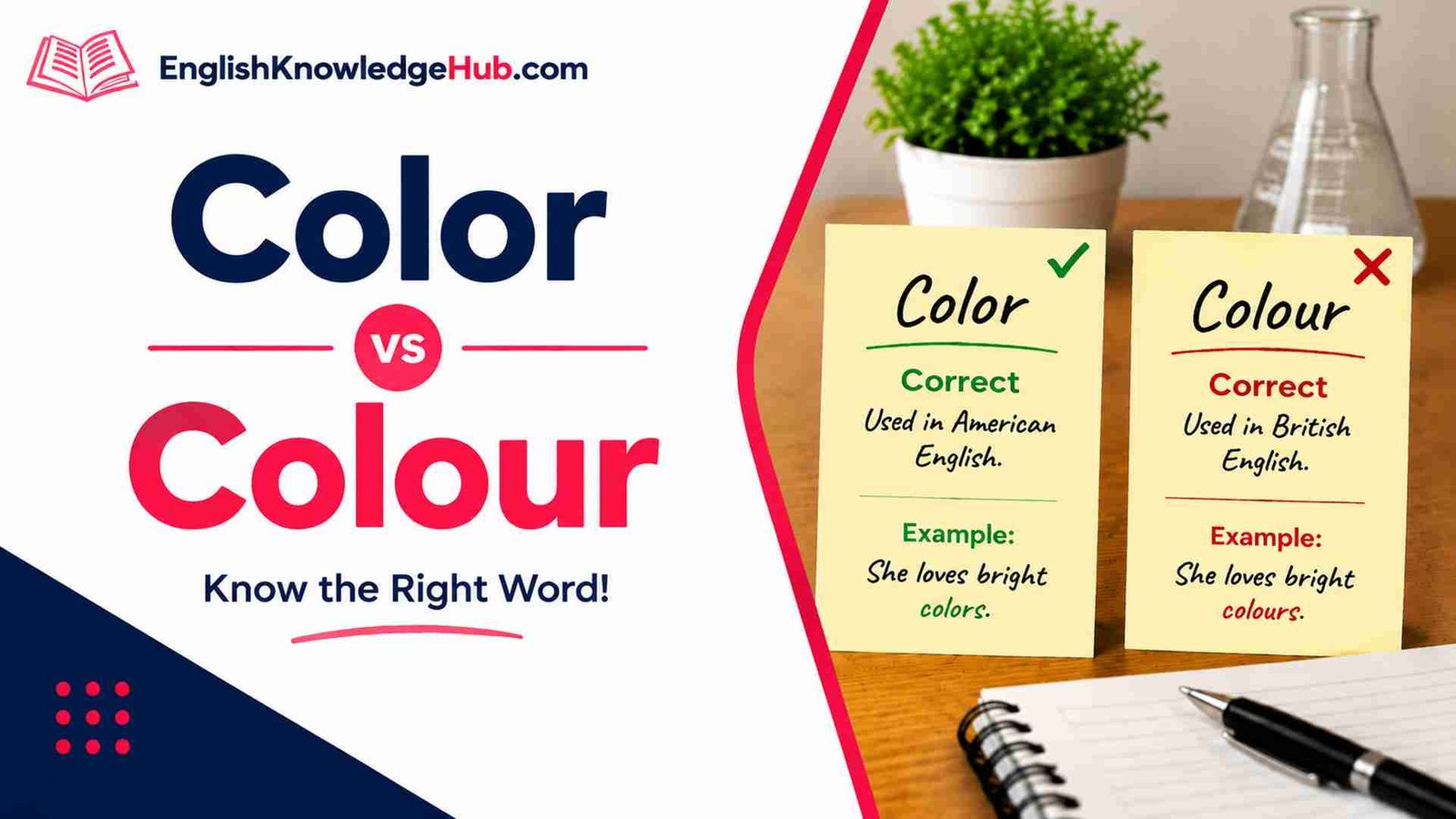
Color and colour are both correct spellings; the difference is regional. Color is the standard American English spelling, while colour is standard in British English and is also widely used in many Commonwealth varieties. The meaning and pronunciation are the same, so choose the spelling that matches your audience or style guide and use it consistently.
In this article, you’ll learn the difference between color or colour, American and British spelling patterns, related words such as colorful/colourful and coloring/colouring, and how to stay consistent in formal writing. Cambridge Dictionary labels color as the US spelling of colour.
Many English learners notice this difference when reading books, websites, or school materials. One writer removes the letter “u”, while another keeps it. The question is not about which spelling is better — it is about understanding which English style you are using.
This article explains the difference between color and colour, when to use each spelling, why the variation exists, and how to avoid common mistakes.
What Does Color or Colour Mean?
Color/colour describes the appearance of something that we see because of how light interacts with objects.
Examples include:
- red
- blue
- green
- yellow
- purple
The word can also describe a quality, feeling, or feature that makes something interesting.
Examples:
- The color of the sky changes before a storm.
- The colour of the old building gives it character.
The meaning stays exactly the same in both spellings.
Color vs Colour: The Main Difference
The difference between color and colour is simply a spelling preference based on region.
| Word | Commonly Used In | Example |
|---|---|---|
| Color | American English | The color of the logo looks modern. |
| Colour | British English, Australian English, and many Commonwealth varieties | The colour of the logo looks modern. |
Neither spelling is incorrect. A writer in the United States would normally write color, while a writer in the United Kingdom would normally write colour.
Why Does Colour Have a “U”?
The extra “u” in colour comes from traditional British spelling patterns.
Over time, American English developed a preference for shorter spellings in some words. As a result, many words ending in -our changed to -or in American usage.
Examples:
| British English | American English |
|---|---|
| colour | color |
| honour | honor |
| favour | favor |
| labour | labor |
This does not mean American spelling is an abbreviation or that British spelling is outdated. They are simply two accepted spelling systems.
When Should You Use Color?
Use color when writing in American English.
This spelling is expected in:
- American schools
- US business communication
- American newspapers
- Websites aimed at US readers
- American software and apps
Everyday examples
- I like the color of your new backpack.
- Which color should we choose for the kitchen walls?
- The sunset had a beautiful orange color.
Workplace examples
- The designer adjusted the color scheme for the company website.
- Please review the color settings before printing the brochure.
- The brand uses a specific color palette across all advertisements.
Academic examples
- The research explored how color affects human attention.
- Scientists observed changes in color patterns among different animals.
When Should You Use Colour?
Use colour when writing in British English.
It is commonly used in:
- The United Kingdom
- Australia
- New Zealand
- Many Commonwealth countries
Everyday examples
- Her favourite colour is purple.
- The colour of the flowers changes during the season.
- I bought a shirt in a darker colour.
Workplace examples
- The marketing team selected new brand colours.
- The report uses colour coding to organize information.
- The company’s colour identity is easy to recognize.
Formal examples
- The article examines the role of colour in modern design.
- The artist used colour to create a strong emotional effect.
Color or Colour: Which One Should English Learners Choose?
The best choice depends on your audience.
Ask yourself:
Who will read my writing?
- Writing for Americans? → Use color
- Writing for British readers? → Use colour
- Writing for an international audience? → Follow the style guide you are expected to use
The most important rule is consistency.
A piece of writing should not switch randomly between British and American spelling.
Common Mistakes With Color and Colour
Mistake 1: Mixing spelling systems
Incorrect:
The colour of my favorite dress is beautiful.
Correct (American English):
The color of my favorite dress is beautiful.
Correct (British English):
The colour of my favourite dress is beautiful.
Explanation:
The first sentence mixes British spelling (colour) with American spelling (favorite). Mixing styles can make writing look inconsistent.
Mistake 2: Believing one spelling is more correct
Incorrect:
Colour is the correct spelling, and color is a mistake.
Correct:
Both spellings are correct in their own English varieties.
Explanation:
English has different regional standards. A spelling used in one country may not be the standard choice in another.
Mistake 3: Using American spelling in British-focused writing
Incorrect:
The color of the product packaging was changed.
Correct:
The colour of the product packaging was changed.
Explanation:
The first sentence is understandable, but British publications and organizations usually prefer colour.
Related Forms: Colorful or Colourful?
The same spelling difference appears in related words.
| American English | British English |
|---|---|
| colorful | colourful |
| colored | coloured |
| coloring | colouring |
| colorless | colourless |
Examples:
American English:
The festival was full of colorful decorations.
British English:
The festival was full of colourful decorations.
Is Color or Colour More Common?
The answer depends on where English is being used.
Color is very common because of the large global influence of American media, technology, and online content.
Colour remains the standard spelling in British English and many countries that follow British spelling conventions.
Frequency does not determine correctness. Both forms are accepted.
Is “Colour” Formal and “Color” Informal?
No.
This is a common misunderstanding.
Both can appear in:
- Formal reports
- Academic writing
- Professional documents
- Everyday conversations
The difference is regional, not formal versus informal.
How to Remember the Difference
A simple memory trick:
American English drops the “u”: color
British English keeps the “u”: colour
You can also remember similar pairs:
- favor / favour
- honor / honour
- labor / labour
Frequently Asked Questions About Color and Colour
Is color or colour correct?
Both are correct. Color is American English, and colour is British English.
Which spelling should I use in an English exam?
Use the spelling style accepted by your exam or course. The key is to remain consistent throughout your writing.
Is colour wrong in American English?
It is understandable, but American English normally uses color.
Is color wrong in British English?
No. People understand it, but colour is the standard British spelling.
Do color and colour have different meanings?
No. They have exactly the same meaning.
Are color and colour pronounced differently?
No. They are pronounced the same in normal English speech.
Should websites use color or colour?
A website should use the spelling that matches its target audience. A US website usually uses color, while a UK website usually uses colour.
Why do British and American English spell words differently?
English developed different regional spelling conventions over time. Many differences are simply traditions followed in different countries.
Final Thought
The difference between color and colour is a reminder that English is not one single system. Different countries have developed their own accepted spelling habits.
Choose the version that matches your readers, use it consistently, and do not worry about one being “more correct” than the other.
For more clear explanations of grammar, vocabulary, and common English mistakes, continue improving your skills with EnglishKnowledgeHub.com.
