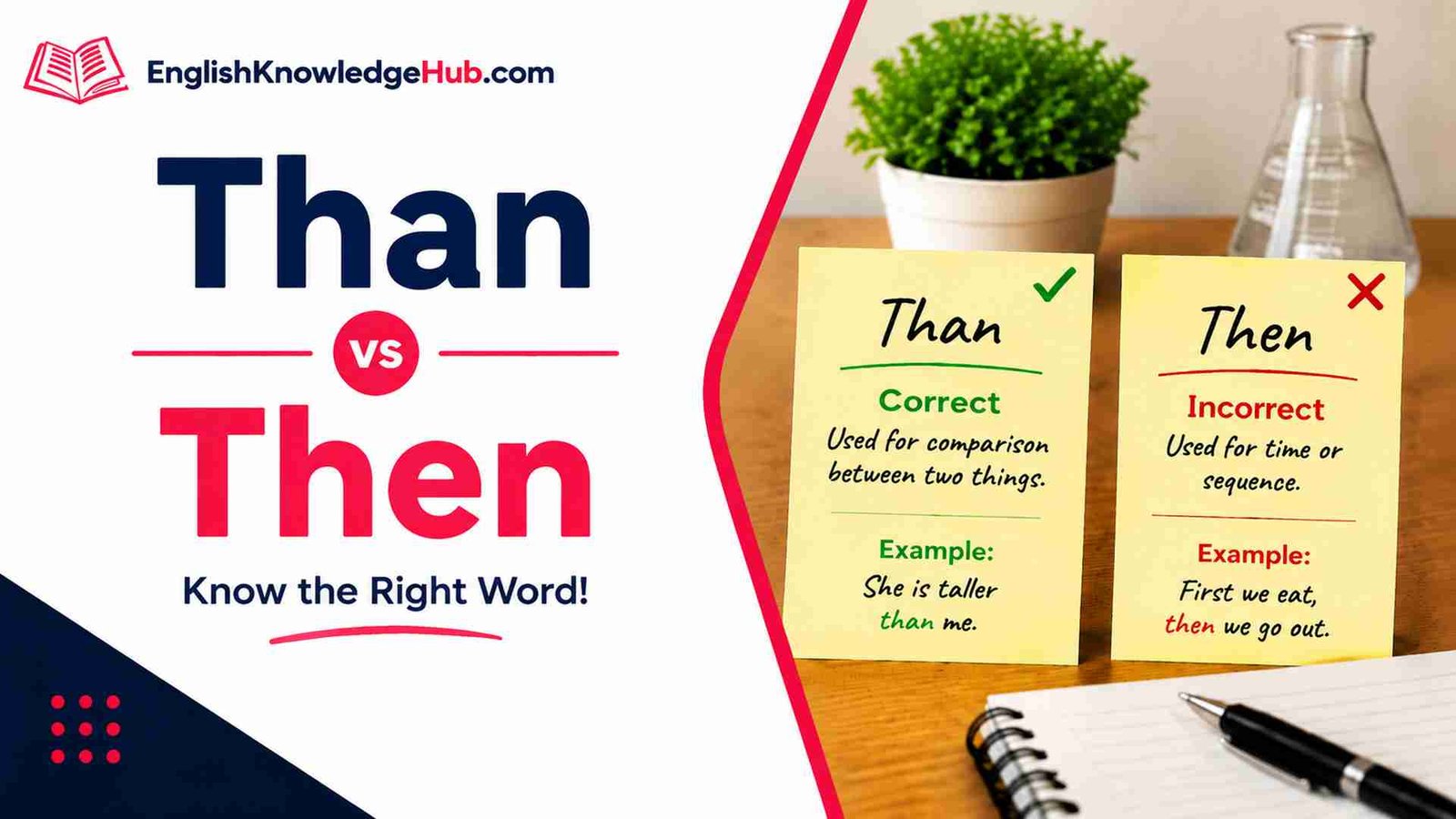
Than is mainly used for comparisons, while then is mainly used for time, order, or what happens next. Write “She is taller than me” when comparing two people, and “We ate dinner, then watched a movie” when showing sequence. The words can sound similar in fast speech, but they do completely different jobs in a sentence.
In this article, you’ll learn Than vs Then through the sentence patterns people actually use, including comparisons, time expressions, rather than, if…then, and common errors that spell-checkers may miss. Merriam-Webster’s usage guidance separates than for comparison from then for time and sequence.
The Difference in One Sentence
If you are comparing, you probably need than. If you are talking about time, order, or the next step, you probably need then.
That sounds simple, but the words become tricky in sentences such as “different than,” “rather than,” “better than I,” and “if this happens, then what?” Instead of memorizing two short definitions, it helps to notice what relationship the word creates.
Than connects two sides of a comparison. It can compare people, objects, amounts, choices, actions, or ideas. Then moves the reader through time or logic. It can point back to a time, show the next action, or introduce a result.
When “Than” Is the Word You Need
Think of than as a comparison bridge. Something appears on one side, something else appears on the other, and than connects them.
For example, “This route is shorter than the highway” compares two routes. “I drink more water than coffee” compares amounts. “The exam was easier than I expected” compares the real experience with an expectation.
This is why than naturally follows many comparative words:
better than, worse than, taller than, smaller than, more than, less than, faster than, rather than.
Here are a few natural examples:
“The blue laptop is cheaper than the silver one.”
“Maya arrived earlier than her manager.”
“The meeting took longer than we planned.”
“I would rather call than send another long email.”
Notice that none of these sentences is mainly telling you what happened next. Each one places two things in comparison.
When “Then” Is the Better Choice
Then usually moves a sentence forward. It often answers questions such as when?, what happened next?, or what follows if this is true?
In “We checked the address, then ordered the package,” then tells you the second action. In “I lived in Karachi then,” it points to a particular time in the past. In “If the file is correct, then send it,” it introduces the result or next step.
You will commonly see then in patterns such as:
back then, since then, until then, by then, from then on, every now and then, first…then, if…then.
These are all connected to time, order, or consequence rather than comparison.
Why “Better Then” and “More Then” Usually Look Wrong
One of the fastest ways to catch this mistake is to look at the word immediately before the blank. If you see a comparative such as better, worse, more, less, taller, faster, or older, than is usually the word you need.
Incorrect: This camera is better then mine.
Correct: This camera is better than mine.
The sentence compares two cameras, so than fits.
Incorrect: We need more then ten chairs.
Correct: We need more than ten chairs.
Here, the comparison is between the required number and ten.
This is similar to other sound-alike mistakes. If homophones tend to trip you up, our To vs Too guide uses the same “look at the word’s job” approach instead of relying only on pronunciation.
“First…Then” Is About Order
Learners sometimes hesitate because two actions can feel like a comparison. A simple test helps: if you could replace the word with next or after that, use then.
“First save the document, then close the program.”
You could say, “First save the document, next close the program.” That shows why then is correct.
The same idea works in everyday conversation:
“Let’s get coffee, then we can walk to the station.”
“She finished university and then moved abroad.”
“Check the total, then click Submit.”
In each sentence, then gives the reader a sequence.
How “If…Then” Works
The pattern if…then connects a condition with a result. The word then is often optional, but when it appears, it makes the result especially clear.
“If the weather improves, then we will leave after lunch.”
The condition is if the weather improves. The result is we will leave after lunch.
You can also write, “If the weather improves, we will leave after lunch.” Both versions are grammatical. Adding then can make the logical relationship more noticeable, especially in instructions or explanations.
“Rather Than” Is a Fixed Comparison Pattern
Rather than means instead of or in preference to. Because it compares alternatives, it takes than, not then.
“I would rather wait than rush the decision.”
“We chose to repair the desk rather than replace it.”
“Rather than blaming someone, let’s fix the problem.”
A useful check is to ask whether the sentence presents two choices. If it does, than is doing comparison work.
What About “Different Than”?
You may have learned that only different from is correct. Modern English is more flexible than that rule suggests. Different from is widely accepted and works in almost every context. Different than also occurs, especially in American English, and can be useful before a full clause.
For a learner who wants a safe general choice, different from is easy to use:
“My answer is different from yours.”
But this does not change the basic than vs then distinction. If you encounter different than, the word is still than, because it is part of a comparison, not a time sequence.
“Than Me” or “Than I”?
Both forms can appear, depending on the structure and level of formality.
“She is taller than me” is extremely common and natural in everyday English.
“She is taller than I am” is more explicit and can sound more formal.
The short form “than I” may also appear, but many speakers find “than I am” more natural when they want the formal structure.
The important point for this article is that all of these comparison structures use than, not then.
A Quick Test That Works in Real Writing
When you are unsure, do not stare at the spelling. Replace the word with a simple idea.
If compared with fits, choose than.
“The train is faster ___ the bus.” → faster compared with the bus → than.
If next, at that time, or in that case fits, choose then.
“Finish your homework, ___ call me.” → next call me → then.
This meaning test is more reliable than trying to remember which word “looks right.”
Common Mistakes in Everyday and Workplace English
Incorrect: The new plan costs less then the old one.
Correct: The new plan costs less than the old one.
The sentence compares costs.
Incorrect: Send the invoice than update the spreadsheet.
Correct: Send the invoice, then update the spreadsheet.
The sentence gives two actions in order.
Incorrect: If the customer agrees, than we can start.
Correct: If the customer agrees, then we can start.
The second clause is the result of the condition.
Incorrect: I would rather stay home then drive in the storm.
Correct: I would rather stay home than drive in the storm.
Rather than compares two choices.
Pronunciation: Why the Mistake Is So Easy
Than and then have different dictionary pronunciations, but in quick speech their vowels can become less distinct. That is why listening alone is not always enough to spell them correctly.
Instead, listen to the meaning of the whole sentence. Is the speaker comparing two things, or moving from one time or action to another? That question usually solves the problem immediately.
Frequently Asked Questions
Is it “better than” or “better then”?
Better than is correct because better introduces a comparison.
Is it “more than” or “more then”?
Use more than when comparing amounts, numbers, or degree: “More than 20 people attended.”
Is it “and than” or “and then”?
If you mean “and next,” use and then: “We ate and then left.”
Can a sentence use both than and then?
Yes. For example: “If this option is cheaper than the first one, then choose it.” Than makes the comparison; then introduces the result.
What is the easiest way to remember than vs then?
Connect than with comparison and then with time or next. Meaning is a better memory tool than sound.
Is “then” ever used for comparison?
Not in the normal comparison patterns covered here. Use than after comparative words such as better, more, less, faster, and older.
Final Takeaway
The Than vs Then choice becomes much easier when you stop treating the words as a spelling pair and start asking what the sentence is doing. Use than to compare. Use then for time, sequence, or a result. If compared with fits, choose than. If next or at that time fits, choose then.
If you want another practical lesson on words that sound alike but do different jobs, read our Advice vs Advise guide. For more clear, people-first English explanations, explore EnglishKnowledgeHub.com.
