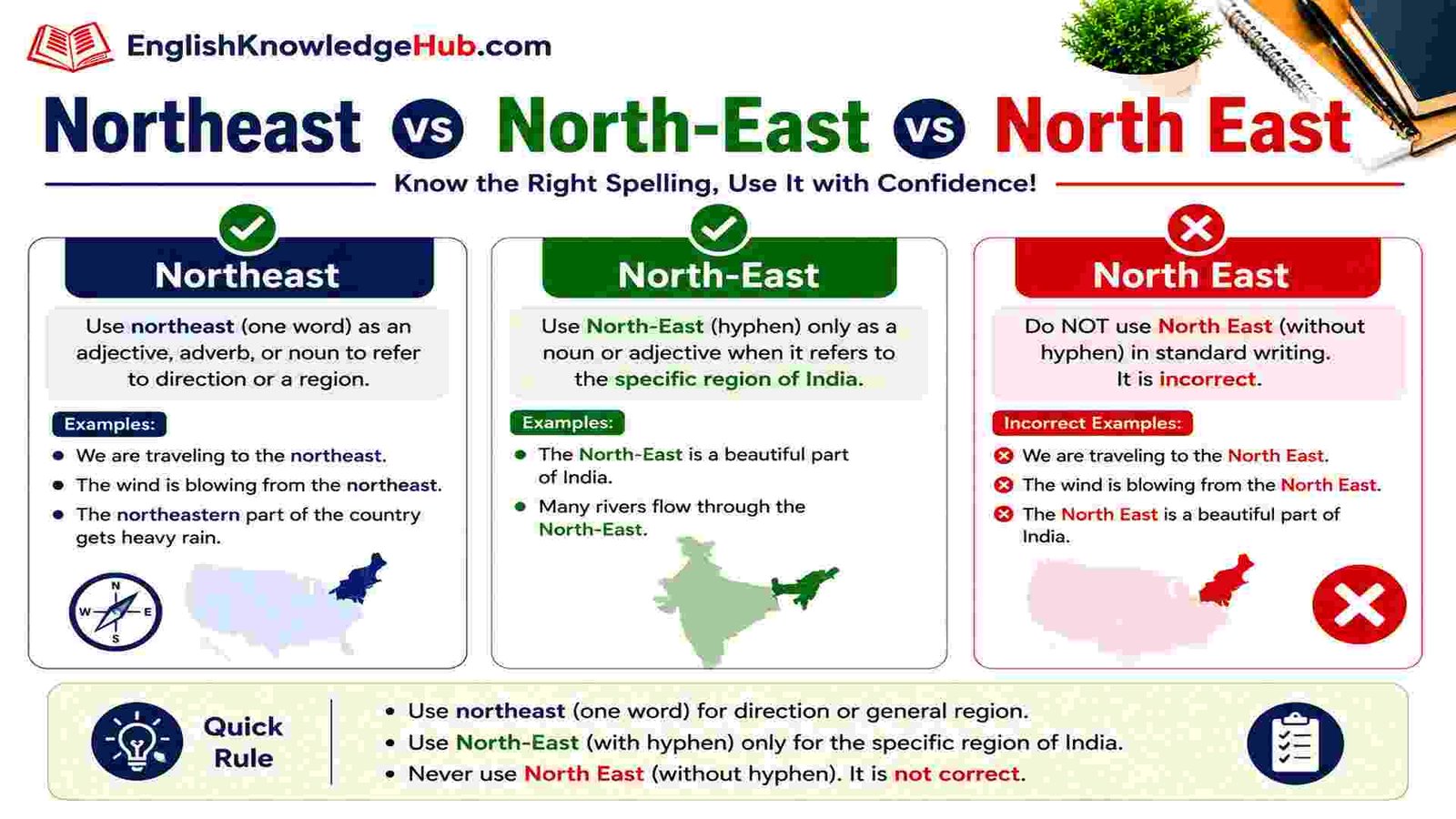
Northeast is the usual one-word spelling for the compass direction between north and east, especially in American English. North-east also appears in British-style writing, while North East can be part of an established regional name. The meaning usually stays the same; spelling style and capitalization tell you which form fits.
In this article, you’ll learn Northeast vs North-East vs North East through compass directions, regional names, capitalization, adjective and adverb uses, and British versus American style. Cambridge lists northeast as the standard direction between north and east and also uses it for regional references.
What Does Northeast Mean?
Northeast is the compass direction halfway between north and east.
Picture a compass in front of you. North is at the top and east is on the right. Northeast sits between them.
The word can describe:
- a direction
- movement
- a position
- part of a place
- a geographical region
For example:
The boat moved northeast after leaving the harbour.
Their house stands northeast of the school.
We stored the equipment in the northeast corner.
Heavy rain reached the northeast by evening.
Although the word has one basic geographical meaning, it can perform different jobs in a sentence.
The Main Difference in Northeast vs North-East vs North East
The three spellings are easier to understand when you look at how they are normally used.
| Form | Typical Use | Example |
|---|---|---|
| northeast | Common spelling, especially in American English | We drove northeast for ten miles. |
| north-east | Hyphenated spelling found in some British styles | The farm lies north-east of the town. |
| North East | Proper or established regional name | She moved to the North East for work. |
The first two forms generally have the same meaning.
The third form is different mainly because capitalization can show that the words are functioning as the name of a particular region.
When to Write “Northeast”
For general American English, northeast is usually the simplest choice.
It can work as a noun, adjective, or adverb.
As a Noun
A noun names a direction or area.
Dark clouds formed in the northeast.
The mountains are visible toward the northeast.
In both sentences, the word names a direction.
As an Adjective
The word can describe another noun.
Please use the northeast entrance.
The northeast classroom receives morning sunlight.
A northeast wind cooled the valley.
Here, it tells us which entrance, classroom, or wind we mean.
You do not need to add a hyphen simply because the word comes before a noun when you are following a style that uses the closed spelling.
As an Adverb
Northeast can also describe movement.
The hikers continued northeast after lunch.
The storm moved northeast overnight.
Turn northeast when you reach the old bridge.
In these examples, the word tells us where someone or something is moving.
When Is “North-East” Correct?
North-east is also a legitimate spelling.
It is especially familiar in British English and in writing styles that prefer a hyphen for compound compass directions.
For example:
The footpath continues north-east through the woods.
Their cottage stands north-east of the village.
A cold north-east wind arrived before sunrise.
The meaning is essentially the same as the one-word form.
This is an example of a style difference, not necessarily a grammar error.
That distinction matters. Learners often think two different spellings mean one must be wrong. English does not always work that way.
Different dictionaries, publishers, schools, newspapers, and organizations may follow different spelling preferences.
American and British English
A useful starting rule is:
American English usually prefers:
northeast
Some British styles prefer:
north-east
However, British usage is not completely uniform. You may also see the one-word spelling in British material.
For that reason, avoid treating the following rule as absolute:
American = northeast
British = north-east
A better approach is to check the style you are expected to follow.
If you are writing for:
- a school
- a university
- a company
- a newspaper
- a journal
- a government department
- a publisher
follow its preferred spelling.
If no style guide exists, choose one accepted form and stay consistent.
Why “North East” Can Be Correct as Two Words
The open form needs a little more care.
For an ordinary compass direction, writing two separate words is less common than using northeast or north-east.
However, North East can be correct when it forms an established geographical or organizational name.
For example:
She has worked in the North East for six years.
The company plans to open another office in the North East.
Here, the words may identify a recognized region rather than simply telling us a compass direction.
Compare these sentences:
Walk northeast until you reach the river.
Tourism increased across the North East.
The first sentence gives a direction.
The second uses the words as the name of a region.
That is why capitalization and context matter.
A Two-Question Test That Solves Most Problems
When you are unsure which spelling to choose, ask yourself these two questions.
1. Am I Simply Giving a Direction?
If yes, use the spelling preferred by your variety of English or style guide.
For example:
Travel northeast for another kilometre.
or:
Travel north-east for another kilometre.
Both can be acceptable under different style systems.
2. Am I Using an Official or Established Name?
If yes, preserve the spelling used in that name.
Do not rewrite proper names just to make them match your usual spelling preference.
This rule applies to geographical areas, institutions, organizations, and other named entities.
Capitalization: Northeast or northeast?
Capitalization is a separate issue from spelling.
A word can be spelled correctly but still be capitalized incorrectly.
Use Lowercase for Ordinary Directions
When the word simply tells you where something is or where it moves, lowercase is normally appropriate.
The train continued northeast.
The village is northeast of the lake.
Our room is in the northeast corner.
The wind came from the northeast.
These sentences describe direction or location.
Use Capitals for Proper or Recognized Regional Names
Capital letters may be needed when you refer to a named or recognized region.
For example:
She spent several years living in the Northeast.
Here, the Northeast may refer to a recognized region of the United States.
Likewise, a regional name may appear as:
the North East
when referring to a recognized area in Britain.
A helpful test is:
Could I point to this as the name of a particular region?
If yes, capitalization may be appropriate.
If you are only pointing someone in a direction, lowercase is usually enough.
Common Mistakes With Northeast vs North-East vs North East
Most mistakes happen because writers mix spelling styles or confuse directions with regional names.
Mistake 1: Switching Spellings Without a Reason
Incorrect:
The road runs northeast before turning north-east near the farm.
Correct:
The road runs northeast before turning northeast near the farm.
Explanation:
The two spellings may both exist, but changing between them in the same piece of writing without a reason creates inconsistency.
Mistake 2: Capitalizing an Ordinary Direction
Incorrect:
Drive Northeast until you see the hospital.
Correct:
Drive northeast until you see the hospital.
Explanation:
The word merely tells the driver which direction to travel. It is not a proper name.
Mistake 3: Thinking the Hyphenated Form Is Always Wrong
Incorrect:
North-east is always a spelling mistake.
Correct:
North-east can be correct in British English and in styles that prefer the hyphen.
Explanation:
The hyphenated spelling has established use. Treat it as a regional or editorial preference rather than automatically correcting it.
Mistake 4: Using Two Words for Every Direction
Less suitable:
The car travelled north east for thirty minutes.
Better:
The car travelled northeast for thirty minutes.
Or, under a hyphenating style:
The car travelled north-east for thirty minutes.
Explanation:
For a normal compass direction, the closed or hyphenated form is generally clearer. The open form is particularly useful when it belongs to an established name or specific house style.
Mistake 5: Changing a Proper Name to Match Your Normal Spelling
Incorrect approach:
My style uses northeast, so I should rewrite every official name that contains North East.
Correct approach:
Keep an official name in its established form.
Explanation:
Style preferences apply to your own general writing. They do not give you a reason to respell proper names.
Daily Conversation Examples
Here are some natural examples:
“Which way should we go?”
“Head northeast after the traffic lights.”
“Where is your new apartment?”
“It is northeast of the university.”
“Which corner should I put the desk in?”
“Try the northeast corner.”
Under a British style that prefers a hyphen, the same ideas could be written with north-east.
The meaning remains the same.
Workplace Examples
Direction words often appear in workplace instructions, reports, maps, and planning documents.
The maintenance crew will inspect the northeast wing on Monday.
Please enter through the northeast gate while the main entrance is closed.
Customer demand increased in the northeastern part of the district.
The new warehouse is northeast of our current distribution centre.
In professional writing, consistency matters. If your organization uses northeast, continue using that spelling unless a proper name requires something different.
Academic Examples
Academic writing often needs accurate descriptions of position and location.
Researchers collected soil samples from the northeast section of the field.
The settlement lies northeast of the excavation site.
Rainfall was highest in the northeastern part of the study area.
The birds moved northeast during the first stage of migration.
A university or journal that follows a hyphenated British style might use north-east instead.
The grammatical meaning does not change.
Formal Writing Examples
Formal reports often need both directions and regional names.
The proposed road will extend northeast from the existing junction.
Economic activity increased in the northeastern districts during the study period.
The committee reviewed transport links serving the North East.
Notice the difference in the final sentence. Capitals can signal that the writer means a recognized region, not simply a direction.
Northeast and Northeastern Are Not Always Interchangeable
These two words are closely related, but their grammar is different.
Northeast can tell us a direction:
The plane flew northeast.
It can also describe a noun:
We used the northeast entrance.
Northeastern is mainly an adjective:
The northeastern entrance was closed.
Farms in the northeastern district received more rain.
This means the following sentence sounds wrong:
Incorrect:
We drove northeastern for two hours.
Correct:
We drove northeast for two hours.
The second sentence works because you need a direction of movement.
What About NE?
The usual abbreviation for northeast is:
NE
You may see it on:
- maps
- weather reports
- road signs
- navigation systems
- addresses
- diagrams
Examples:
Wind: NE at 15 km/h
Continue NE after the junction.
The storm is moving NE.
Abbreviations are useful where space is limited, but in normal sentences the full word is often easier to read.
Which Form Should You Choose?
If you want a practical rule, use this:
For general American English:
Use northeast.
For British English:
Use northeast or north-east, depending on the style you follow.
For official names:
Keep the spelling and capitalization used by the name itself.
For a normal compass direction:
Avoid changing randomly between one word, a hyphenated form, and two words.
Think of spelling style like choosing a road lane. More than one lane may be valid, but moving between them constantly without a reason makes the journey less smooth.
Your writing works the same way. Pick the appropriate style and stay in it.
FAQs
Is Northeast vs North-East vs North East a grammar difference?
It is mainly a spelling, style, and capitalization difference. The one-word and hyphenated forms usually express the same compass direction, while the two-word capitalized form can appear in established names.
Is northeast one word?
Yes. Northeast is a standard one-word spelling and is especially common in American English.
Is north-east with a hyphen correct?
Yes. North-east is an accepted spelling in British English and in styles that prefer hyphenated compass directions.
Is north east without a hyphen incorrect?
Not automatically. It can occur in proper or established names and in some specific house styles. For an ordinary compass direction, northeast or north-east is usually clearer.
Should northeast have a capital letter?
Use lowercase for an ordinary direction. Use capitals when the word forms part of a proper name or represents a recognized geographical region.
Which form should I use in American English?
Use northeast in most American writing. It is the familiar closed form.
Which form should I use in British English?
British writing may use north-east or northeast. Follow the style guide used by your school, employer, publisher, or institution.
What is the difference between northeast and northeastern?
Northeast can name or show a direction. Northeastern mainly describes something located in, toward, or connected with the northeast.
Final Thoughts
The easiest way to understand Northeast vs North-East vs North East is to stop looking for one spelling that must replace every other form. Northeast is the common American choice, north-east remains valid in British-style writing, and North East can be correct when it belongs to an established regional or proper name.
For ordinary directions, follow one spelling style and use it consistently. For proper names, keep their established spelling and capitalization.
For more simple lessons on grammar, spelling, confusing words, and everyday English usage, visit EnglishKnowledgeHub.com.
