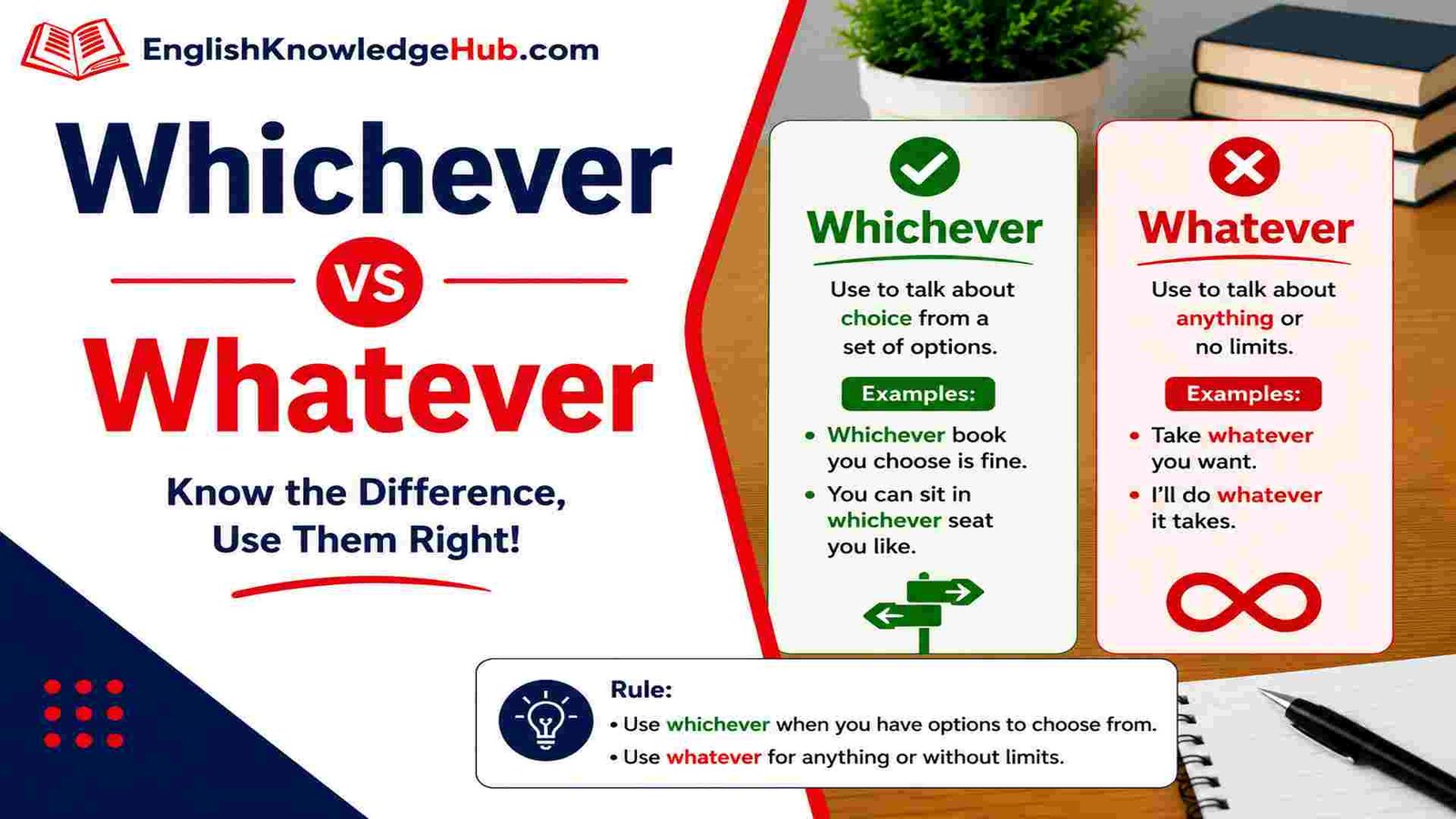
Whichever and whatever are both correct, but they point to different kinds of choice. Use whichever when the options come from a known or limited set. Use whatever when the choice is open, unknown, or unrestricted. A useful shortcut is: whichever = which one from these, while whatever = anything that fits.
In this article, you’ll learn how Whichever vs Whatever changes with context, why the size of the choice matters, how both words work as pronouns and determiners, and when whatever can sound dismissive. Cambridge Grammar explains that whichever means any one from a choice, while whatever can mean anything or no matter what.
The Difference Is Really About the Choice
The easiest way to separate the two words is to look at what the speaker is choosing from. If the choices are already visible, named, or limited, whichever usually fits best.
Suppose a waiter shows you three desserts. “Choose whichever you like” means choose any one of those desserts. The set is clear and limited.
Now imagine someone tells you, “Order whatever you like.” The choice is much wider. You can choose anything available, not just one item from a small named set.
Use Whichever for a Limited Set
Whichever often answers the idea of “which one?” It can stand alone or come before a noun.
“Take whichever seat is free” means choose one seat from the seats available. “Choose whichever route looks shorter” means select one route from a group of possible routes.
This limited-choice idea also appears in formal instructions: “Please sign whichever form applies to your case.” The reader is not being offered every possible form in the world. The choice comes from a known group.
Use Whatever for an Open Choice
Whatever is broader. It can mean anything that, no matter what, or an unspecified thing.
“Eat whatever you want” does not point to a fixed short list. “Whatever happens, call me” means the instruction remains true no matter what event occurs.
That broader meaning is why whatever often sounds natural with ideas, actions, situations, and things whose exact identity is not important.
Whichever One or Whatever One?
Whichever one is common when the listener is choosing from a known set: “Whichever one you choose will fit in the box.”
Whatever one is possible in some contexts, but it usually sounds less natural when the speaker clearly has a limited group in mind. If you are pointing at three shirts, “whichever one you like” is the more natural choice.
Whichever Day vs Whatever Day
These phrases show the difference well. “Choose whichever day works best” often suggests a known set of available days. “Come whatever day you like” sounds more open and less restricted.
The two meanings can overlap because real-life choices are not always perfectly limited or unlimited. When both seem possible, ask what you want to emphasize: selection from known options, or freedom without much restriction.
Whatever Can Mean “No Matter What”
One important use of whatever has nothing to do with choosing an object. It can introduce a clause meaning no matter what.
“Whatever happens, stay calm” means the advice is true in every possible situation. “Whatever the reason, we still need an answer” means the reason does not change the main point.
Whichever can do something similar when the choice is between alternatives: “Whichever route we take, we will arrive late.” Here the routes form the limited set.
Can “Whatever” Sound Rude?
Yes. Used by itself as a reply, Whatever. can sound dismissive or annoyed. Cambridge notes that vague expressions such as whatever can be impolite in some conversational contexts.
Compare “Choose whatever you like,” which is friendly and neutral, with “Whatever,” said after someone gives advice. The grammar is not the problem. Tone and situation change the meaning.
Common Mistakes
Less suitable: There are two doors. Go through whatever is open.
Better: There are two doors. Go through whichever is open.
Because the sentence gives a limited set of two doors, whichever is clearer.
Less suitable: Whichever happens in the future, I will support you.
Better: Whatever happens in the future, I will support you.
The sentence refers broadly to any possible event, so whatever is the natural choice.
Whichever and Whatever in Questions
Neither word is simply a fancy replacement for which or what. In ordinary direct questions, we usually say “Which option do you prefer?” or “What do you want?” The -ever forms add the idea that the exact choice does not matter or that any choice in the relevant range is acceptable.
A Quick Test That Works
Before choosing, ask one question: Can I clearly point to the set of options? If yes, whichever is often best. If the possibilities are open or undefined, whatever is usually better.
This is a practical guide, not an absolute law. Context can make the boundary flexible, but the limited-set versus open-choice distinction solves most learner problems.
Frequently Asked Questions
What is the main difference between whichever and whatever?
Whichever normally selects from a limited set. Whatever is broader and can mean anything or no matter what.
Can whichever and whatever both be pronouns?
Yes. Both can stand in place of a noun, and both can also appear before nouns as determiners.
Is “choose whatever you want” correct?
Yes. It gives the listener an open or broad choice.
Is “choose whichever you want” correct?
Yes, especially when both people understand the limited group of choices.
Can “whatever” be rude?
Yes, when used alone as a dismissive reply. In ordinary phrases such as “whatever you need,” it is neutral.
Final Thoughts
The best way to solve Whichever vs Whatever is to look at the size of the choice. Use whichever for one option from a limited group and whatever for an open choice, an unknown thing, or the meaning “no matter what.”
For more clear grammar and word-choice guides, explore EnglishKnowledgeHub.com.
