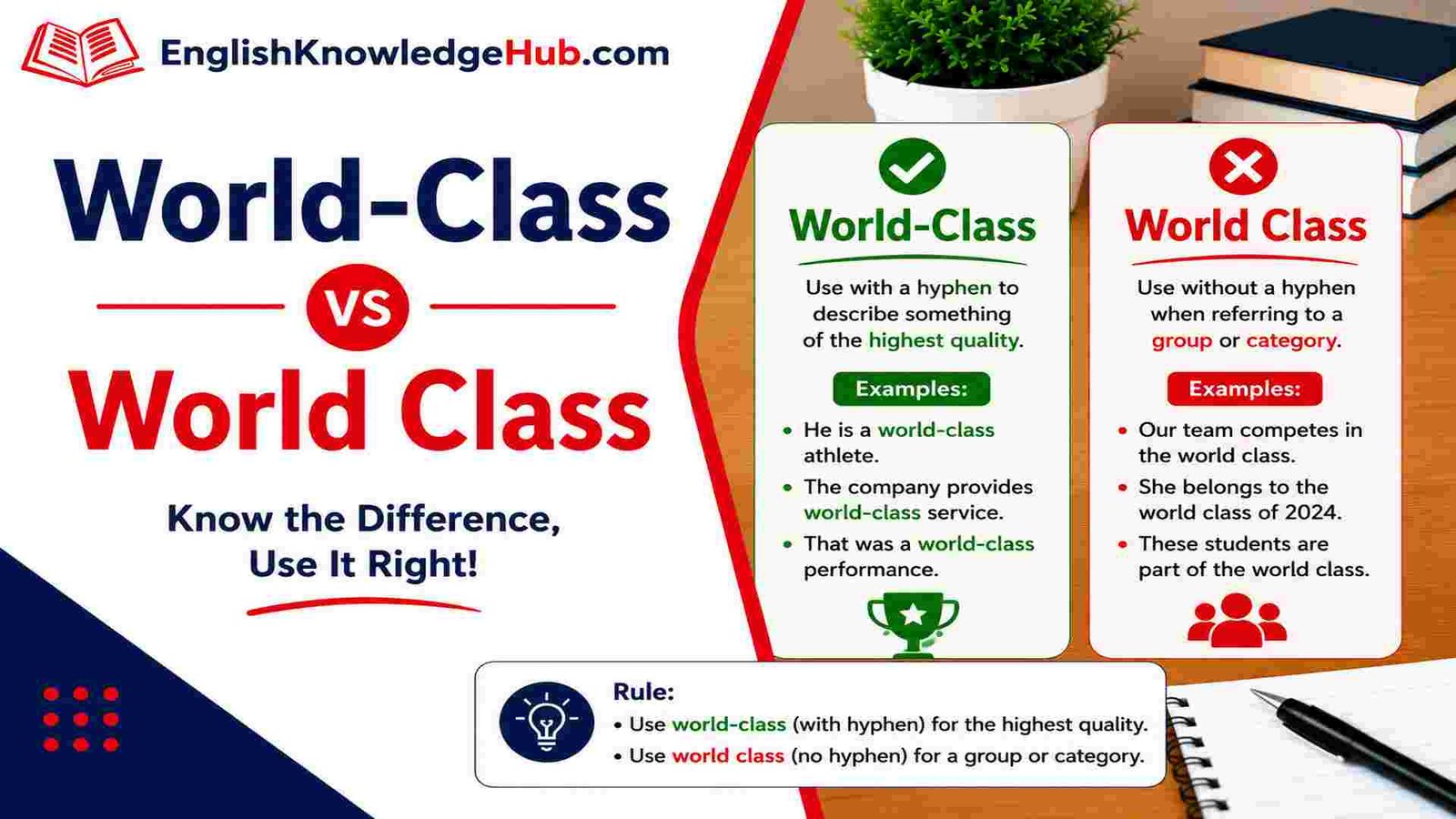
World-class is the standard dictionary spelling of the adjective meaning among the best in the world. Use the hyphen confidently before a noun, as in “a world-class hospital,” and it is also correct after a linking verb, as in “The hospital is world-class.” The open form world class appears in real usage, but sentence position does not automatically require you to remove the hyphen.
In this article, you’ll learn World-Class vs World Class through compound-adjective rules, before-and-after-noun examples, style variation, and related phrases such as world-renowned and first-class. Merriam-Webster lists world-class as the established adjective meaning “of the highest caliber in the world.”
The Main Rule Behind World-Class vs World Class
When world-class comes directly before a noun, use a hyphen.
- a world-class athlete
- a world-class restaurant
- a world-class university
- a world-class research center
- a world-class performance
When the description comes after the noun, especially after a linking verb such as is, was, seems, or remains, you may see both world-class and the open variant world class. Major dictionaries list the adjective as world-class, so keeping the hyphen is the safest edited choice.
- The athlete is world class.
- Their restaurant is world class.
- The university remains world class.
- Her performance was world class.
Here is the easiest rule to remember:
Use world-class as the safest standard adjective. Do not automatically remove the hyphen just because the adjective comes after the noun.
There is one useful detail to know. Because world-class is an established compound adjective, some writers keep the hyphen even when it comes after the noun.
For example:
- Their service is world-class.
- Their service is world class.
Both forms can be found in careful English. If you are writing before a noun, however, the hyphenated form is the safest and clearest choice.
What Does World-Class Mean?
World-class means extremely good or good enough to compare with the best examples in the world.
Imagine three levels:
- good
- excellent
- world-class
Calling something world-class is a strong compliment. It suggests an unusually high level of quality, ability, skill, or service.
For example:
Nadia is a world-class swimmer.
This does not simply mean Nadia can swim well. It suggests her ability is at an extremely high level.
Another example:
The clinic provides world-class medical care.
The phrase tells us that the medical care is considered exceptionally good.
You can use world-class for many things, including:
- athletes
- teachers
- doctors
- hotels
- universities
- technology
- customer service
- restaurants
- facilities
- performances
- research
- businesses
Why Do We Put a Hyphen in World-Class?
A hyphen can connect two words that work together as one description.
Look at this sentence:
They hired a world-class engineer.
The words world and class work together to describe engineer.
We are not talking about a world engineer or a class engineer. The complete idea is world-class engineer.
You can think of the hyphen as a small piece of glue. It tells the reader:
“Read these two words together.”
The same thing happens in other compound adjectives:
- a well-known author
- a high-quality camera
- a five-year plan
- a full-time employee
- a world-class musician
This is why writing a world class musician without the hyphen is less suitable in standard edited English.
A Quick Comparison
A useful way to understand World-Class vs World Class is to compare the same idea in two sentence positions.
| Before a Noun | After the Noun |
|---|---|
| a world-class chef | The chef is world class. |
| a world-class hotel | The hotel is world class. |
| a world-class team | The team is world class. |
| a world-class laboratory | The laboratory is world class. |
| a world-class performer | The performer is world class. |
Notice what changes.
In the left column, the description comes before the noun.
In the right column, the noun appears first and the description follows a linking verb.
The meaning remains almost the same.
Examples From Everyday Conversation
Here are some natural examples you might hear or use in daily life.
- We ate at a world-class restaurant during our trip.
- My brother dreams of becoming a world-class goalkeeper.
- That new sports center looks world class.
- The singer gave a world-class performance last night.
- Their new hotel is world class.
- She received training from a world-class coach.
- The food was good, but I would not call it world class.
- He wants to become a world-class chess player.
Notice that world-class usually sits directly before the noun it describes.
Workplace Examples
The term appears often in business because companies want to describe very high standards.
- Our company wants to build a world-class support team.
- The new manager created a world-class training program.
- We need world-class security systems for the new facility.
- Their customer service is world class.
- The company hired several world-class software engineers.
- Management wants the new office to become a world-class workplace.
- Their technical support remains world class even during busy periods.
Be careful not to overuse the phrase in business writing.
Writing:
We offer world-class products, world-class service, world-class support, and world-class technology
can sound like advertising rather than useful information.
Specific facts are often stronger.
For example:
Our support team answers urgent customer requests 24 hours a day.
That statement gives the reader something clear and measurable.
Academic and School Examples
The expression also works naturally in educational writing.
- The university opened a world-class science laboratory.
- Students can use world-class research equipment.
- The school hopes to develop a world-class mathematics program.
- Her research is world class.
- The new library has world-class learning resources.
- The professor leads a world-class research team.
- Their engineering department is world class.
In academic writing, strong claims should have support. Calling research world-class is a big statement, so formal papers may need evidence to justify it.
Formal Writing Examples
Here are examples that would fit reports, proposals, official documents, and professional communication.
- The project will create a world-class transportation network.
- The organization plans to develop a world-class training facility.
- The city aims to provide world-class public services.
- The new medical center will offer world-class specialist care.
- The institution has invested in world-class research facilities.
- The proposed center could become a world-class cultural destination.
The phrase is acceptable in formal English, but strong formal writing should not rely on praise alone.
Common Mistakes to Avoid
Mistake 1: Removing the Hyphen Before a Noun
Incorrect:
She works for a world class company.
Correct:
She works for a world-class company.
Explanation:
The two words work together to describe company. Since they come directly before the noun, the hyphen makes the relationship clear.
Mistake 2: Writing It as One Word
Incorrect:
They built a worldclass sports center.
Correct:
They built a world-class sports center.
Explanation:
Worldclass is not the standard spelling. Do not join the two parts into one word.
Mistake 3: Thinking the Open Form Is Always Wrong
Incorrect belief:
“The service is world class” must be wrong because there is no hyphen.
Correct:
The service is world class.
Explanation:
The open form is commonly used when the description follows the noun. Some writers also use world-class in this position, depending on their style.
Mistake 4: Using World-Class to Mean Famous
Incorrect idea:
A famous person must be world-class.
Correct idea:
A person can be famous without being world-class.
Explanation:
Fame describes how widely known someone is. World-class describes a very high level of skill or quality.
A famous actor may be known around the world, but calling that actor world-class makes a judgment about the quality of the person’s work.
World-Class and World-Renowned Are Not the Same
These two expressions are sometimes confused.
World-class focuses on quality.
World-renowned focuses on fame or recognition.
Compare:
She is a world-class surgeon.
This means she is an exceptionally skilled surgeon.
She is a world-renowned surgeon.
This means she is famous internationally.
A person can be both:
She is a world-renowned, world-class surgeon.
However, the two descriptions do different jobs.
What About First-Class?
First-class also describes something excellent, but it does not always carry the same worldwide comparison.
Compare:
The hotel provides first-class service.
This means the service is excellent.
The hotel provides world-class service.
This suggests the service compares with the best found anywhere.
Both are strong compliments, but world-class usually makes the bigger claim.
Can World-Class Come After “Is”?
Yes.
This is one reason the World-Class vs World Class question does not have a completely mechanical answer.
You may see both:
Their research is world class.
and
Their research is world-class.
The first follows the common pattern of dropping the hyphen when the compound comes after the noun.
The second keeps the established spelling of the compound adjective.
Neither sentence is difficult to understand, and both forms occur in edited English.
For learners, the safest consistent approach is to keep the established spelling world-class in both positions:
- world-class + noun
- noun + is + world-class
Examples:
a world-class hospital
The hospital is world class.
This pattern is easy to remember and produces natural sentences.
Is There a British and American English Difference?
There is no important British versus American difference that learners need to memorize for this expression.
Both varieties of English use world-class as a compound adjective.
Individual newspapers, companies, schools, and publishers may make different style choices when the phrase appears after a noun. That is usually a matter of house style rather than a major difference between British and American grammar.
If you are writing for a particular employer, university, or publication, follow its style guide.
A Two-Second Test
When you are unsure, find the noun being described.
Ask:
Does the phrase come directly before the noun?
If yes, use the hyphen.
They hired a world-class designer.
Now ask:
Does the noun come first, followed by is, was, seems, remains, or another linking verb?
The open form can work naturally.
The designer is world class.
Try another example:
They built a ______ training center.
The phrase comes before training center.
Write:
They built a world-class training center.
Now change the sentence:
Their training center is ______.
A natural choice is:
Their training center is world class.
This small test solves most hyphen problems with this expression.
Frequently Asked Questions
Is world-class one word or two words?
It contains two words connected by a hyphen when used in its standard hyphenated form: world-class. Do not write worldclass as one word.
Should world-class have a hyphen?
Use the hyphen when world-class appears directly before the noun it describes, such as a world-class athlete or world-class service.
Is “world class service” correct?
In polished writing, world-class service is the better form because the compound description comes before the noun service.
Is “the service is world class” correct?
Yes, the open form occurs in real usage, but The service is world-class is also standard and matches the dictionary headword. Do not treat the open form as grammatically required.
Can I write “the service is world-class”?
Yes. Some writers keep the hyphen because world-class is an established compound adjective. The important point is to stay consistent with the style you are following.
What does world-class mean?
It means exceptionally good or good enough to compare with the best of its kind in the world.
Should I capitalize World-Class?
Normally, no.
Write:
She is a world-class athlete.
Capitalize it only when normal title capitalization requires it, such as:
How to Build a World-Class Team
Final Takeaway
For World-Class vs World Class, the safest modern rule is to treat world-class as the established adjective. Use it before a noun, as in a world-class university, and you can also keep the hyphen after a linking verb, as in The university is world-class. The open form world class occurs in real usage, but sentence position does not require it.
Also remember that the hyphenated adjective is well established, so you may sometimes see it retained after a linking verb. That is a style choice, not automatically a grammar mistake.
The most useful rule for everyday writing is simple:
Safest standard form: world-class, both before a noun and after a linking verb.
The open form world class may occur in some styles, especially predicatively.
For more simple grammar lessons, word comparisons, spelling guides, and practical English examples, explore EnglishKnowledgeHub.com and make each writing choice with greater confidence.
