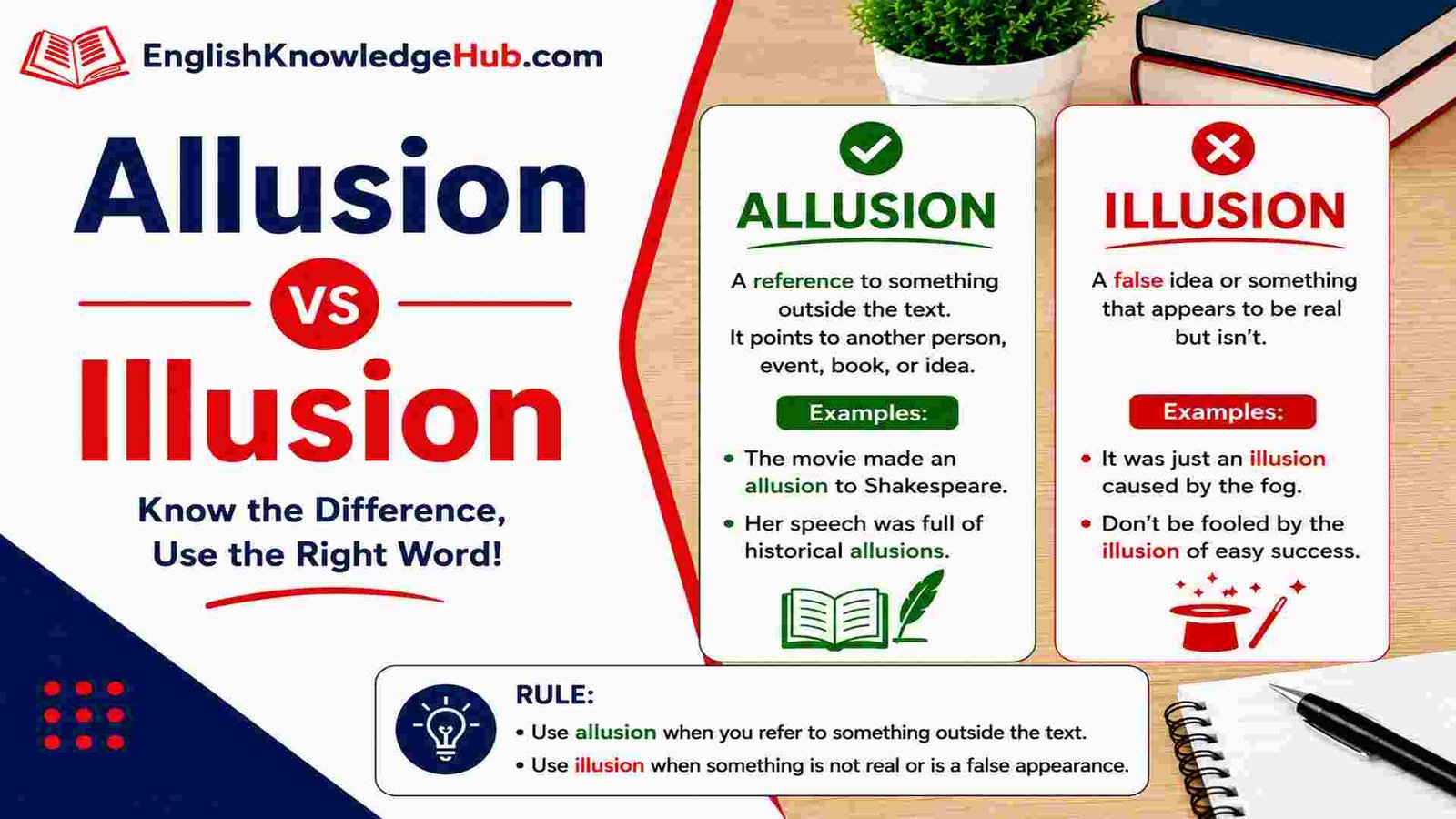
Allusion and illusion are different nouns. An allusion is an indirect reference to a person, place, event, story, work, or idea. An illusion is something that seems real or true but is actually misleading, false, or unreal. If a writer hints at another work, that is an allusion. If your eyes or mind are deceived, that is an illusion.
In this article, you’ll learn how Allusion vs Illusion differ in meaning, pronunciation, sentence patterns, literature, everyday use, and related words such as allude, imply, delusion, and hallucination. Merriam-Webster explains that an allusion is an indirect reference, while an illusion is something false or unreal that appears true or real.
The Fastest Way to Separate the Two Words
Think of allusion as a reference and illusion as a false appearance.
“The novel contains an allusion to Greek mythology” means the writer indirectly refers to Greek mythology. “The mirror creates an illusion of a larger room” means the mirror makes the room appear different from reality.
The words sound similar, which is why spelling alone is not a reliable guide. Meaning is the better test.
What an Allusion Actually Does
An allusion points toward something without explaining it fully. Writers often use allusions because they expect readers to recognize the reference and bring their own background knowledge into the sentence.
A poem might allude to a famous myth without naming the whole story. A speech might make an allusion to a historic event. A joke can allude to a movie scene that the audience already knows.
The reference does not have to be literary. You can make an allusion to a song, a celebrity, a political event, a family story, or another conversation.
Allusion vs Direct Reference
The word allusionRomeo and Juliet because it relies on the reader recognizing the association.
That does not mean every allusion must be mysterious. Some are obvious. The key point is that the writer refers to something rather than fully explaining it.
What an Illusion Means
An illusion is a misleading appearance, impression, or belief. Something looks, sounds, feels, or seems one way but is actually another.
Optical illusions are the easiest example. Two lines may look different in length even when they are equal. A stage magician can create the illusion that an object disappears. A large mirror can give the illusion of extra space.
The word also works figuratively. “He had the illusion that success would come without effort” means he held a false idea about reality.
Illusion, Delusion, and Hallucination Are Not the Same
These words overlap, but careful writers separate them.
An illusion usually involves a misleading perception or appearance. A delusion is a false belief held despite evidence to the contrary, and the term also has specific clinical uses. A hallucination is a sensory experience that occurs without an external stimulus and also has medical meaning.
In everyday writing, do not casually use clinical terms as exact synonyms for illusion. If you simply mean something looked different from reality, illusion is often the right word.
Allude, Allusion, and Illusion
The verb connected to allusion is allude: “The speaker alluded to the earlier controversy.” You normally allude to something.
There is a rare verb illude, but most learners will almost never need it. In ordinary English, we talk about creating an illusion, giving the illusion, or being under an illusion.
This is useful because some learners try to build a verb from illusion in places where a different phrase is more natural.
Allusion vs Implication
An allusion is a type of reference. An implication is an idea suggested without being stated directly. They can overlap, but they are not the same.
If a writer calls a difficult journey “an odyssey,” that may be an allusion to Homer. If a manager says, “We may need to rethink staffing,” the implication might be that jobs could change, even if no literary or cultural reference is involved.
If indirect meaning is the part you want to understand better, our Imply vs Infer guide explains the difference between what a speaker suggests and what a listener concludes.
Pronunciation
Allusion and illusion are pronounced very similarly in most accents. The first vowel is usually the main audible difference, and in fast speech even that can be subtle.
Because pronunciation may not save you, use the memory connection: allusion → allude → indirect reference. Illusion → unreal appearance.
How the Words Work in Literature and Academic Writing
In literary analysis, allusion is common because writers constantly refer to earlier texts, myths, history, religion, and popular culture. A strong analysis should explain what the allusion adds rather than merely point out that it exists.
For example: “The storm imagery contains an allusion to the biblical flood, reinforcing the theme of destruction and renewal.” That sentence does more than identify a reference. It explains its effect.
Illusion appears in literature too, but usually for themes of perception, deception, fantasy, or appearance versus reality: “The character maintains an illusion of control even as the situation collapses.”
Everyday and Workplace Examples
In everyday conversation: “His joke was an allusion to that old TV show.” “The lighting creates the illusion that the ceiling is higher.”
At work: “The presentation included an allusion to the company’s early advertising campaign.” “The temporary increase gave the illusion of long-term growth.”
The words can appear in the same paragraph without overlapping in meaning.
Common Mistakes and Why They Happen
Incorrect: The poem contains an illusion to Greek mythology.
Correct: The poem contains an allusion to Greek mythology.
The poem is making an indirect reference, not creating a false sensory impression.
Incorrect: The mirrors create an allusion of extra space.
Correct: The mirrors create an illusion of extra space.
The mirrors make the room appear larger than it is.
Awkward: She alluded that the deadline might change.
Better: She alluded to the possibility that the deadline might change.
Allude normally takes to.
Useful Sentence Patterns
| Pattern | Example |
|---|---|
| an allusion to + noun | The title contains an allusion to a famous myth. |
| allude to + noun/idea | She alluded to an earlier disagreement. |
| an illusion of + noun | The design creates an illusion of depth. |
| under the illusion that + clause | He was under the illusion that the task would be easy. |
| give/create the illusion that + clause | The edit gives the illusion that both scenes happened together. |
A Memory Trick That Connects Meaning and Spelling
Allusion begins like allude. Both involve a reference. Illusion begins with ill-, and you can imagine an illusion making your perception “ill” or unreliable. The second trick is only a memory device, but it helps many learners.
Frequently Asked Questions
What is the difference between allusion and illusion?
An allusion is an indirect reference. An illusion is a false or misleading appearance, impression, or belief.
Is a literary reference an allusion?
It can be, especially when the reference is indirect and assumes the reader will recognize it.
Is an optical trick an allusion or illusion?
An illusion.
What verb comes from allusion?
Allude, usually followed by to.
Can illusion mean a false belief?
Yes. It can describe a mistaken idea or impression as well as a misleading visual or sensory appearance.
Are allusion and illusion pronounced the same?
They are very similar in many accents, which is one reason they are easy to confuse.
Final Takeaway
For Allusion vs Illusion, remember allusion = indirect reference and illusion = misleading or unreal appearance. If a writer points toward another work or idea, choose allusion. If something seems real but is not, choose illusion. Connecting allusion with the verb allude makes the distinction much easier to remember.
For more clear explanations of commonly confused English words, explore EnglishKnowledgeHub.com.
