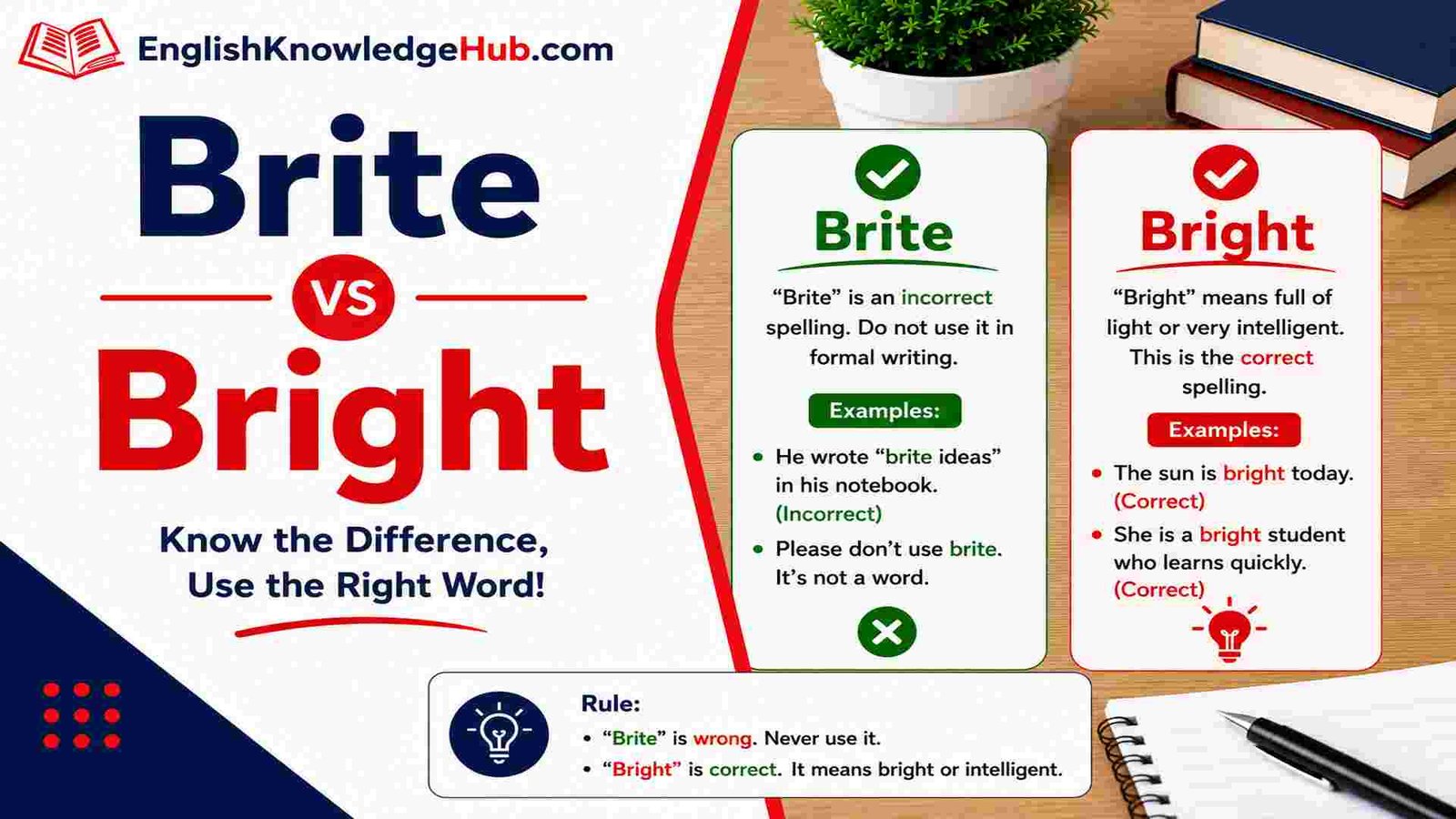
Bright is the standard spelling in modern English. Use bright for light, vivid color, intelligence, cheerfulness, or a promising future. Brite appears mainly as a stylized spelling in brand names, product names, advertising, and a few specialized terms, so it should not replace bright in ordinary school, business, or formal writing.
In this article, you’ll learn how Brite vs Bright differs in standard spelling, branding, meaning, pronunciation, word forms, and real-world exceptions. Merriam-Webster lists bright as the standard adjective for shining, vivid, intelligent, cheerful, and promising, while Etymonline records brite as a spelling variant associated with phonetic spelling reform and advertising.
Why “Bright” Is the Form You Should Normally Write
In standard English, the spelling is bright, even though the letters gh are not pronounced in modern speech.
“The room is bright.” “She is a bright student.” “They chose a bright red sign.” “The company has a bright future.”
In each sentence, bright is the normal dictionary form. Writing brite in an essay, email, report, application, or ordinary article would usually look like a spelling error unless you were deliberately reproducing a name or specialized term.
Why Does Bright Have a Silent “gh”?
The spelling reflects the history of English. The gh once represented a sound that later disappeared from standard pronunciation, while the letters remained in writing.
The same historical pattern appears in words such as light, night, right, sight, and flight. Modern spelling is not always a perfect map of modern sound.
That is why spelling the word exactly as it sounds, brite, feels logical even though it is not the usual standard form.
What “Brite” Is Used For
Brite is common in creative commercial spelling. Businesses and products sometimes drop silent letters to create a shorter or more memorable name.
A well-known example is Lite-Brite, where both words use stylized spellings. You may also see Brite in names of cleaning products, dental businesses, lighting brands, software, or other commercial labels.
When a company or product officially uses Brite, keep that spelling. Proper names are not corrected to match ordinary dictionary spelling.
Is “Brite” Completely Invented?
It is more accurate to say that brite is nonstandard for ordinary modern writing than to claim it has never existed as a spelling.
Etymonline records brite in phonetic spelling-reform efforts from the late nineteenth century and in advertising from the early twentieth century. That history helps explain why the form feels familiar even though bright remains the standard general-English spelling.
This distinction matters because trustworthy spelling advice should separate nonstandard from nonexistent.
The Main Meanings of “Bright”
Bright first relates to light: “The sun is bright,” “a bright lamp,” “bright eyes.”
It also describes vivid colors: “a bright yellow jacket.” When used for intelligence, it means clever or quick to learn: “He is a bright child.”
The word can describe mood or expression: “She gave us a bright smile.” It can also mean promising: “The team’s future looks bright.”
The meanings differ, but the spelling stays the same.
Bright as an Adverb and Noun
Merriam-Webster also records bright as an adverb in some uses and as a noun, especially in plural forms such as brights for vivid colors, brightly colored clothes, or a vehicle’s high beams.
“Turn off your brights” refers to high-beam headlights. “The collection mixes neutrals with brights” refers to vivid colors.
These less common grammar roles do not change the standard spelling.
Bright, Brighter, Brightest
The normal comparative and superlative forms are brighter and brightest.
“This screen is brighter than the old one.” “Venus is one of the brightest objects in the night sky.” “She had the brightest idea of the group.”
Do not build these forms from the stylized brite in ordinary English. Briter and britest are not the standard forms.
Brightly and Brightness
The related adverb is brightly: “The lights shone brightly.” The noun is brightness: “Lower the screen brightness.”
These word-family forms are useful spelling anchors. If you remember brightness and brightly, keeping the gh in bright becomes easier.
“Brite” in Specialized Industry Language
You may encounter brite tank or bright beer tank in brewing. Industry terminology can vary by company and region, and brite is established in some commercial brewing contexts.
This does not make brite a general replacement for the adjective bright. Specialized vocabulary often develops its own spelling conventions.
If you are writing inside a specific industry, follow that industry’s accepted terminology. If you are simply writing “a bright light” or “a bright student,” use bright.
Brand Names Are Not Grammar Examples
Seeing a form on packaging does not automatically make it standard spelling. Brands deliberately use altered forms such as lite, kwik, xpress, or brite to stand out.
That creative freedom is useful in marketing, but it should not be transferred automatically into essays or professional writing.
The same principle applies to other believable-looking misspellings. Our Tweek vs Tweak guide explains another case where a familiar sound can tempt writers toward the wrong standard form.
Common Mistakes
Incorrect in standard writing: The sun was brite this morning.
Correct: The sun was bright this morning.
Incorrect in an essay: She is a brite student.
Correct: She is a bright student.
Correct proper name: The child played with a Lite-Brite.
Here the stylized spelling belongs to the product name, so changing it would be wrong.
Pronunciation
Bright is pronounced like right with a b sound at the beginning. The gh is silent in modern standard pronunciation.
Brite in a brand or stylized spelling is normally pronounced the same way, which explains why people sometimes assume the spellings are interchangeable.
A Quick Context Test
| Context | Use | Example |
|---|---|---|
| ordinary adjective | bright | a bright room |
| intelligent | bright | a bright student |
| vivid color | bright | bright green |
| promising future | bright | a bright future |
| official brand/product name | keep official spelling | Lite-Brite |
| specialized industry term | follow industry usage | brite tank |
Frequently Asked Questions
Which is correct, brite or bright?
Bright is the standard spelling in ordinary English.
Is brite a real word?
It has historical and stylized uses, especially in advertising and names, but it is not the normal standard spelling of bright.
Why is “gh” silent in bright?
The spelling preserves an older stage of English in which those letters represented a sound that later disappeared.
Can I use brite in a business name?
Yes. Creative brand spellings do not have to follow ordinary dictionary spelling.
Is it brighter or briter?
Brighter is correct.
What is the noun form of bright?
Brightness is the main abstract noun. Brights can also be a noun in specific contexts such as colors or high-beam headlights.
Final Takeaway
For Brite vs Bright, write bright in normal English. Brite is mainly a historical phonetic variant, stylized commercial spelling, proper-name element, or occasional specialized industry form. If you are describing light, color, intelligence, cheerfulness, or a promising future, the standard spelling is always bright.
For more practical spelling guides that separate real exceptions from ordinary mistakes, explore EnglishKnowledgeHub.com.
