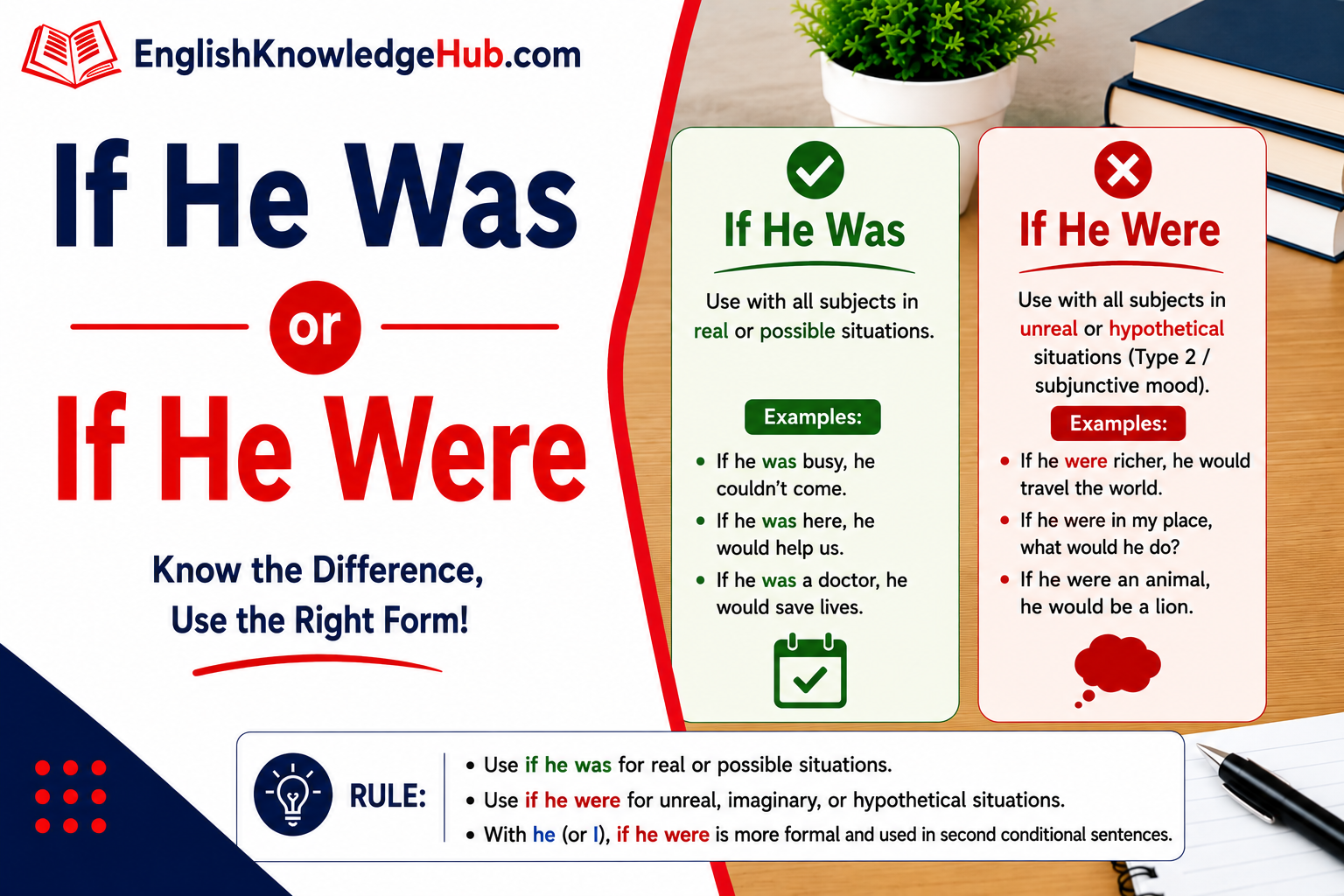
“If he was” and “if he were” can both be correct, but they usually signal different meanings. Use if he was when you are talking about a real or possible past situation whose truth is uncertain. Use if he were for an unreal, imagined, or contrary-to-fact situation, especially in careful formal English: “If he were here, he would know what to do.”
In this article, you’ll learn how If He Was or If He Were works in factual past questions, hypothetical conditions, wishes, as if/as though clauses, and everyday speech. Merriam-Webster’s subjunctive guide explains that were is the traditional past subjunctive form, while was has also been used for centuries in hypothetical and wish constructions.
The Meaning Matters More Than the Word “If”
A common mistake is to think every sentence beginning with if he must use were. That is not true. The word if can introduce a real uncertainty as well as an unreal condition.
“If he was at the office yesterday, he may have seen the package.” The speaker does not know whether he was there. His presence is a real past possibility, so was is natural.
“If he were at the office now, he would answer the phone.” The sentence imagines a situation that is not true or is presented as contrary to reality, so traditional formal grammar prefers were.
Use “If He Was” for a Real Past Possibility
When you are trying to discover what actually happened in the past, use the normal indicative form was.
“If he was sick yesterday, that explains his absence.” “If he was driving at 8 p.m., he could not have answered the call.” “If he was the person you saw, we should contact him.”
These sentences do not claim the condition is imaginary. The speaker is uncertain about a fact and considers what follows if that fact turns out to be true.
Use “If He Were” for Unreal or Hypothetical Situations
Were is the traditional subjunctive form for situations imagined as unreal, contrary to fact, or highly hypothetical.
“If he were taller, he could reach the shelf.” “If he were the manager, he would change the policy.” “If he were here now, we could ask him.”
These are not ordinary past-time statements. The form were helps mark distance from reality.
Why “Were” Appears With He, She, I, and It
Normally we say I was, he was, she was, it was. The subjunctive is unusual because were can appear with all those subjects in an unreal construction.
“If I were you…” “If she were available…” “If it were easy…” “If he were ready…”
This is why were can look “wrong” to learners who know basic past-tense agreement. It is not ordinary past indicative grammar; it is a special mood form.
Is “If He Was” Wrong in a Hypothetical Sentence?
No, not universally. Modern English frequently uses was in hypothetical clauses, especially in conversation and informal writing.
Merriam-Webster notes that both “If I were…” and “If I was…” have long histories, even in accomplished literary writing.
For careful formal writing, were remains the safest choice for clearly contrary-to-fact situations. In everyday speech, was may sound completely natural to many speakers.
“If He Was” Can Be More Precise Than “If He Were”
Sometimes changing was to were changes the meaning.
“If he was rude at dinner, you should tell him” means the speaker does not know whether the rude behavior actually happened.
“If he were rude, I would not invite him” describes an imagined character trait or hypothetical situation.
The first is about uncertain fact. The second is about an unreal or conditional idea.
Wishes: “I Wish He Were” vs “I Wish He Was”
Traditional formal English prefers were after wish when the wish is contrary to reality: “I wish he were here.” The meaning is that he is not here.
However, “I wish he was here” is also very common in everyday English. Merriam-Webster documents this competition between indicative was and subjunctive were.
If you are writing an exam, formal essay, or polished professional document, I wish he were is the conservative choice.
As If and As Though
The same difference can appear after as if and as though.
“He acts as if he were the owner” presents the ownership as unreal or doubtful. “He looked as if he was tired” can describe an appearance that may actually have been true.
In real usage, was and were also overlap here, so context and formality matter.
Second Conditional Sentences
Hypothetical present or future conditions often use the second conditional pattern: if + past form, would + base verb.
“If he were more patient, he would enjoy the job.” “If he were available tomorrow, we would invite him.”
Even though the verb form looks past, the sentence can refer to the present or future. The past form helps create hypothetical distance rather than simple past time.
This is also why modal choices such as would, could, and might often appear in the result clause. Our May or Might guide explains how might behaves in tentative and hypothetical situations.
Common Mistakes and Better Choices
Overcorrection: If he were at work yesterday, he may have received the parcel.
Better if his presence is a real unknown fact: If he was at work yesterday, he may have received the parcel.
Formal hypothetical: If he were the director, he would approve the change.
Everyday variant: If he was the director, he would approve the change.
The second is common in speech, but were more clearly marks the hypothetical meaning.
Incorrect agreement in an ordinary past statement: He were at the office yesterday.
Correct: He was at the office yesterday.
The special were form does not replace was in ordinary factual past statements.
Questions That Help You Choose
Ask first: Could this condition have been a real fact? If you are uncertain about what actually happened, was is often right.
Then ask: Am I imagining something contrary to reality? If yes, were is the traditional and safest formal choice.
| Situation | Preferred form | Example |
|---|---|---|
| uncertain real past | was | If he was there, he saw it. |
| unreal present hypothetical | were | If he were here, he would help. |
| formal contrary-to-fact wish | were | I wish he were here. |
| informal hypothetical | was often heard | If he was here, he’d help. |
| ordinary factual past | was | He was here yesterday. |
Frequently Asked Questions
Which is correct, if he was or if he were?
Both can be correct. Use was for uncertain real past facts and were for clearly unreal or hypothetical conditions, especially in formal writing.
Is “if he was” grammatically wrong?
No. It is fully standard when the sentence concerns a real past possibility, and it is also common in informal hypothetical usage.
Why do we say “If I were you”?
Because were is the traditional subjunctive form for a hypothetical situation contrary to fact.
Can I say “I wish he was here”?
Yes, especially in informal English. I wish he were here is the traditional formal form.
Does “were” always mean past tense?
No. In subjunctive clauses, were can describe unreal present or future situations.
Which form should I use in an exam?
For clearly contrary-to-fact hypotheticals, were is the safest formal choice.
Final Takeaway
For If He Was or If He Were, do not choose based on the word if alone. Use was when you are uncertain about a real past fact. Use were to clearly mark an unreal or hypothetical situation, particularly in formal writing. Modern English also uses was in many hypothetical sentences, so the most accurate rule is about meaning and style, not a blanket ban.
For more practical explanations of real English grammar, explore EnglishKnowledgeHub.com.
