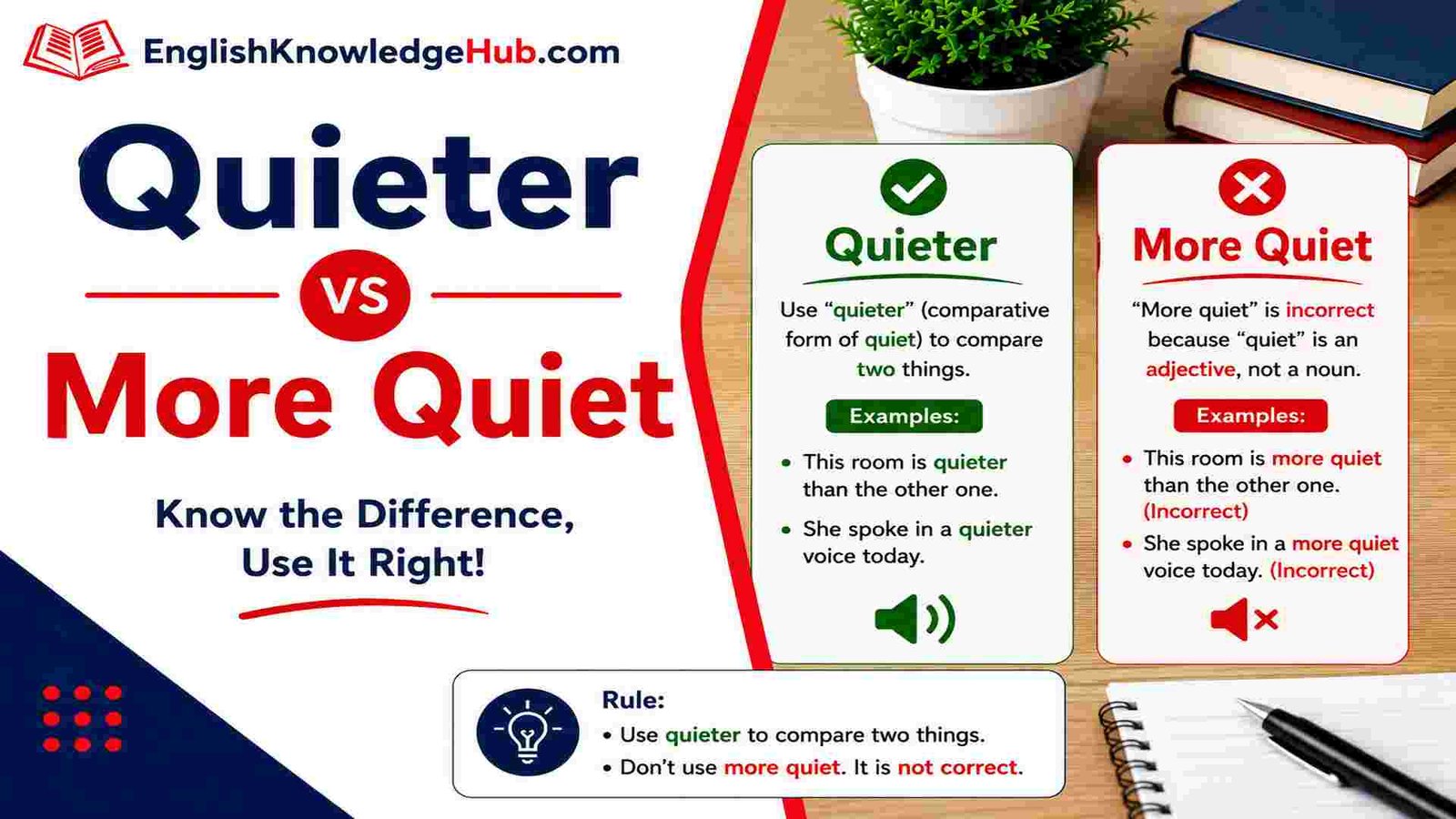
Quieter is the normal comparative form of quiet in most everyday English, while more quiet is also possible in some contexts. Use quieter when you simply compare two people, places, sounds, or situations. Use more quiet when you want to give special emphasis to the quality of quietness or when the phrase fits the rhythm of the sentence better.
In this article, you’ll learn how Quieter vs More Quiet works in real sentences, why both forms can appear, which one sounds most natural in everyday English, and how to avoid awkward comparisons. Merriam-Webster lists quieter as the regular comparative form of quiet.
Why Quieter Is Usually the Better Choice
English often forms the comparative of short adjectives by adding -er. That is why we naturally say smaller, faster, softer, and quieter. In a normal comparison, quieter sounds direct and effortless.
For example, “This room is quieter than the hallway” simply compares noise levels. “My new keyboard is quieter than the old one” does the same. Nothing extra needs to be added because the standard comparative already carries the meaning.
When More Quiet Can Sound Natural
More quiet is not automatically wrong. Speakers sometimes use it when they want to focus on the idea of quietness itself, especially in a contrast such as “more quiet than calm” or in a sentence where the rhythm makes more quiet feel smoother.
Imagine someone describing two cafés. “The café near the park is quieter” sounds like a straightforward comparison. “I wanted somewhere more quiet and private” puts extra attention on the qualities the speaker wanted. In that kind of sentence, more quiet can feel natural.
The practical rule is simple: choose quieter by default. Use more quiet only when it genuinely sounds better for the emphasis or structure you need.
Quieter in Everyday Conversation
You will hear quieter much more often in ordinary speech. A parent may say, “Can you be a little quieter?” A student may say, “The library is quieter after lunch.” At work, someone may ask for “a quieter place to take the call.”
These sentences all follow the same pattern: one level of quiet is being compared with another.
Quieter Than or More Quiet Than?
Both forms can be followed by than, but quieter than is normally the more idiomatic choice.
Natural: The side street is quieter than the main road.
Possible but less usual: The side street is more quiet than the main road.
The second sentence is understandable, but most speakers would choose the first unless they had a reason to emphasize quiet.
Quiet, Quieter, Quietest
The normal comparison pattern is quiet, quieter, quietest. For example, “This office is quiet,” “The meeting room is quieter,” and “The archive room is the quietest place in the building.”
This pattern is useful because learners sometimes try to build all comparisons with more and most. English does not work that way for every adjective. With quiet, the -er and -est forms are well established.
What About More Quietly?
Do not confuse more quiet with more quietly. Quiet is an adjective, while quietly is an adverb.
Compare: “The room became quieter” describes the room. “She spoke more quietly” describes how she spoke. If you are describing a noun or a state, quieter is often what you need. If you are describing an action, more quietly may be correct.
Common Mistakes
Less natural: This fan is more quieter than mine.
Correct: This fan is quieter than mine.
Do not use more together with an -er comparative. The comparative meaning is already built into quieter.
Incorrect: Please speak quieterly.
Correct: Please speak more quietly.
Here, the sentence describes the verb speak, so the adverb quietly is needed.
Which Form Should You Use in Formal Writing?
In formal writing, quieter is normally the safest and most concise choice. Use more quiet only when the context makes the emphasis useful. Good writing is not about forcing one form everywhere. It is about choosing the form that sounds natural and communicates the comparison clearly.
Frequently Asked Questions
Is more quiet grammatically correct?
Yes. It can be correct, but quieter is the usual comparative in most contexts.
Is quieter a real word?
Yes. Quieter is the standard comparative form of quiet.
Can I say more quieter?
No. Use either quieter or, in a suitable context, more quiet. Do not combine both comparative markers.
What is the superlative of quiet?
The usual form is quietest.
Is quieter than correct?
Yes. “Quieter than” is the normal structure for comparing two levels of quietness.
Final Thoughts
For most Quieter vs More Quiet questions, choose quieter. It is the standard and most natural comparative of quiet. Keep more quiet for the smaller number of sentences where emphasis or rhythm makes it a better fit.
For more practical English comparisons explained in simple language, visit EnglishKnowledgeHub.com.
