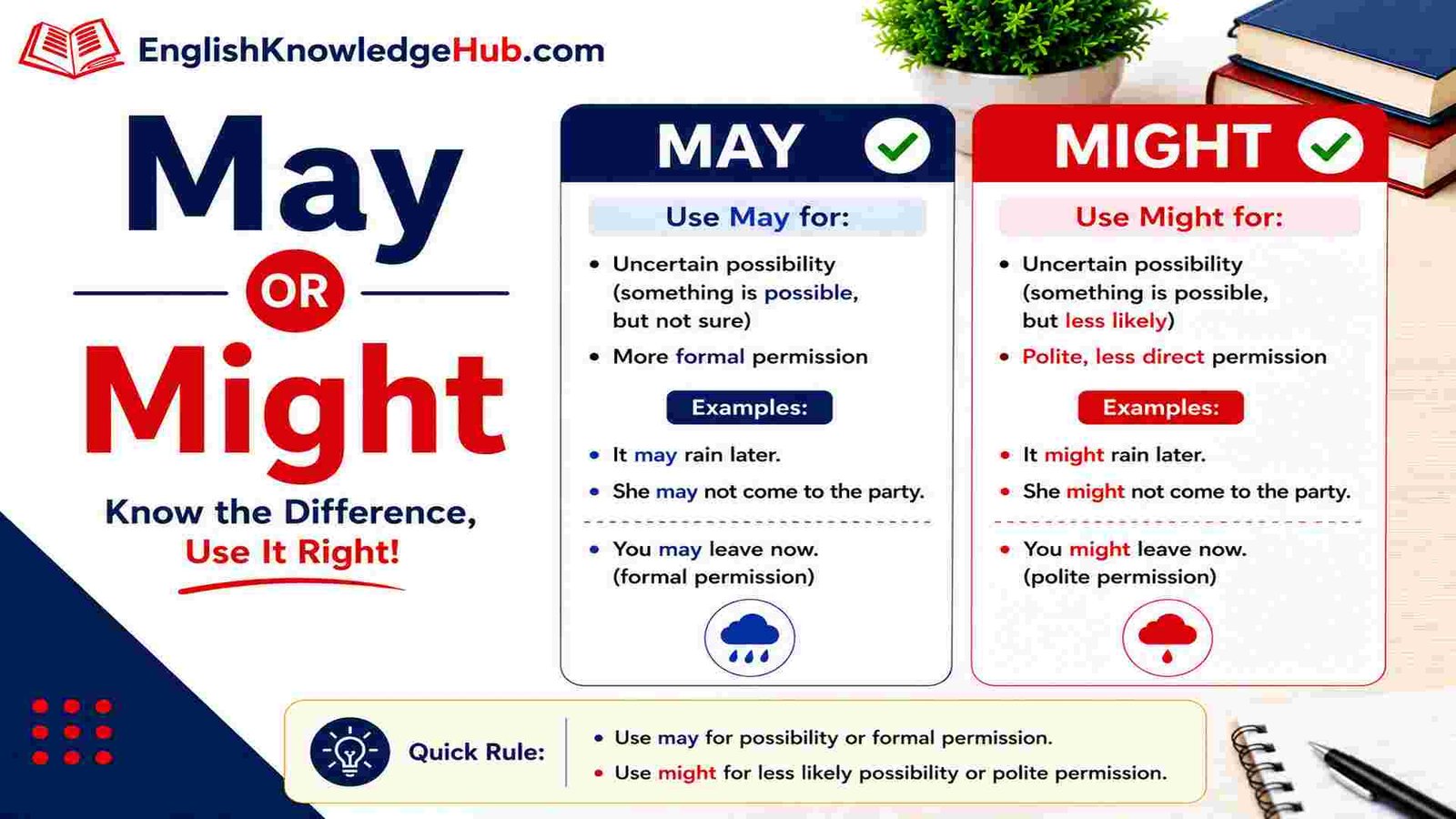
May and might both express possibility, and in many modern sentences either one can be correct. May can also ask for or give permission and often sounds formal. Might can make a possibility, suggestion, or request sound more tentative. Do not rely on fixed percentages such as “may means 50% and might means 30%”; real usage is more flexible.
In this article, you’ll learn how May or Might work for possibility, permission, reported speech, suggestions, past possibilities, criticism, and hypothetical situations. Cambridge Grammar notes that may and might both express degrees of possibility and that native speakers do not always agree on a strict certainty ranking between the modal verbs.
For Present and Future Possibility, They Often Overlap
“It may rain later” and “It might rain later” both say rain is possible. In many ordinary conversations, the difference is small enough that either sentence works.
Some speakers use might when they want to sound more uncertain or tentative. “I might come to the party” can feel less committed than “I may come to the party.” But this is a tendency, not a mathematical rule.
Tone, context, stress, and the speaker’s own habits all affect how certain the sentence sounds. That is why assigning exact probability percentages to may and might is misleading.
When “May” Is Especially Natural
May is common for present or future possibility: “The train may be late.” “We may need more information.” It also appears frequently in formal and academic writing because it can soften a claim: “This result may indicate a change in behavior.”
That academic use is important. Writers use may to avoid presenting a possible interpretation as a proven fact.
May also has a separate permission meaning: “May I come in?” “You may leave when you finish.” In this role, may sounds more formal than everyday can.
When “Might” Is Especially Natural
Might often sounds more tentative, distant, or cautious. “I might take Friday off” presents the plan as undecided. “That might be the answer” offers a possibility without much commitment.
It is also useful for polite suggestions: “You might want to save a copy first.” This does not simply describe possibility. It gently recommends an action.
Another formal use is permission: “Might I ask a question?” Cambridge describes this as very formal and not especially common in everyday speech.
May for Permission, Might for Very Formal Requests
When asking permission, “May I…?” is standard and polite: “May I use this chair?” “May we leave early?”
“Might I…?” can also ask permission, but it is more formal and can sound old-fashioned or deliberately polite in everyday American English. “Might I add one point?” is more likely in a formal discussion than in a casual conversation.
For ordinary permission, can is also established English, not a grammar mistake. If that distinction is what you are trying to learn, our May or Can guide explains ability, permission, and possibility in more detail.
Why “Might” Is Called the Past Form of “May”
Traditional grammar describes might as the past form of may, and that relationship still appears clearly in reported speech.
Direct speech: “She may be late.”
Reported speech: “He said she might be late.”
Cambridge notes that may expressing possibility often becomes might when speech is reported in the past.
But might is not limited to past time. “It might rain tomorrow” is about the future. Modal verbs express attitude and possibility as well as time, so a simple “may = present, might = past” rule is not enough.
May Have vs Might Have
Both may have + past participle and might have + past participle can describe uncertainty about a past event.
“She may have missed the bus.” “She might have missed the bus.” Both mean the speaker is not sure what happened.
Again, might have can sound slightly more tentative in some contexts, but the difference is not fixed.
“Might Have” Can Also Describe an Unrealized Possibility
Might have has another important use: something was possible but did not happen, or the speaker imagines what could have happened.
“If we had left earlier, we might have caught the train.” The actual result is that we did not catch it.
Context matters because “He might have left already” can simply mean “Perhaps he has left,” while “He might have won if he had trained harder” describes an unreal past possibility.
“You Might Have…” Can Express Criticism
One meaning many beginner guides miss is polite or irritated criticism.
“You might have told me the meeting was canceled.” The speaker is not wondering whether the other person possibly told them. The sentence means the person should have told them and did not.
Cambridge specifically notes this use of might have + past participle for disapproval or criticism.
May Not vs Might Not
Both can express negative possibility.
“The package may not arrive today.” “The package might not arrive today.” In both cases, non-arrival is possible.
Be careful with context because may not can also mean lack of permission: “Visitors may not enter this area.” That sentence can mean visitors are not allowed to enter, not merely that perhaps they will not enter.
If ambiguity matters, rewrite the sentence: “Visitors are not permitted to enter this area” is unmistakable.
Hypothetical Situations Often Favor “Might”
Might is very natural in unreal or imagined situations.
“If I had more free time, I might learn Italian.” “If she lived closer, we might see her more often.” These sentences describe possibilities inside hypothetical conditions.
May is less natural in many strongly counterfactual structures, especially when the condition itself is unreal.
May Well and Might Well
The adverb well can strengthen either modal: “She may well be right.” “He might well decide to stay.”
These phrases often mean that the possibility is quite reasonable or unsurprising. They do not follow a simple scale where might must always be weaker than may.
Common Mistakes
Over-simple rule: May always means a higher probability than might.
Better: Both express possibility. Might often sounds more tentative, but context matters and there is no universal percentage difference.
Incorrect: He may can come tomorrow.
Correct: He may come tomorrow. / He can come tomorrow.
Standard English does not normally stack two central modal verbs together.
Incorrect: She might to call later.
Correct: She might call later.
Modal verbs take the base verb without to.
Incorrect for ability: I might swim when I was five.
Better: I could swim when I was five.
For past ability, could is the normal modal.
How They Work in Real Writing
Everyday: “I may go out later” or “I might go out later.” Both express an undecided possibility.
Workplace: “We may need to revise the schedule.” This sounds appropriately cautious without being vague.
Academic: “The findings may reflect differences in sample size.” Here may acts as a hedge and avoids claiming more certainty than the evidence supports.
Polite suggestion: “You might want to confirm the address before leaving.”
A Better Decision Guide Than Probability Percentages
| Meaning | Natural choice | Example |
|---|---|---|
| present/future possibility | may or might | It may/might rain. |
| formal permission | may | May I come in? |
| very formal permission | might | Might I ask a question? |
| tentative suggestion | might | You might want to check again. |
| reported past form of may | might | She said she might come. |
| unreal past possibility | might have | We might have won if… |
| criticism about past action | might have | You might have warned me. |
Frequently Asked Questions
Which is more certain, may or might?
Might often sounds more tentative, but there is no reliable fixed percentage. Context and speaker choice matter.
Can may and might be used interchangeably?
Often for present or future possibility, yes. They are not interchangeable in every permission, reporting, or hypothetical structure.
Is might only the past tense of may?
No. It functions as a past form in reported speech, but it also expresses present and future possibilities and hypothetical ideas.
What is the difference between may have and might have?
Both can express uncertainty about a past event. Might have also commonly describes unrealized possibilities and criticism.
Can might ask permission?
Yes, but it is very formal: “Might I ask a question?”
Is “may not” always about possibility?
No. It can also deny permission, as in “You may not enter.”
Final Takeaway
For May or Might, do not memorize fake certainty percentages. Both modals can express possibility, and their meanings overlap heavily. Use may naturally for possibility and formal permission; use might when a possibility or suggestion is more tentative, in many hypothetical structures, in reported speech, and in special patterns such as might have. Context is a better guide than a rigid scale.
For more practical modal-verb explanations, explore EnglishKnowledgeHub.com.
